Punjab · Mixed-Gender Folk Dance
Jindua Dance of Punjab
Jindua Dance is a mixed-gender folk dance from Punjab, performed to folk songs about love, longing and the happiness of being together. Where Bhangra and Giddha are danced by men and women separately, Jindua puts a male and female performer — or a mixed group — at the centre, and lets the song carry as much of the performance as the footwork.
This guide explains what Jindua is, what is genuinely documented about it, what remains uncertain, and how to enquire about Jindua dance performers for an event.
- Region
- Punjab, in India and Pakistan
- Format
- Mixed-gender — a couple or a mixed group
- Theme
- Love, longing and togetherness
- Carried by
- Sung folk songs, with dance steps added to them
- Seen today at
- Cultural festivals, college and school programmes, stage competitions, celebration evenings
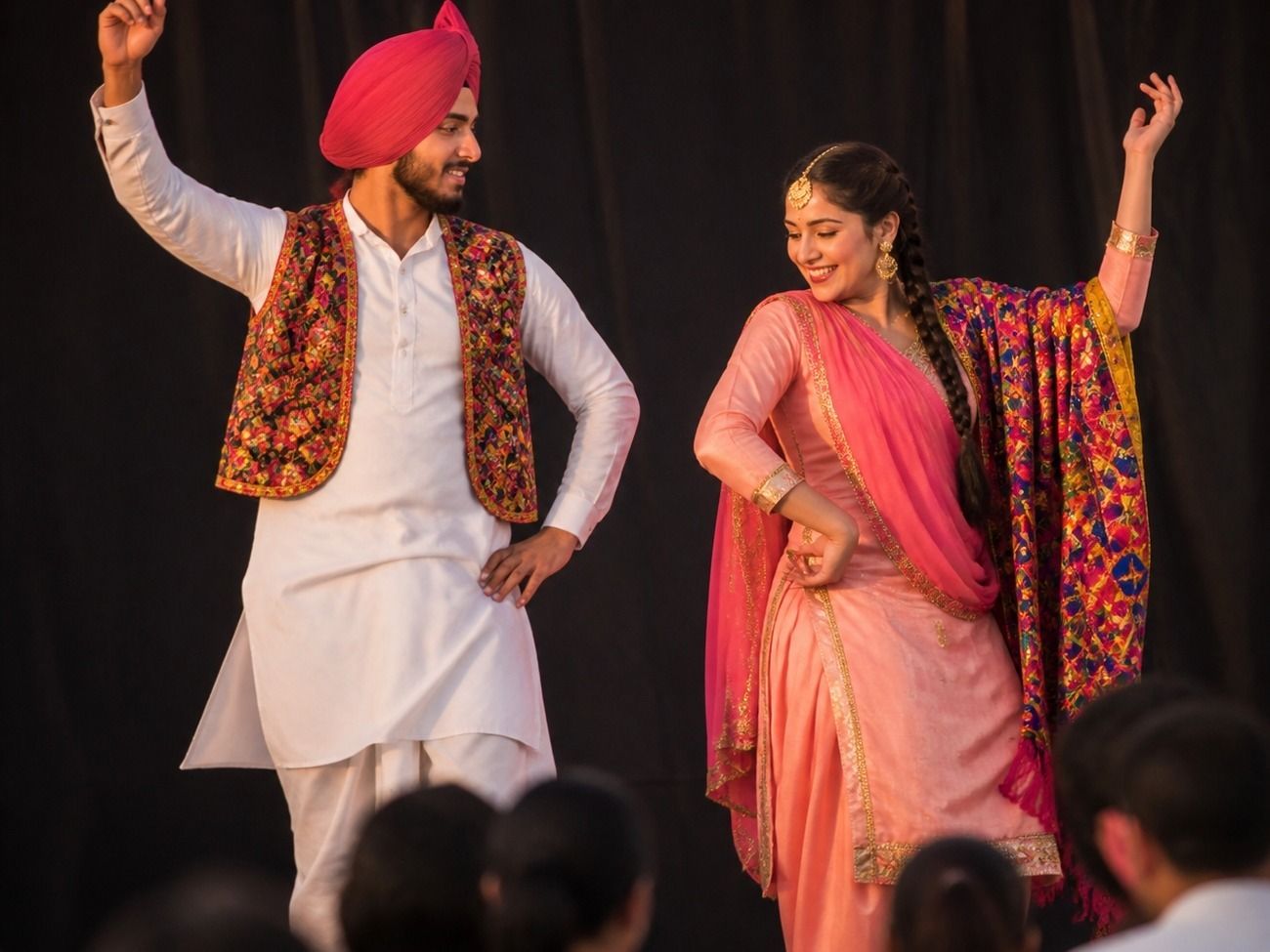
A note on imagery: this page deliberately does not use a photograph of Bhangra, Giddha or generic Punjabi stick dancing and label it as Jindua. Where an authentic image was not available, an illustration is used instead.
What Is Jindua Dance?
Jindua is a folk dance of Punjab in which a male and a female performer — or a small mixed group — dance to a folk song about love. It is described in Indian folk-dance references as a dance that grew out of couples singing love songs, and that later acquired specific dance steps. In practice, that means the song comes first and the movement is built around it.
That song-led quality is what makes Jindua feel different from the Punjabi dances most people know. Bhangra is a group dance driven by the dhol, with shoulders rolling and footwork speeding up as the rhythm climbs. Giddha is performed by women in a circle, with clapping and boliyan. Jindua sits somewhere else again: it is quieter, more lyrical, and it is built on the exchange between two people rather than on the energy of a large group.
What makes Jindua distinctive
- It is mixed-gender. This is the single most consistent point across the sources that describe it — a male and female pair, or a mixed set, rather than a men-only or women-only formation.
- The song carries the story. Jindua songs deal with love, longing and the joy of being together, and the dance follows the emotional shape of the lyric.
- Expression over acrobatics. The interest lies in gesture, eye contact and partner interaction rather than in high jumps or fast spins.
- It lives on stage and in community programmes. Documented performances take place at cultural festivals, folk-dance competitions and college or school programmes, where it is usually presented as a set item.
How this page treats uncertain information
Jindua is a real and performed Punjabi folk dance, but it is far less documented in print and online than Bhangra, Giddha, Luddi or Sammi. Rather than padding the page with invented origin stories, this guide separates three things clearly:
- Documented: the mixed-gender format and the love-and-longing theme, which recur across independent descriptions.
- Uncertain: origin dates, a founding region, and any named historical figure — none of these could be verified.
- Not supported: the idea that Jindua is a stick dance, or that it has one fixed costume and instrument set. See the stick-dance section below.
No external reference links are included on this page by design; the research behind it is summarised here in plain language.
If you want to see how Jindua fits into the wider picture, the Punjab dance collection on BookMyDance lists the folk forms of the region, from the well-known to the rarely staged.
Jindua Dance History and Cultural Background
The account that recurs most often is simple: Jindua began with couples singing love songs, and the dance steps were added to those songs over time. Some references describe it as a male and female pair dance built around a love theme; others group it with Punjab's collective, mixed-gender traditions, alongside forms such as Karthi. Both descriptions agree on the essentials — two people, one song, and a love story at the centre.
What is reasonably documented
- Jindua is a Punjabi folk dance in which the song and the dance are closely tied together.
- The theme is love and emotional exchange, sung rather than narrated.
- The format is mixed-gender, which separates it from the gender-segregated Punjabi forms.
- It is performed today as a staged folk item at festivals, competitions and cultural programmes.
What is not firmly established
Please treat these as open questions
- Origin date: no reliable source gives one. Any specific century quoted for Jindua should be treated as unsupported unless it cites a documented source.
- Founding region: references describe Jindua as a Punjabi dance without agreeing on a single district or belt, unlike Jhumar (Sandalbar) or Malwai Giddha (Malwa), which are tied to named areas.
- Continuity of format: whether Jindua has always been mixed-gender, or moved that way over time, is not clear from available sources.
- Published documentation: mainstream encyclopedic overviews of Punjabi folk dance cover Bhangra, Giddha, Luddi, Sammi, Jhumar, Kikli, Malwai Giddha and Gatka, but do not carry a dedicated Jindua entry. That gap is the main reason this page is careful about asserting details.
What this means in practice is that Jindua is best described as a living Punjabi folk tradition whose core — mixed-gender, song-led, love-themed — is well attested, while its deeper history is carried by performers and communities rather than by a documented record. If a performer or organiser tells you a specific origin story, it is worth asking where that account comes from.
Key Characteristics of Jindua Folk Dance
These are the features that hold up across independent descriptions of the Jindua folk dance.
- Performance style
- Song-led and expressive. The lyric sets the mood, and the dancers interpret it through movement and gesture rather than performing a fixed athletic routine.
- Movements and rhythm
- Gentle and lyrical compared with Bhangra. Jindua is not built on an accelerating drum crescendo; it stays with the emotional tempo of the song. Detailed step names are not documented — see the steps section.
- Group or individual format
- Mixed-gender. A male and female pair is the format most often described; a small mixed group is also common in stage presentations.
- Music and accompaniment
- Folk songs form the base. Instrumentation is not standardised in the sources, and stage groups often work with recorded or amplified music. Do not assume a specific instrument set without asking the performers.
- Traditional clothing
- No Jindua-specific costume is documented. Performers generally wear Punjabi festive dress — details in the costume section.
- Cultural occasions
- Folk and cultural festivals, school and college programmes, inter-college and folk-dance competitions, community celebration evenings, and stage items within larger programmes.
One common mix-up worth avoiding
Boliyan — the short, witty sung couplets — are documented as central to Giddha. Jindua is described simply as being performed to folk songs. If you are writing a programme note, saying that Jindua is "performed to folk love songs" is accurate; describing it as a boliyan-based dance is not something the sources support.
Jindua Dance Steps and Performance Style
This is the point at which most pages about Jindua start inventing. There is no standardised, published step vocabulary for Jindua that could be verified — no equivalent of a named syllabus that you could learn from a written source. What follows is what can honestly be said about the performance style, clearly separated from what cannot.
What can be said about the performance style
- The steps follow the song. Phrasing, pauses and repeats in the lyric shape when the movement changes, rather than the other way round.
- Partner interaction is the focus. Turns, changes of position and mirrored gestures between the two dancers carry the meaning of the piece.
- Expression does much of the work. Facial expression and hand gestures convey the love-and-longing theme; the footwork stays within a moderate range.
- Formation is simple and flexible. Pairs or small mixed sets, with the arrangement adapted to the stage or the space available.
What a staged Jindua item usually involves today
When Jindua is performed at a festival, a college programme or a cultural evening, what the audience sees is generally a choreographed set piece rather than an open community dance. In practice that means a fixed running time, a rehearsed sequence, a chosen song or medley, and often colour-coordinated dress. That is a legitimate way to present a folk form — but it is a stage adaptation, and it is honest to call it one.
Distinguishing a documented step from a group's own version
If you are producing a programme or writing about the dance, these questions will separate the two:
- Is this sequence taught as a traditional form in your region, or was it choreographed for performance?
- Which song is it set to, and what is the song about?
- Does the movement come from a family or village tradition, or from a folk-dance syllabus?
- If the sequence is shortened for the stage, what has been left out?
Answers to those questions will tell you far more than a generic list of "traditional Jindua steps" copied from another website.
Jindua Traditional Stick Dance — Clarifying the Tradition
The phrase "Jindua traditional stick dance" appears in search results and video titles, so it deserves a straight answer: no reliable source documents Jindua as a stick dance. The association appears to come from loose tagging of folk-dance videos on social platforms, where the word Jindua is used as a general label for Punjabi folk items, and from the word turning up in song and video titles rather than from any documented tradition.
Where the confusion may come from
- Social media and video uploads that tag several different Punjabi folk items with the same keyword set.
- Punjabi song and performance titles in which the word Jindua appears — a title is not a description of the dance form.
- Genuine confusion with the stick-based Punjabi traditions, which are separate forms with their own names.
The Punjabi stick traditions that are documented
Punjab does have well-documented traditions built around sticks — they are simply not Jindua:
- Gatka
- A Sikh martial art performed with wooden sticks that simulate swords, usually accompanied by a shield. It is demonstrated at Sikh festivals and is often described as a martial or sword dance.
- Dankara (Dhamal/Dhankara)
- A celebratory Punjabi dance in which two men hold coloured sticks and tap them together in rhythm with the drums, often seen at weddings.
Practical advice for event organisers
If what you actually want is a stick performance, ask for the form by its own name — a Gatka demonstration or a Dankara item — and describe it that way in your programme. Booking a stick act and listing it as "Jindua" misleads your audience and misrepresents the performers' own tradition. Conversely, if you want Jindua, expect a mixed-gender song-led item with no sticks involved.
Jindua Dance in Punjabi Weddings and Celebrations
A mixed-gender dance about love and longing is a natural fit for a Punjabi celebration, and Jindua is performed at cultural programmes and festive gatherings. The honest qualification is this: Jindua's place at weddings is not documented as firmly as it is for the dances Punjab most often names in a wedding context. Where sources are clear, they are clear about other forms — so it is worth knowing which is which.
- Luddi
- Documented as a dance for weddings and for celebrating victory, performed in circles by men and women with clapping, finger-clicking, jumps and half-turns. See Luddi dance of Punjab.
- Jhumar
- Documented as slower and more rhythmic, usually performed at wedding ceremonies, often in a circle to emotional songs. See Jhumar dance.
- Jaago
- Associated with the night before a Punjabi wedding, with a group carrying a decorated pot with lit lamps and singing together.
- Jindua
- Described as a mixed-gender love-song dance. Its strongest documented presence is in cultural programmes, folk festivals and stage items — which is also where it works beautifully inside a sangeet or mehndi evening.
Where Jindua works well in a celebration
- A sangeet or mehndi cultural item. A short mixed-gender Jindua piece gives a wedding evening a folk centrepiece that is not simply a film-song dance. The wedding sangeet dance page covers how such items are usually planned.
- A cultural or folk segment. If your programme already includes Punjabi folk forms, Jindua adds contrast precisely because it is lyrical rather than high-energy.
- A community or family celebration. A smaller, song-led item can suit an intimate gathering better than a large group performance.
- A festival or corporate cultural evening. Mixed-gender folk items travel well with audiences who do not speak Punjabi, provided the song is introduced properly.
Traditional performance or contemporary stage adaptation?
Both are worth watching, but they are not the same thing, and organisers should know which one they have booked.
- Traditional setting
- People who know the songs join in; the dance follows the singing; there is no fixed running time; dress is the performers' own festive clothing; the audience is often part of the event rather than watching from a distance.
- Stage adaptation
- A rehearsed item with a fixed duration and formation; music is usually recorded or amplified; costumes are often coordinated; the sequence may be shortened or extended for the programme; the audience watches rather than joins.
Neither is inauthentic — stage presentation is how most audiences meet folk forms today. What matters is that the programme note, the artiste brief and the audience expectations line up with what is actually going to happen.
Jindua Dance Costume, Music and Instruments
Here again, the reliable answer is narrower than most pages suggest. No Jindua-specific costume or fixed instrument set is documented. What can be described is the general festive dress of Punjabi folk performance and the musical context the dance sits in — with the distinction kept clear.
Clothing
Punjabi folk performers generally appear in the festive clothing of the region. For men this commonly means a kurta, often with a waistcoat and a pagri or turban; for women, a salwar kameez or similar suit with a dupatta, frequently in bright colours, and sometimes a phulkari shawl. Groups that perform as a troupe often coordinate colours for the stage.
What to keep in mind
- This dress is shared across many Punjabi folk forms. It should not be described as "the Jindua costume".
- Bhangra-specific costume conventions — for example the particular turbans and vests used by competition teams — belong to Bhangra, not to Jindua.
- If costume accuracy matters for your event, ask the performers what they will actually wear and whether it reflects their own tradition.
Music and instruments
- The song is the foundation. Jindua is described as being performed to folk songs, and the movement is shaped by the lyric.
- The dhol is the defining percussion of Punjabi folk performance generally, but no source could be verified that assigns a specific Jindua instrumentation. Treat any claim of a fixed Jindua instrument set as unverified.
- Stage performances often use recorded or amplified tracks for reliability, especially at indoor events where a live singer may not be practical.
- Ask before you assume. If live music matters to your programme, confirm whether the group can bring musicians or whether they perform to a track.
Questions worth asking a group
- Which songs will you perform, and can you explain what they mean to a mixed audience?
- Is the music live or recorded, and what do you need from us for sound?
- How many dancers will appear, and is the item mixed-gender?
- What is the running time of the item as you perform it?
Jindua Dance Performance for Events
Jindua is a specialised item: fewer groups perform it than Bhangra or Giddha, and a genuinely good Jindua piece depends on performers who know the songs. Planning is therefore mostly a matter of asking the right questions early and being flexible about format.
- Event type and venue
- An indoor stage with a proper floor and controlled lighting suits a lyrical item best. For outdoor or lawn events, plan for wind and ambient noise, both of which affect a song-led performance more than a percussion-driven one. Confirm ceiling height if the venue has a low stage or a chandelier above it.
- Item length
- Ask for the exact running time of the item rather than estimating it. A Jindua piece set to a single song and a longer medley are different bookings with different rehearsal needs, and the running time should be agreed in writing before the event.
- Number of performers
- The core of Jindua is the pair. Some groups present it with a small mixed set for a fuller stage picture. Decide which you want, and confirm the final number of artistes — it affects travel, green-room space and cost.
- Stage and sound requirements
- Share a stage plan with dimensions, and confirm whether the group needs a sound engineer, a specific number of microphones, or playback support. If live singing is involved, the audio requirement is larger than for a recorded track.
- Authenticity and repertoire
- Ask the group to describe their Jindua repertoire and its background before you confirm. A group that can explain the songs and the tradition is a better choice than one that simply lists Jindua among many items.
- Budget and availability
- Fees depend on the number of artistes, travel, duration and the date. Ask for a written quote that covers the performance, travel, and any accommodation, and confirm the cancellation terms. This page does not quote prices because they genuinely vary by event.
Building a folk segment around Jindua
If you are programming more than one folk item, Jindua works best as a change of pace. Pair it with a high-energy form such as Bhangra or an all-women Giddha item, so the audience hears the contrast between percussive and lyrical Punjabi traditions. A dance troupe can often supply several of these items in one programme, which keeps the evening coherent and simplifies logistics.
Book Jindua Dance Performers
If you would like Jindua performed at your event, the practical route is to send the details to the BookMyDance team and let them check which folk artistes can genuinely present this form.
Send these details with your enquiry
- Event date and city
- Venue and whether it is indoor or outdoor
- Type of event — wedding, sangeet, cultural evening, festival, corporate programme
- Approximate audience size and stage dimensions
- Whether you want a pair or a mixed group
- Whether you need live music or a recorded track
- Any language or programme-note requirements
What this page does not claim
- That BookMyDance holds a verified roster of Jindua specialists — repertoire is confirmed case by case.
- That any particular price, date or troupe is available.
- That a Jindua item is a standard wedding ritual; it is a cultural performance you choose to include.
For related requirements you can also look at festival concept dancers or dancers for private parties.
Frequently Asked Questions About Jindua Dance
What is Jindua Dance?
Jindua Dance is a mixed-gender folk dance from Punjab, performed to folk songs about love, longing and togetherness. It is described in Indian folk-dance references as a dance that grew out of couples singing love songs and was later given specific dance steps. Unlike Bhangra and Giddha, which are performed by men and women separately, Jindua brings a male and female performer, or a mixed group, to the front of the performance.
What is the history of Jindua Dance?
The most widely repeated account in Indian folk-dance references is that Jindua evolved from couples singing love songs, and that set dance steps were added over time. No reliable source gives a verified origin date, a founding region or a named historical figure for the form. It is usually grouped with Punjab's collective, mixed-gender traditions, but published documentation on Jindua is much thinner than for Bhangra, Giddha or Luddi.
What are the main characteristics of Jindua Folk Dance?
The characteristics that recur across sources are the mixed-gender format, the lead role of the song, and a theme of love and emotional exchange. The tempo is gentler and more lyrical than Bhangra, and the emphasis falls on expression, gesture and the exchange between partners rather than on acrobatic footwork. Formation and group size vary with the group performing it.
What are the traditional Jindua Dance steps?
No standardised, published step vocabulary for Jindua could be verified. Groups that perform it today usually learn a choreographed sequence for a stage item rather than a fixed traditional step list. Anything presented as the definitive traditional Jindua steps should be treated as a particular group's version, not as a documented standard.
Is Jindua Dance performed at Punjabi weddings?
Jindua is performed at Punjabi cultural programmes and celebrations, and a mixed-gender love-song dance fits a sangeet or mehndi setting well. However, the wedding association is not documented for Jindua as firmly as it is for Luddi, Jhumar or Jaago, which are the forms most often named in wedding contexts. Treat a Jindua wedding item as a cultural performance chosen for the occasion rather than as a fixed wedding ritual.
Is Jindua Dance a traditional stick dance?
There is no reliable documentation of Jindua as a stick dance. The phrase appears mainly in video titles, social media tags and search results, where the term Jindua is used loosely. The stick-based Punjabi traditions that are documented are different forms altogether, such as Gatka, a Sikh martial art performed with wooden sticks, and Dankara, a celebratory dance in which two men tap coloured sticks together. A stick act should not be presented as Jindua.
How can I enquire about booking Jindua Dance performers?
Send your event date, city, venue, audience size and the kind of item you want through the BookMyDance enquiry page, and the team can check which folk performers can genuinely present Jindua. Ask any group to describe their Jindua repertoire before you confirm. This page does not list fixed prices, and no specific Jindua troupe is claimed here as verified.
Planning a Jindua performance for your event?
Tell the BookMyDance team your date, city, venue and the kind of item you have in mind. They can check which folk artistes are able to present Jindua properly, and help you build a programme that places it well alongside other Punjabi forms.
This page is an informational guide to the Jindua dance of Punjab. It does not quote fixed prices, guarantee artiste availability, or claim any ranking on search engines.