Claps and finger clicks
The dancers make part of the percussion themselves. Clapping and finger clicks mark the beat and hold the circle together, so the group's timing is audible as well as visible.
Punjabi folk tradition
The Luddi dance of Punjab is a traditional circle dance in which men and women move together while clapping, clicking their fingers and turning through jumps and half-turns. It is a dance of celebration — performed at weddings and at moments of victory — and it is known on both sides of the Punjab, in India and in Pakistan. Dancers usually move to the sound of the dhol and the shehnai, with the beat also carried by their own claps and stamping feet.
This guide explains what the Luddi folk dance of Punjab is, what reliable sources actually document about its history, how it is performed, what dancers wear, the music it uses, and how to enquire about Punjabi Luddi dancers for an event.

A circle dance of celebration, built on claps, finger clicks and turning footwork.
Luddi is a traditional folk dance of Punjab in which a group forms a circle and dances while clapping their hands and clicking their fingers, moving through jumps and half-turns. Reference descriptions of the form note that the rhythm builds as the dancers stamp their feet. It is not a solo display: the dance works because the circle moves together, so timing and coordination matter more than individual flourish.
Its identity comes from two things. First, the occasion — Luddi is associated with celebration and victory, and it is a familiar sight at Punjabi weddings and at gatherings held to mark a success. Second, the movement — the clapping circle, the finger clicks and the turning footwork give Luddi a character of its own, even though it shares the Punjabi folk vocabulary of the dhol and the boliyan with other forms.
Luddi is often mentioned alongside Bhangra and Giddha as one of the Punjabi folk dances people recognise, and it is far less commercially visible than Bhangra. It has a regional cousin in the Sammi dance of Punjab, another circle form from the same cultural region, though the two are performed quite differently.
Visitors usually arrive at this page for one of four reasons: to understand a lesser-known Punjabi folk form, to prepare a school or college cultural item, to write about Punjabi heritage, or to plan a folk performance for a wedding or cultural programme. The sections below answer each of those needs, and they separate what reliable sources record from what is only commonly said.
What the record shows — and where it stops.
Luddi's early history is best described in broad terms, because the documented record is thin. Encyclopaedic and reference entries describe Luddi simply as a traditional folk dance of Punjab, performed in circles by men and women with clapping, finger clicks, jumps and half-turns, and popular in both eastern and western Punjab. That is the reliable core: a folk form with no recorded founder, no fixed date of origin and no single founding event.
Where Luddi's history is discussed in more detail, it is usually through regional association rather than dates. Cultural writing on the dance traces its rise to the Malwa region of Punjab and links it to celebrations of victory over adversaries, which is why the dance carries a triumphant character rather than a purely seasonal one. Punjabi newspapers in Pakistan have also documented Luddi as part of cultural festivals and performing-arts programmes, which reflects how widely the dance is shared across the region.
Luddi's later history is much easier to trace than its origins, and it is largely a story of continuity through weddings, festivals and — more recently — the stage. One documented milestone is a record attempt: a Punjabi group, the Folk Blaster Society, was reported to have entered the International Book of Records with a continuous Luddi performance of more than 112 minutes, using ten dancers, two singers and five folk instrument players. Their stated aim was to draw attention to a folk form they felt had been overshadowed by Bhangra.
The dance also has a song tradition attached to it. The wedding song Luddi Hai Jamalo, sung by Noor Jehan and released in the 1980s, is still sung by women at weddings and is closely associated with the dance. Songs of this kind are how many Punjabis first meet Luddi — through the music of a family celebration rather than through a stage performance.
A dance of good news — for a win, a wedding or a family coming together.
Luddi's cultural weight sits in what it is used for. It is a dance of good news. Reports from Pakistan describe it being performed at weddings and at sports occasions to celebrate a victory, and Luddi has been danced in the streets and stands by Punjabi cricket supporters after major tournament wins. Where Bhangra is tied to the harvest calendar, Luddi is tied to outcomes and occasions — a match won, a wedding under way, a family reunited.
At weddings, the dance belongs to the celebration itself rather than to a stage. A folklore archive account collected from a Punjabi informant in Pakistan describes Luddi as a circular formation that people dance while clapping and spinning, usually at celebrations and ceremonies such as weddings and family dinners, and most often during the winter and spring wedding season when relatives travel back home. The same account notes that among women it is often led by older members of the family, with younger women joining and learning the dance as they grow into those celebrations.
That passing-down is a large part of Luddi's cultural role. Because it is learnt by joining a circle rather than by formal instruction, the dance carries family memory as much as choreography. Writers on Punjabi culture also treat the clapping and the circle as an expression of togetherness — the ring closing and reopening as people step in and out of the dance.
It is worth keeping each Punjabi dance distinct here. Luddi is not a synonym for Punjabi folk dance, and it should not be described as though it were interchangeable with Giddha or with the Sammi circle dance. Its identity comes from its celebration context, its clapping circle and its turning footwork.
A moving circle rather than a numbered routine — claps, clicks, jumps, half-turns and stamping feet.
Luddi has no standardised, published sequence of steps. Reliable descriptions agree on the character of the movement rather than on a fixed order of steps, which is typical of folk dances learnt inside a community. What is consistently described is this: dancers move in a circle, click their fingers and clap their hands, travel through jumps and half-turns, and accelerate the rhythm by stamping their feet.
Cultural writing on the dance adds that the apparently spontaneous footwork actually demands attention, precision and careful coordination, and that the whole body is engaged — head, upper limbs and lower limbs together. Jumping and semi-twisting are described as key components, and the circle is said to form in pairs, at times taking on a snake-like shape as the dancers weave. The posture most often associated with Luddi is the one hand placed behind the back with the other moving in undulating, flowing motions at the front, which is what gives the dance its serpentine reputation.
The dancers make part of the percussion themselves. Clapping and finger clicks mark the beat and hold the circle together, so the group's timing is audible as well as visible.
Travel happens through jumping and turning rather than through long strides. Half-turns let dancers keep the circle moving while changing direction and facing.
Stamping feet are used to lift the tempo and to add weight to the beat, which is how a Luddi performance gathers speed as it goes on.
One hand is commonly held behind the back while the other moves in flowing motions at the front. Pairs and groups coordinate so the ring stays even and the line stays unbroken.
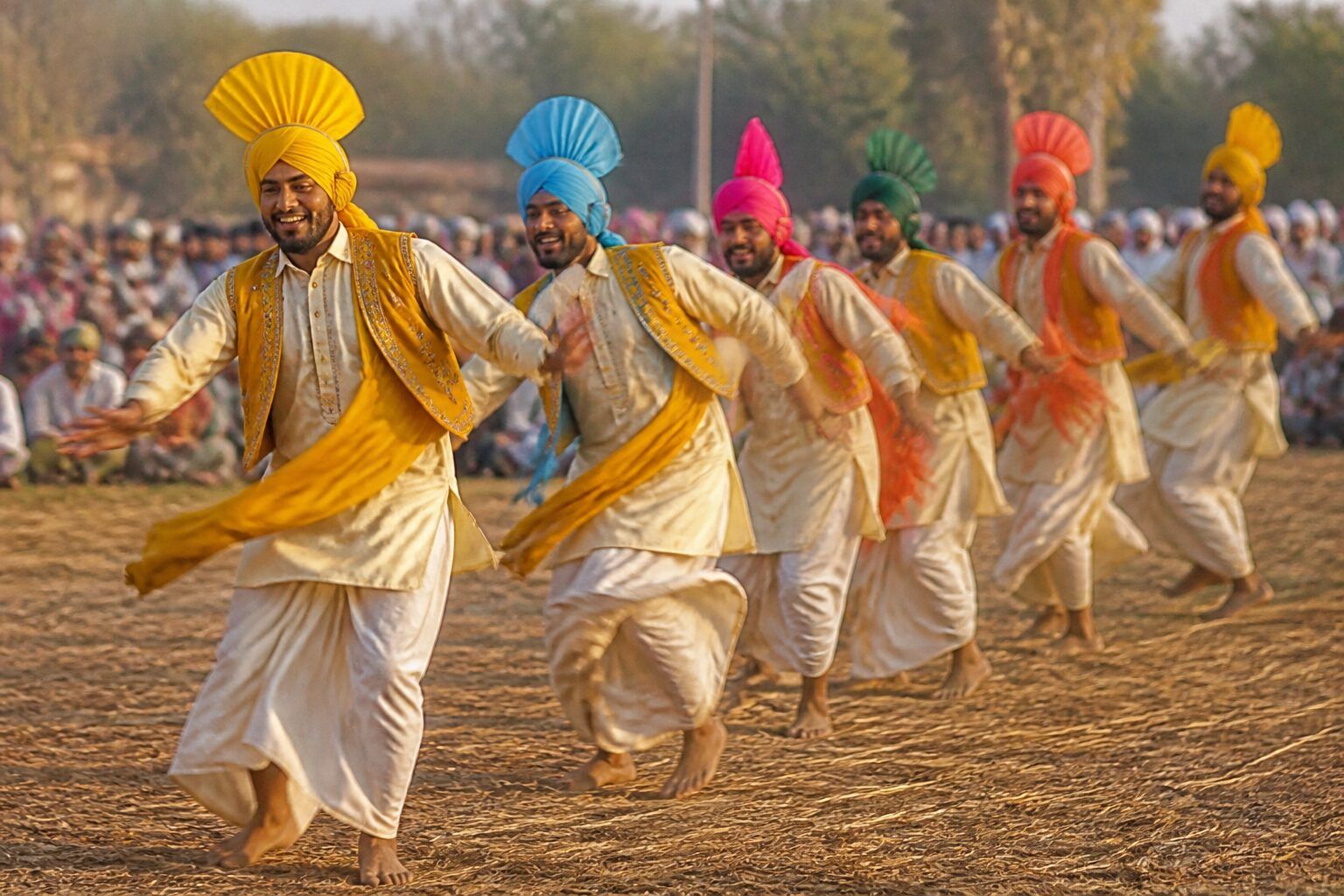

Punjabi folk dress, worn for the occasion — not a single prescribed uniform.
There is no documented costume unique to Luddi. Performers wear the folk dress of their region and community, and the clothing described in accounts of the dance is the everyday festive dress of rural Punjab: colourful, embroidered and practical enough to dance in. Any statement that one particular outfit is "the" Luddi costume should be treated with caution.
For men, accounts of the dance describe turbans, kurtas and salwars — typically a kurta or kurta-pyjama with a chadra or salwar, often layered with an embroidered waistcoat, a colourful turban (pagri) and, in performance settings, juttis. For women, the description is a bright salwar kameez or similar Punjabi ensemble with a heavily embroidered phulkari dupatta, and jewellery is a noted part of the look: earrings, necklaces, bangles and, in many families, a nose ring. Writers on the dance single out the colour of the clothing as part of its appeal.

Dhol-led, shehnai-sweetened, and partly played by the dancers' own hands and feet.
Luddi is danced to the dhol and the shehnai. That pairing is the one recorded in reference descriptions of the dance: a performance on the tunes of dhol and shehnai, in pairs or in groups. Accounts of the form also mention drums, cymbals and oboes — the same family of instruments described with their Punjabi names, where the shehnai is the reed instrument and cymbals such as the manjira add a metallic edge.
What makes Luddi's rhythm distinctive is that the dancers are part of the percussion. Clapping hands and clicking fingers carry the beat through the circle, and stamping feet accelerate the tempo as the performance builds. The dhol sets the frame; the circle fills it in.
The song tradition matters as much as the instruments. Luddi Hai Jamalo, the Noor Jehan song from the 1980s, is closely associated with the dance and is often sung at weddings by women, and many Luddi performances are built around songs of that kind rather than around a purely instrumental track. In wedding settings, the singing and the dancing tend to be one activity rather than two.
From a family circle in a courtyard to a choreographed stage item.
Luddi lives in two different settings, and they look quite unlike each other. In its community setting it is a participation dance: a circle forms wherever there is room, dancers join and leave as they wish, and there is no audience in the formal sense. In its staged setting it becomes a performance item with a beginning, a build and an ending — choreographed for a stage, a festival or a cultural programme.
For organisers, group presentation is usually the deciding factor. A Luddi circle looks best when the ring is even and the claps land together, so troupes tend to rehearse formations and transitions rather than individual steps. If you are programming a Luddi item, the useful questions are about numbers: how many dancers, how long the piece runs, whether live musicians are included, and how much stage space the circle needs.
Punjabi folk-dance performers for celebrations, cultural programmes and stage events.
If you are looking for a Punjabi Luddi dance performance, the practical point to know up front is that Luddi is offered far less often as a standalone item than Bhangra. Many folk troupes perform it as one part of a Punjabi folk set rather than as a full-length piece, and the number of dancers who specialise in Luddi specifically is smaller than the number who specialise in Bhangra. Availability therefore has to be confirmed for your date and city rather than assumed.
The occasions where a Luddi item works well are the ones the dance was made for — celebrations with a Punjabi audience and a reason to be joyful, including weddings and cultural events.
Mehndi, sangeet and baraat celebrations, where a Luddi item sits naturally beside the family's own dancing. Ask for a version that can pull guests into the circle at the end.
Annual days, festival celebrations and cultural showcases where a folk item is part of a wider programme. A short Luddi piece pairs well with other regional folk dances.
Cultural fests, youth festivals and inter-college competitions, where Luddi is a distinctive choice precisely because it is less commonly staged than Bhangra.
Folk festivals, heritage and tourism events, and state cultural programmes where an authentic Punjabi folk repertoire is required.
When you enquire, the details that matter most are the date and city, the type of occasion, the length of the item you want, whether you need live dhol and shehnai or a recorded track, and whether the performance should be a Luddi piece on its own or part of a Punjabi folk set. Share those five things and any troupe you approach can tell you quickly whether they can deliver.
Tell us your date, city, occasion and the kind of Punjabi folk performance you have in mind. We will check what is available for your event — including whether a troupe can perform Luddi as a dedicated item.
Availability, troupe size and pricing are confirmed by the artist for your specific date and city. This page does not list a fixed Luddi troupe, and no booking is guaranteed until an artist confirms it.
Short, practical distinctions — Luddi remains the subject here; the others are context.
| Point of comparison | Luddi | Bhangra | Giddha | Sammi |
|---|---|---|---|---|
| Typical performers | Men and women, in mixed or single-sex groups | Traditionally men | Women | Women |
| Formation and movement | Circle or pairs; clapping, finger clicks, jumps, half-turns and stamping feet | Circle around a dhol player; high leaps, shoulder work and vigorous footwork | Circle with clapping, expressive gestures and recited boliyan | Circle with slow, fluid arm movements, claps and footwork |
| Typical occasion | Weddings, victory and achievement celebrations, festivals | Harvest (Vaisakhi) and festive celebrations | Festive and wedding gatherings | Folk-song gatherings of the Sandal Bar and Pothohar belt |
| Accompaniment | Dhol and shehnai, with cymbals in some accounts; claps and stamping from the dancers | Dhol and boliyan | The dancers' claps; traditionally without a drum | Traditionally without a drum — carried by song |
The shortest version: Luddi and Giddha share the clapping circle but differ in context and movement; Luddi and Bhangra share the dhol and the Punjabi folk vocabulary but differ in formation and in feel; Luddi and Sammi are both circle dances from the same cultural region but are performed at different speeds and in different settings. For fuller guides to the other forms, see the Bhangra and Giddha dancers page and the Sammi dance guide.
Luddi is a traditional folk dance of Punjab performed by men and women in a circle. Dancers clap their hands and click their fingers as they move, travelling through jumps and half-turns and stamping their feet to build the rhythm. It is associated with weddings and with celebrations of victory, and it is known in both Indian and Pakistani Punjab. It is usually performed in pairs or in groups to the sound of the dhol and the shehnai.
Luddi is documented as a traditional folk dance of Punjab with no recorded founder or founding date. Cultural writing links its rise to the Malwa region and to celebrations of victory, and the dance has been recorded at weddings, festivals and sports celebrations across the region. In more recent history it has moved onto stages and into cultural programmes, and one Punjabi group was reported to have set an International Book of Records mark with a continuous Luddi performance of over 112 minutes.
No exact origin date, founder or single historical event for Luddi is established in reliable sources. Reference entries describe it simply as a traditional Punjabi folk dance, and detailed writing places its rise in the Malwa belt of Punjab, where it was danced to mark victory. Stories you may read online about the dance beginning with a specific rescue or battle are popular traditions told about Luddi rather than documented history, so they are best presented as such.
The core characteristics are a circular formation, clapping hands, clicking fingers, jumping, half-turns and stamping feet that accelerate the tempo. One hand is commonly held behind the back while the other moves in flowing, undulating motions at the front. The whole body is engaged, and the circle is often formed in pairs, at times taking on a snake-like shape as the dancers weave. There is no single standardised sequence of steps — the movement follows the song and the group.
There is no costume unique to Luddi. Performers wear Punjabi folk dress: men are described in turbans, kurtas and salwars, often with an embroidered waistcoat, while women wear bright salwar kameez ensembles with a phulkari dupatta and traditional jewellery such as earrings, necklaces and bangles. Colours are vivid — mustard, orange, magenta and green. For a stage booking, the troupe usually agrees on one coordinated colour scheme.
Luddi suits celebrations with a Punjabi character: weddings and sangeet functions, cultural programmes and annual days, college fests and youth festivals, folk and heritage festivals, and events marking a victory or achievement. In a community setting it is danced wherever there is room for a circle, from a courtyard to a hall. On a stage it is usually presented as a short choreographed item, alone or as part of a Punjabi folk set.
Share your date, city, type of occasion, the length of item you want, and whether you need live dhol and shehnai or a recorded track. Send your enquiry through the BookMyDance contact page and availability can be checked with folk-dance artists for your date. Because fewer troupes offer Luddi as a standalone item than Bhangra, it is worth enquiring early and confirming whether Luddi will be performed as a dedicated piece.