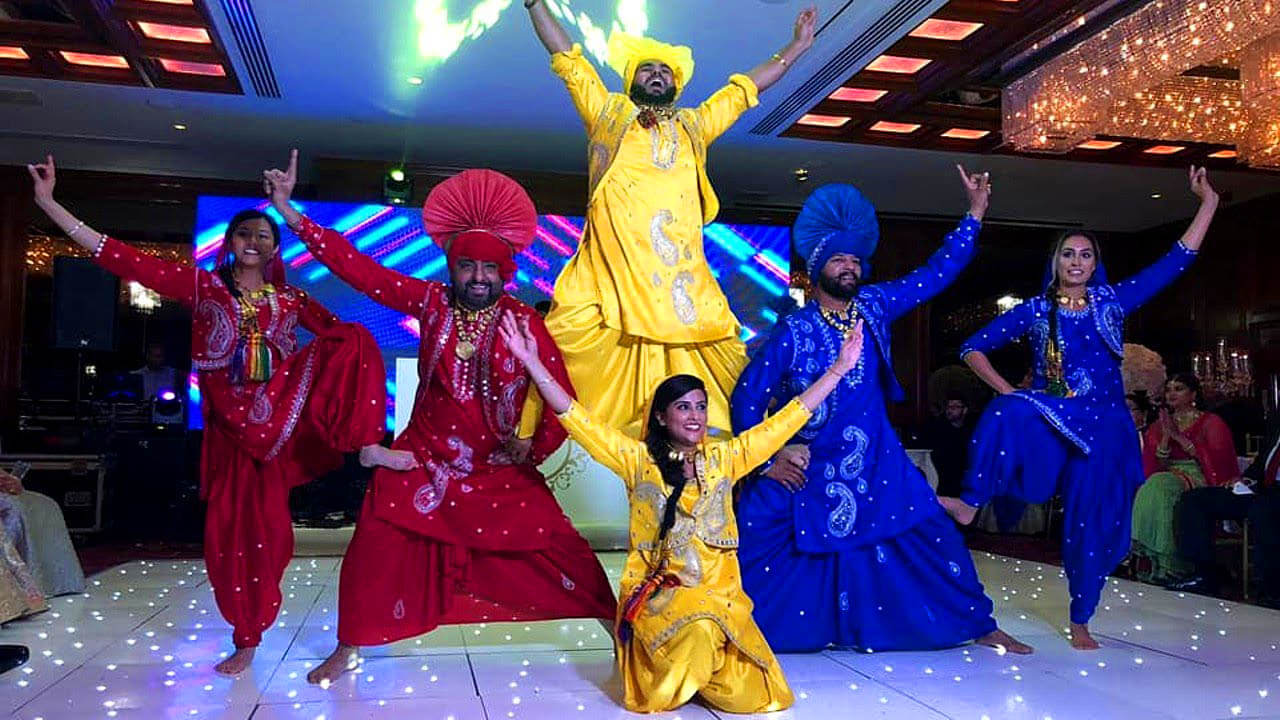
Women's dance · verses
Bhangra & Giddha
Giddha is the women's circle dance built around recited verses — the tradition Kikli is usually seen next to. Bhangra is the drum-driven form that shares the same stage.
Read about Bhangra and GiddhaPunjabi folk tradition
Kikli is the paired twirling dance of Punjabi girls and young women — two dancers cross their arms, grip each other's hands, lean back and spin faster and faster while the women around them sing and clap. This guide explains what the Kikli dance of Punjab is, how the movement works, where it comes from, and how an event organiser can enquire about a Kikli or Kikli-themed performance.
Part of the folk-dance tradition of Punjab — playful, song-led and performed in pairs rather than by solo dancers on a stage.

Kikli is not a stage spectacle with a fixed running time. It is a folk activity of Punjabi girls and young women, built on one simple and demanding idea: two dancers, holding each other's hands, spin each other round at speed without losing balance.
The dance is performed in pairs. Two girls stand facing each other and cross their arms so that the right hand takes the left and the left hand takes the right; the hands are then locked together firmly and the dancers lean back, stretching their arms as far as they can. From that position they whirl round and round in a continuous circle. The word is also written Kikkli — the two spellings describe the same dance, and the alternative spelling appears in older published accounts.
What gives Kikli its character is everything happening around the pair. As the two dancers turn, other women and girls sing folk songs, keep time with clapping, and call out to push them faster. The floating dupattas and the tinkle of anklets have been recorded as the sound and sight of the dance at its peak. In that sense Kikli is a shared folk expression rather than a performance delivered to an audience: the people singing are part of the dance.
Several published descriptions treat Kikli less as choreography and more as a physical game — something close to a playground challenge that happens to be danced. That is worth keeping in mind, because it explains why the form has no official troupe, no authority fixing the steps, and no single standard routine. When you see Kikli on a stage today, you are watching a modern adaptation of a courtyard tradition.
Readers reach this page for two different reasons. Some want to understand a folk form that is central to the way Punjabi girlhood and community life are remembered in song; others are organising a cultural item and want to know how to ask for it. This page answers both, and it separates what reliable sources record from what is simply not established.
A traditional Punjabi folk dance of girls and young women, performed in pairs, in which the dancers clasp crossed hands, stretch backwards and whirl to the rhythm of folk songs and clapping from the people around them.
Kikli is recorded as one of the folk dances of Punjabi women and girls, with its origin given simply as Punjab. Encyclopaedia Britannica describes kikli as a dance performed by girls and young women in northern India and Pakistan, in which dancers in pairs clasp hands over crossed arms, stretch backward and whirl, charged with energy and fast rhythms and often accompanied by traditional rhyming songs.
That geography matters. Because the dance belongs to the wider Punjab rather than to a single district or one side of the India–Pakistan border, it is part of a shared cultural inheritance. Folk songs, songs of the harvest, songs of teasing and songs for girls' gatherings travel in the same way — and a traditional Kikli song, sung while the pair spins, is a normal accompaniment to the dance.
Kikli does not exist without its singing. Published descriptions set the dance inside a group of women clapping and singing while the pair in the middle spins, with the tempo of the singing setting the tempo of the turning. Anyone planning to present Kikli on a stage therefore has to make a decision the tradition did not need: keep the live singing and clapping of a group, or move to recorded accompaniment. Both are used today, and they give the item a very different feel.
The song tradition has also travelled beyond the courtyard. Contemporary Punjabi singers and producers have recorded Kikli-themed songs, which is one reason the word is familiar to audiences who have never seen the dance itself.
Reliable sources do not give Kikli an exact origin date, a named founder or inventor, an originating village, or a single historical event as its beginning. We have found no credible evidence for a fixed number of performers as a rule of the tradition (two is typical, four is recorded), or for Kikli being tied to one particular festival or ritual. Where a page or a video states a precise year or attributes the dance to a specific dynasty or community without citing a source, that claim should be treated cautiously — including if you see it repeated on this subject elsewhere.
Kikli sits in the same family of Punjabi folk expression as Giddha, the women's dance of verses and teasing, and it belongs to the everyday culture of girls' gatherings — courtyards, courtyards at weddings, school breaks, festival days and leisure evenings. It carries no religious ceremony and no ritual function in the accounts we consulted. Its cultural value lies elsewhere: in the trust and coordination two dancers need to spin at speed without falling, in the group singing that pushes them on, and in the fact that the dance has been passed down through generations of girls rather than through any institution.
It is also a reminder of how much of Punjabi folk dance survives outside formal documentation. Kikli is far better known as a lived activity than as a written tradition, which is why published descriptions concentrate on the movement, the handhold and the singing, and say comparatively little about costume or occasion.
Descriptions of Kikli agree on a single repeating movement rather than a sequence of steps. Below is the traditional pattern as published sources record it — treat it as the established core of the dance, not as a universal choreography, because performance practice varies between groups, families and regions.
Published accounts record that Kikli is sometimes performed by four girls instead of two, and that the songs sung with the dance come in many versions. That variability is the honest picture of a folk form: the movement pattern is consistent, but who performs it, for how long, and to which song is decided by the group, not by a rule.
For anyone staging it, the practical consequence is that the choreography has to be built for the occasion. A cultural programme item usually reduces the open-ended spinning of a courtyard Kikli into short, controlled rounds with a clear entry and exit, so that the item fits a set duration and a stage floor. If you are planning a programme, that adaptation is worth discussing with the performers rather than assumed.
Costume is the least documented part of Kikli, and it is important not to invent one. What the sources describe is what the movement produces — not a uniform.
Published descriptions of Kikli focus on the movement rather than on a designated costume: the dupatta or odhni is noted for floating outward as the pair spins. A dedicated ceremonial Kikli outfit is not recorded, so the traditional setting implies ordinary traditional Punjabi dress rather than a special uniform.
The tinkling of anklets as the dancers turn is described as part of the dance's sound, along with the clapping that marks the beat. This is a folk, hand-made rhythm rather than an arranged soundtrack.
Kikli songs are sung by the group around the dancers, with clapping; a variety of songs is used with the dance. No specific instrument is documented as a requirement of the traditional form.
The two are often confused, so keep them separate. In the traditional setting Kikli is informal — whoever wants to try spins in the middle while everyone else sings, and the dance stops when the dancers do. On a modern stage, the same movement becomes a choreographed item: matching costumes, recorded accompaniment in most cases, a fixed duration, and formations built around it for the audience's benefit. If you are enquiring about a performance, say which version you are looking for, because the rehearsal and production requirements are not the same.
This section is for organisers. It explains how to enquire, what to ask a dance group before you confirm anything, and how to keep a genuine Kikli item separate from a general Punjabi folk dance package.
Kikli is a specialised form, and not every Punjabi dance troupe performs it. Plenty of groups offer Bhangra, Giddha or a general Punjabi folk set, and Kikli may not be part of their repertoire at all. So the first question in any enquiry should be direct: does the group perform Kikli, or a Kikli-themed piece, with dancers who have rehearsed the paired twirl? If the answer is that they perform a broader Punjabi folk presentation instead, that is useful information — it tells you what you are actually buying, and it lets you decide whether the programme needs a genuine Kikli item or a folk set in which Kikli appears as one short segment.
Booking here works through an enquiry rather than an instant-purchase flow. You describe the event, and the arrangement — performers, group size, duration and pricing — is worked out from there. BookMyDance does not publish fixed packages or standard fees for a Kikli performance, and this page does not claim confirmed availability. Availability is exactly what the enquiry is for.
If the item you want must centre on Kikli itself, say so in the enquiry and ask for it in writing. A general Punjabi folk presentation may include Bhangra, Giddha, Jhumar and other forms with Kikli as a brief moment inside them — which can be the right answer for a wedding or a corporate cultural evening, and the wrong answer if your programme is built around Kikli specifically. Being explicit at the enquiry stage is the simplest way to avoid a mismatch on the day.
Include the event date, city, venue and audience details in your first message — the more precise your brief, the more useful the reply. If your programme is larger than one item, see dance troupe bookings, wedding and sangeet performers or dancers for private parties.
Kikli is short, visual and easy to read from a distance, which is why it works as a cultural item. The contexts below are modern performance settings where a Kikli or Kikli-themed piece can be considered — they are not claims that Kikli is traditionally performed at each one.
Heritage evenings, state cultural showcases and regional folk festivals are the most natural fit, because the audience is there specifically to see folk forms that represent Punjabi tradition.
Annual days, cultural weeks and inter-college competitions suit Kikli well: the paired twirl is compact, needs few props, and gives students a folk form that is clearly different from the usual Bhangra performance.
Society gatherings, association events and festival programmes can carry a Kikli item, especially when the organisers want a women-led folk performance rather than a high-energy dance number.
At Punjabi weddings, Kikli can work as a short cultural item in a sangeet or pre-wedding programme where a folk moment fits the sequence — it is not traditionally a wedding ritual, so treat it as programming rather than ceremony.
Companies running India-themed or regional cultural events can include a Kikli segment as a heritage highlight, usually paired with a broader folk set so that the programme has variety.
Museum programmes, tourism and craft festivals, and region-focused exhibitions use folk items like Kikli to represent living Punjabi traditions rather than stage entertainment alone.
BookMyDance is a dance and performer booking service that arranges artists for events across India, and it publishes its contact details openly — a phone number, WhatsApp and an enquiry page — so you can raise a question directly with a person rather than fill in a form and wait.
The enquiry route is useful for a folk item like Kikli precisely because so much depends on the group. Whether a troupe has dancers who can perform the paired twirl, whether they can add live singing, what they wear, and how many rounds the item needs are all questions that have to be answered by the performers for your date and city. No pricing table can answer them, which is why this page does not offer one.
What you get at the enquiry stage is a conversation about your programme: the event type and venue, the duration, the audience, and the kind of folk presentation that suits it. On this page we deliberately avoid promising things that cannot be verified in advance — availability, fixed fees, or a specific response time. Ask, and you will know quickly where you stand.
There is no automated booking flow for a folk item like this, and that is deliberate — every Kikli performance is worked out around the event. The sequence below is what a typical enquiry looks like from your side.
A Kikli item needs rehearsal, not just availability — the paired twirl has to be safe on your floor and stable at speed. If your event is close, say so in the enquiry and ask what the group can realistically prepare. It is better to change the item than to stage a twirl that has not been rehearsed properly.
Kikli is one thread in the wider folk dance tradition of Punjab. These pages cover the forms most often programmed alongside it, plus the full state directory.
Women's dance · verses
Giddha is the women's circle dance built around recited verses — the tradition Kikli is usually seen next to. Bhangra is the drum-driven form that shares the same stage.
Read about Bhangra and Giddha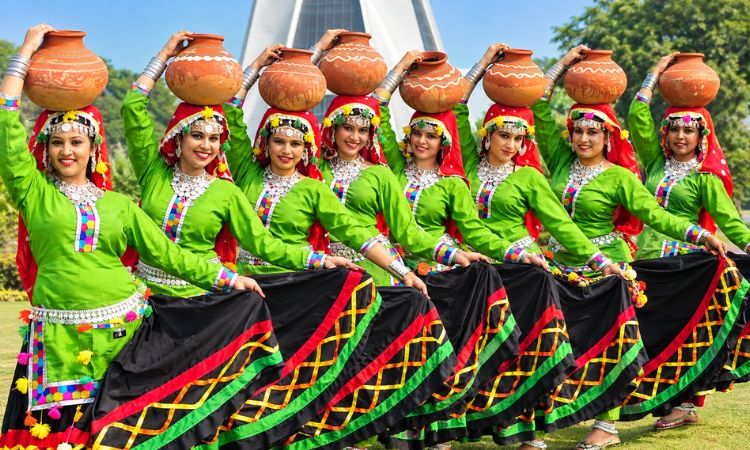
Punjabi folk · no drums
Another women's folk form that keeps its own rhythm, traditionally without an instrument. Sammi is slower and circle-based; Kikli is fast and performed in pairs.
Explore the Sammi folk dance
Punjabi folk · lyrical
Slow, swaying and carried by song, Jhumar is the lyrical counterpart to Kikli's speed — a useful contrast if you are building a multi-item folk programme.
Discover the graceful Jhumar danceKikli — also spelt Kikkli — is a traditional folk dance of Punjabi girls and young women, usually performed in pairs. Two dancers stand face to face, cross their arms, grip each other's hands firmly, lean back until their arms are stretched, and then whirl round and round at speed while folk songs are sung and clapped around them.
Kikli belongs to the shared folk heritage of Punjab, recorded by Britannica as a dance of girls and young women in northern India and Pakistan. It is a group activity rather than a solo or star performance, and the encouragement of the women and girls singing and clapping around the pair is part of the dance itself. It is also remembered in a folk-song tradition named after the dance, which keeps the form alive well beyond the courtyards where it began.
The movement is built on one repeating idea: a pair faces each other, crosses their arms so the right hand meets the left, locks the hands tight, leans backwards to full arm stretch and spins continuously. Balance, a firm grip and matching speed keep the pair upright. The tempo is pushed by the clapping and singing around them, and published descriptions note that the dance is sometimes performed by four girls instead of two.
Yes — they are different forms with different performers and different rhythm sources. Bhangra is a vigorous Punjabi harvest dance associated mainly with men and usually driven by the dhol, while Kikli is a paired girls' and young women's dance carried by singing and clapping rather than a drum. Kikli is generally described as closer in character to a playground sport — the challenge of spinning fast without losing balance — which feels very different from a staged Bhangra set.
Yes. Send the event date, city, venue and the kind of programme you are planning through the BookMyDance contact page, message the team on WhatsApp, or call +91-9355056666 — and ask directly whether a group performs Kikli or a Kikli-themed item. Availability, group size and pricing are confirmed on enquiry; the site does not publish fixed packages.
It can be discussed for school and college cultural functions, annual days and inter-college competitions, because the paired twirl is short, visually clear and easy for an audience to follow. On stage it is presented as a rehearsed item rather than the informal courtyard version, so the group needs practice time to make the spinning safe on a flat, dry surface — and the item is usually placed inside a wider Punjabi folk set.
Confirm that the group actually performs Kikli, or a Kikli-themed piece, rather than only general Punjabi folk dance; the number of dancers and how the pairs are formed; the length of the item; whether the accompaniment is recorded or sung live; the costume the group will wear; the stage or floor space and its surface; travel from the performers' city; and whether the item suits your audience. Then confirm the final arrangement in writing with the provider.
There is no standard fee for a Kikli performance, and BookMyDance does not publish fixed prices. The cost depends on performers' availability for your date, your city and the travel distance, how many dancers are required, the length and number of items, whether live singing is part of the show, costume and production needs, and how the item fits into the rest of your programme. Share those details in your enquiry and pricing can be discussed upfront.
Tell us the event date, city and the programme you are building, and ask whether Kikli or a Kikli-themed performance is possible for your audience — a cultural evening, a school or college function, a folk festival or a wedding cultural segment. Availability, group size and pricing are confirmed on enquiry.
Note on scope: this page describes Kikli as a Punjabi folk tradition and how to enquire about a Kikli-themed performance. It does not list individual performers or guarantee availability, and it does not present a costumed stage routine as if it were the traditional form.