Skip to Bhangra dance content

Punjab · Folk Dance

Bhangra Dance of Punjab: History, Tradition and Performances

The Bhangra dance of Punjab is a group folk dance from the harvest season that grew out of Punjabi village life and became one of the most widely recognised dance forms in the world. This guide covers where Bhangra comes from, how it is danced, what performers wear, how the dhol drives the rhythm, and what to think about when you want Bhangra performers at your own event.

Shoulders rolling in time, arms lifting on the beat, and the dhol setting a rhythm the whole group can feel — that is the energy of a live Punjabi Bhangra performance.

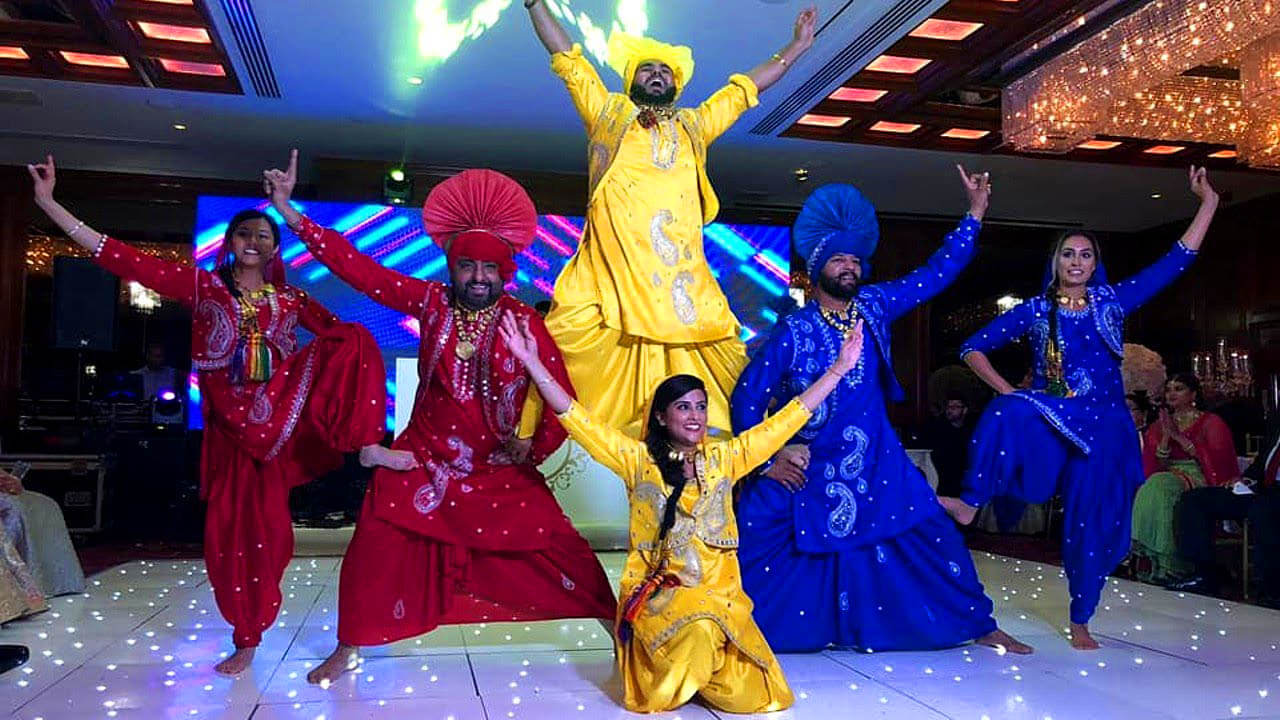
Bhangra dance group in kurta, waistcoat and pagri performing on stage at a Punjabi celebration
Bhangra performers on stage at an indoor celebration. Stage groups often colour-coordinate their costumes, while folk performers wear their own festive clothing.
  • Region Punjab, north-west India and eastern Pakistan
  • Main instrument Dhol, a large two-headed drum
  • Traditional season The harvest, including Baisakhi
  • Seen today at Weddings, festivals, college and stage events

Bhangra is the traditional folk dance of Punjab. It is performed by a group to the beat of the dhol, a large two-headed drum, and it grew out of Punjab's farming calendar: the harvest was a shared community event, and dancing together was part of marking it. That is why Bhangra has always been a group activity rather than a solo performance, and why its movements are built for open ground — strong shoulder work, raised arms, bouncing steps and the occasional jump.

What Is Bhangra Dance?

Bhangra is a Punjabi folk dance with two clear layers. The older layer belongs to rural Punjab: harvest-time celebrations where singers, a dhol player and a circle of dancers turned a good crop into an evening of music. The newer layer belongs to stages, competitions, weddings and film — the same movement vocabulary, rearranged for an audience, a fixed running time and a choreographed group of dancers.

Its connection with Punjab's agricultural traditions is the reason for its timing and its mood. Bhangra was associated with the wheat harvest and with Baisakhi, the spring harvest festival, when Punjabi communities celebrated the season together. The dancing was outdoors, unplanned and open to anyone who wanted to join.

Musically, Bhangra is built on rhythm. The dhol carries a repeating pattern while singers deliver folk verses, and the dancers answer the beat with their feet and shoulders. That combination gives Bhangra its recognisable character: fast, loud, physical and collective, with everyone working to the same pulse.

Today the word covers both the traditional dance and a whole music genre. A village Bhangra, a university competition routine and a Bollywood-style Bhangra number for a sangeet night are all called Bhangra, even though they look different on stage.

Group of Bhangra and Giddha performers in traditional Punjabi attire lined up at a celebration
A performing group in traditional Punjabi attire. Mixed and all-women Bhangra groups are common on stage today, while the traditional village form was danced by men.

Bhangra is not the same as Giddha

The two are often named together because both come from Punjab, but they are different dances. Giddha is a women's folk dance built around clapping, boliyan and a circle of dancers, while Bhangra is the dhol-driven group dance described on this page. If you want to read about both traditions together, see the Bhangra and Giddha dance traditions page.

History of Bhangra Dance

Bhangra's history has two halves: a long, largely undocumented folk phase in rural Punjab, and a well-documented modern phase in which the dance moved onto stages, campuses and wedding floors around the world.

Roots in Punjab's harvest cycle

Bhangra took shape among farming communities in Punjab, in what is now north-west India and eastern Pakistan. It was tied to the agricultural year rather than to temples, courts or a single patron. When the harvest came in, the community celebrated: drummers played, singers sang folk verses, and dancers formed a circle in an open space and took turns. The dance was not staged, and there was no audience separate from the performers.

The season most closely associated with Bhangra is the spring harvest, and the festival that marks it — Baisakhi (also written Vaisakhi). It is worth separating two ideas here: Baisakhi is a festival with religious and seasonal meaning of its own, while Bhangra is one of the cultural activities that has traditionally accompanied the wider celebrations around the harvest.

From open ground to the stage

Through the twentieth century, Bhangra shifted from the village circle to organised performance. Schools, colleges and cultural organisations began presenting it at functions and competitions. State and national cultural programmes gave Punjabi folk troupes a formal stage, with fixed entries, formations and costumes, and Punjabi cinema and later popular music carried Bhangra songs far beyond the region.

The partition of Punjab in 1947 divided the region between India and Pakistan. Bhangra continued to be danced on both sides of the border, and Punjabi families who moved to Delhi, other Indian cities and overseas took the tradition with them. Scholars generally treat Bhangra as a shared Punjabi tradition whose modern story is bound up with migration as much as with the harvest.

Competition teams and the global Bhangra scene

From the late twentieth century onwards, Bhangra developed a second life as an organised team activity. University and community teams — first in the United Kingdom, the United States and Canada, and now in India as well — train for months and perform choreographed routines at judged competitions. These routines borrow the traditional movement vocabulary but add formations, uniform costumes, props and carefully edited music.

Alongside the competitions, Bhangra became a music style in its own right, mixing Punjabi folk rhythms with pop, hip-hop and electronic production. That is why a modern audience may first meet Bhangra at a wedding, a festival, a college fest, a television talent show or a fitness class rather than in a Punjabi village.

What is not firmly established

Bhangra does not have a single documented founding date, founder or "first village", and different accounts give different explanations of how the word itself came about. Dates and origin stories that circulate online are not consistently supported by evidence. Treat firm claims about a specific year of origin with caution, and read the tradition as a gradual folk development with a clear modern history.
Cultural Significance of Bhangra

Bhangra matters in Punjab for a simple reason: it needs no stage, no fee and no training to join. That openness is exactly why it has become one of the most visible symbols of Punjabi culture in the world.

A shared, not solo, tradition

In its folk setting Bhangra is danced by a group, with dancers taking turns in the middle while the rest keep the rhythm. It is participation rather than spectatorship, and that is why it has always been open to anyone who turned up — old or young, skilled or not.

Celebration and good news

Bhangra is tied to occasions people mark together: the harvest and Baisakhi, weddings, festivals, village gatherings and, in modern settings, results and wins. The dance is a way of announcing that something good has happened.

Music and language kept alive

Bhangra carries Punjabi folk singing with it. The boliyan — short Punjabi couplets sung during the dance — use humour and everyday observation, and they keep the language in public performance.

Colour and festive dress

Bright, high-contrast colours, embroidered waistcoats, pleated turbans and phulkari work are part of how audiences recognise Bhangra. Festive Punjabi dress and the dance are closely associated, even though there is no single required outfit.

A way to stay connected

For Punjabi communities living outside India, Bhangra teams, competitions and festival performances became a way to hold on to heritage and to introduce it to a wider audience. That is why one of India's most local folk dances also has a truly global amateur network.

A global symbol of Punjab

From film songs and sporting celebrations to college fests and fitness studios, Bhangra is the Punjabi folk element most non-Punjabi audiences meet first — and very often the one they name when they think of Punjabi culture.

Traditional Bhangra Dance and Its Styles

"Bhangra" describes a family of performances rather than one fixed routine. The folk form, the competition routine and the party item share movements, but they are organised very differently.

How traditional folk Bhangra is performed

Traditional Bhangra belongs to open ground rather than a stage. A singer leads, a dhol player sets the tempo, and the dancers form a circle or a loose group. Everyone repeats the same step together, and individual dancers step into the middle to show a variation before rejoining. There is no fixed running time, no front row and no separation between performers and onlookers — people join in, drop out and join again as the evening goes on.

The stage and competition form

On stage the same movement vocabulary is reorganised. Teams work in lines, diagonals and blocks, routines run to a fixed length, and the music is usually an edited track rather than a live drummer responding to the dancers. Competition and stage groups typically train for months, colour-coordinate costumes, and are judged on synchronisation, formations, energy and technique. Nothing about this is less authentic than the village form — it is simply a different setting with different rules.

Party, fusion and film styles

There is also the Bhangra most wedding guests actually dance. Here the chaal and the shoulder work are kept, but the music may be a chart song or a folk-pop or electronic track, the tempo is fixed by a DJ, and the group changes constantly as guests join. Film choreography pushes the style further, blending Bhangra steps with other dance forms, which is why "Bollywood Bhangra" and "folk Bhangra" can feel like two different things.

How much does Bhangra vary?

Considerably. Punjab itself has distinct regional belts — Majha, Malwa and Doaba are the usual names — and folk songs, tempo and styling differ across them. Different troupes also favour different steps, formations and costumes, and a team's routine is a choreographer's work, not a standard script. It is safer to ask a group what style they perform than to assume there is one "correct" Bhangra.

If you are booking a performance

Ask the group whether they perform the traditional folk style, a choreographed stage routine or a party-style set that invites guests in. Each one suits a different kind of event, and the answer changes the stage size, the running time and the sound requirements.

Bhangra Dance Steps and Movements

Bhangra looks far more complicated from the outside than it is. The whole dance is built from a small number of movements, repeated in time with the drum — which is why a beginner can pick up the basic feel of it in a single session.

  • The chaal — the base step. Chaal (roughly "movement" or "gait" in Punjabi) is the basic Bhangra rhythm and the first thing most learners are taught. The dancer steps and bounces in time with the chaal beat on the dhol, keeping the knees soft so the body drops and rises on every pulse. Get this single step comfortable and you have the foundation of the whole dance.
  • Shoulder and upper-body work. Bhangra is danced from the shoulders as much as from the feet. Dancers shrug, roll and push the shoulders forward and back while the arms stay loose and low. This shoulder movement is what gives the dance its characteristic swagger and what most first-time watchers notice.
  • Rhythmic arm raises and claps. Arms lift outward or overhead on the strong beats and drop on the weaker ones, which makes the group's movement readable from a distance. Claps, wrist flicks and light hand gestures are used to hold the rhythm, especially when dancers are singing.
  • Bouncing and stepping patterns. The bounce is what ties the other movements together. The weight shifts from foot to foot in a steady stepping pattern, and the whole body rides the beat. Squats and deep knee bends are used within this framework, which is why the dance looks as physical as it feels.
  • Jumps, kicks and leaps. Big jumps, kicks and leaps are accents rather than the base of the rhythm. They usually land on the loudest beat or at the end of a musical phrase, so a group appears to lift and land together.
  • Group coordination and formations. In the traditional circle, everyone repeats the same step while individual dancers take turns in the centre; on stage the group arranges itself in lines, diagonals and blocks. Either way the effect comes from everyone landing the same movement at the same moment, with dancers watching the dhol player as well as each other for cues.

Learning it in the right order

Start with the chaal on a slow dhol loop, then add the shoulder work, then the arms, and only after that try jumps and kicks. Practise in short bursts rather than long sessions: Bhangra is repetitive, and the knees, ankles and lower back take the load. A warm-up before dancing and a general level of fitness matter more than natural coordination.

A note on step names

Bhangra step names are not standardised. Different teachers, teams and regions use different names for the same movement, and much of the traditional vocabulary is in Punjabi with no single accepted English version. Treat any list of step names — including this one — as a description of movement families rather than a formal syllabus.

Bhangra Dance Music and the Dhol

In Bhangra the percussion does not simply accompany the dance — it leads it. The drummer's pattern decides when the group steps, when it lifts and how long a phrase lasts.

The dhol is a large, two-headed barrel drum worn across the body and played with two sticks: one heavier stick for the deep, resonant tone and one thinner stick for the sharp crack. Its basic pulse is the chaal, the same beat that gives the dancers their base step. Because the chaal repeats steadily, the drummer can add accents, rolls and breaks on top of it — and the dancers respond to those cues, changing step or jumping when the pattern changes.

A Bhangra dance with dhol accompaniment is the classic pairing: one drummer, a song, and a group of dancers working to the same rhythm. Alongside the drum, Punjabi folk singing carries the melody. The boliyan — short Punjabi couplets, often sung by the dancers themselves or by a lead singer — sit inside the rhythm and give the performance its words, its humour and its subject matter.

Other instruments commonly heard in Punjabi folk ensembles include the dholki, the tumbi, the algoza, the chimta and the harmonium, though a traditional Bhangra setting may use nothing more than a dhol and voices.

Traditional accompaniment

Live dhol, live voices, no amplification and no fixed running time. The tempo belongs to the drummer, the songs are folk songs and boliyan, and the performance ends when the people dancing decide it ends.

Modern and amplified arrangements

Recorded or amplified music, a DJ or a produced track, a fixed tempo and a set running time. Modern Bhangra production often builds on programmed drums while still using the dhol's rhythm and feel, and it frequently mixes in pop, hip-hop or electronic elements.

Worth asking before you book

Does the performance include a live dhol player or a recorded track? A live drummer changes the atmosphere of the show and also the practical requirements — sound setup, stage space and sometimes an additional performer fee.

Bhangra Dance Costume

Bhangra costume is traditional Punjabi festive dress, cut for movement. There is no single compulsory outfit: colours, embroidery and even individual garments change with the region, the troupe and the occasion.

Men's traditional Bhangra costume

The men's outfit is built around a loose tunic and a cloth tied at the waist, finished with a turban. Performance versions add a waistcoat and a pleated crest on the turban, and groups often choose a shared colour scheme.

Common elements of a traditional Bhangra costume for men. Regional and troupe variations are normal.
Garment What it is
Kurta A long, loose tunic, usually in a bright colour, worn over the lower garment.
Tehmat / chadra / lungi The lower garment — a length of cloth tied at the waist, sometimes folded and tucked. Tehmat, chadra and lungi are related names used in different places.
Waistcoat (jugi) A sleeveless waistcoat worn over the kurta, very often embroidered or patterned. It is one of the most recognisable parts of a stage Bhangra costume.
Pag (turban) with turla The Punjabi turban, tied for performances with a pleated, fan-shaped crest called the turla at the front.
Kamarkassa / parna A sash or length of cloth tied around the waist over the kurta.
Rumal A small cloth, tucked into the turban or carried in the hand as part of the look.
Kaintha A folk ornament or necklace worn over the kurta by some performers.
Jutti Traditional leather shoes with an embroidered upper. Stage teams may wear juttis, or dance barefoot.

Women's Bhangra costume

Women dancing Bhangra usually wear festive Punjabi dress: a kurta with a salwar, or a ghagra (lehenga) with a dupatta, often with embroidered or phulkari-inspired borders. Jewellery such as a tikka, bangles and earrings is part of the look, and groups commonly match colours across the team. All-women Bhangra teams generally adapt this festive dress rather than following one fixed uniform.

What actually varies in practice

Quite a lot. Colour palettes differ by group and region, embroidery ranges from plain to heavily worked, and some troupes perform in a single signature palette while others let dancers wear their own festive clothes. Traditional folk performers typically wear what they would wear to a celebration rather than a costume bought for the stage. The constant across all of it is loose, comfortable clothing that allows the shoulders, arms and knees to move freely — that matters more than any particular colour.

For event organisers

Ask whether costumes are provided by the group, whether they can be matched to your event's colour theme, and whether changing space is needed on site. These are booking details the group or the booking team confirms, not standard inclusions.

Bhangra Dance Performances for Events

A live Bhangra performance suits almost any occasion that is meant to feel celebratory and Punjabi. What changes between events is the style, the running time and how much the audience is invited to join in.

Weddings and wedding celebrations

Bhangra dancers for weddings usually appear as entry or procession entertainment, as a stage item, or as the act that opens the dance floor. A short, high-energy set with a live dhol player works particularly well outdoors or in a large hall.

Sangeet nights

Sangeet is the most natural fit of all: a family performance evening where a professional set can lift the energy and cover the moment when relatives take over the floor. Many groups offer a short teach-and-dance segment here. Sangeet and wedding dance performers

Corporate events

Annual days, product launches, conferences and award nights use cultural performances as a break in the programme. Corporate bookings usually need a fixed slot, a defined stage area and a set that finishes on time.

College festivals and cultural programmes

College fest committees and cultural societies book Bhangra dance groups for competitions, festival nights and annual functions. These events are usually planned well in advance, so the schedule and budget are agreed early. Dance troupes for events

Festivals and community events

Baisakhi celebrations, harvest festivals, temple and community functions, and city cultural programmes all feature Bhangra, often alongside other Punjabi folk forms. Festival and concept dance performers

Private celebrations and themed events

Birthdays, anniversaries, family reunions and Punjabi-themed parties use shorter Bhangra sets, sometimes with guests invited to learn a few steps. Performers for private parties

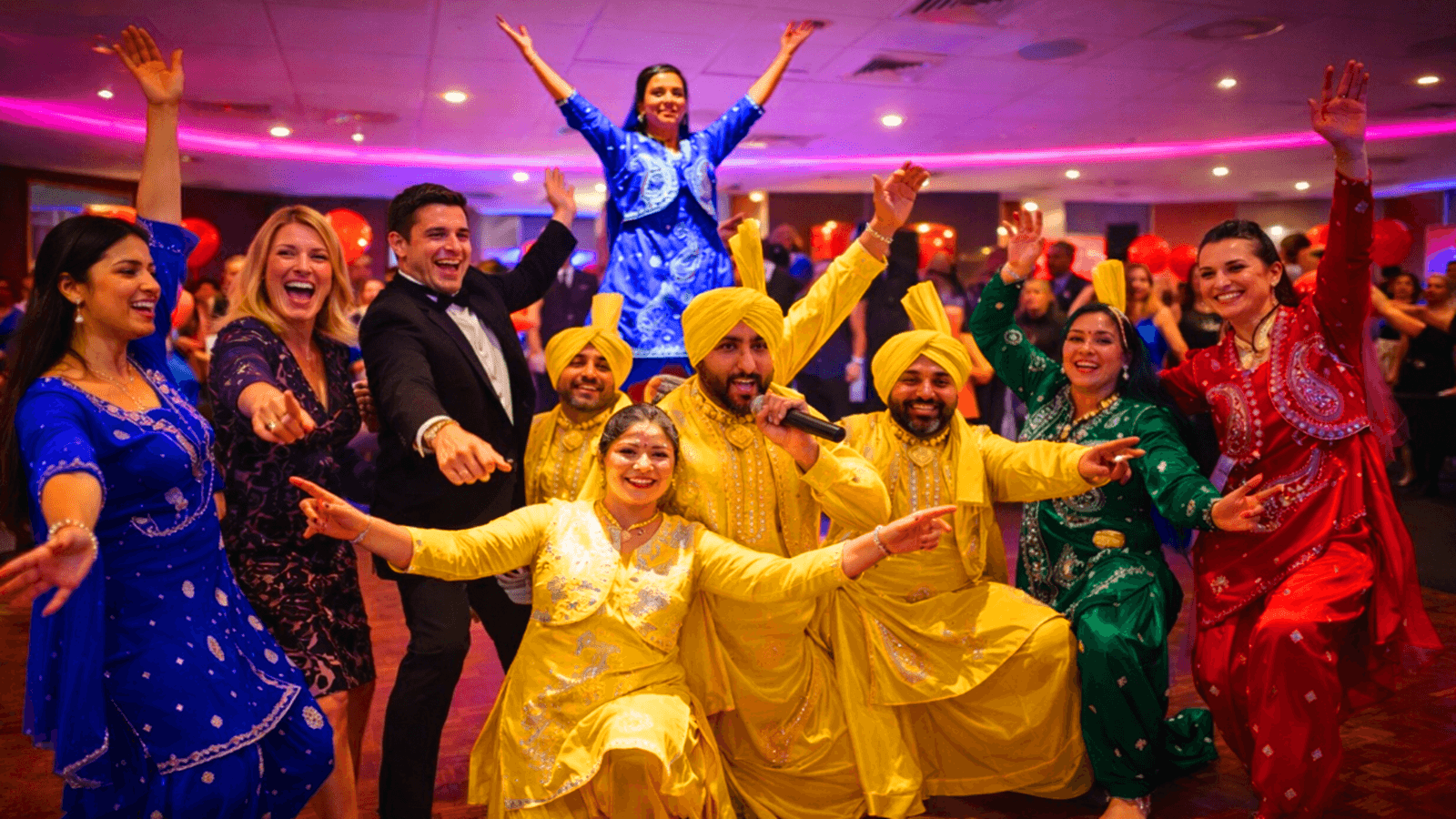
Bhangra performers dancing with guests at an indoor celebration
Bhangra performers and guests together at an indoor celebration. At private events the line between the performers and the dance floor often disappears.

About fees, travel and availability

Charges for a Bhangra dance group are not fixed by dance form. They depend on the group, the date, the city, the length of the performance, the number of dancers and whether a live dhol player is included. This page therefore does not quote prices — the performer or the booking team confirms fees, travel and availability when you enquire.

How to Choose a Bhangra Dance Group?

Most booking problems come from details that were never discussed, not from the dancing. These are the points to confirm with the performer or the booking team before you agree to anything.

  • Experience with your kind of event. A group that regularly performs at weddings may be less suited to a corporate stage slot, and vice versa. Ask what events they usually do.
  • Group size and performance duration. How many dancers will actually perform, and for how many minutes? A three-minute entry item and a twenty-minute stage set are different bookings.
  • Music and sound requirements. Recorded track or live musicians? Ask what audio file, microphone and sound-system support they need, and who is providing it.
  • Stage dimensions and venue suitability. Ask for their minimum performance area and floor type, and whether they are comfortable on an outdoor surface or a raised stage.
  • Costume and choreography. Are costumes provided and can they be matched to your theme? Can the group choreograph to a song you have chosen, and how much notice do they need?
  • Travel, setup and scheduling. Where are they travelling from, when will they arrive, how long is setup, and when exactly will the performance start?
  • Budget and what is included. Ask for a written breakdown covering the performance fee and any expenses — travel, stay, costumes, additional instruments or extra dancers.
  • Live dhol player. Confirm whether a dhol player is part of the act or costs extra, since it affects both the feel of the show and the sound setup.
  • Safety and coordination on the day. Who is the named contact for the group, and who from your side will coordinate with them? Confirm a changing area, water and a brief on any stage restrictions.
  • References and past performances. Ask to see performance videos from events similar to yours, and to speak to an organiser who has booked them before.

These are questions, not standard inclusions

Nothing in this list is guaranteed by default. Different groups include different things, and the right answer for a wedding is not the right answer for a college fest. Confirm each point with the performer or booking team and get the agreed details in writing before the event.

Why Choose BookMyDance for Bhangra Performances?

BookMyDance is a dance and performer booking platform covering folk, classical and modern dance, arranged by state and region. The Punjab section is where Bhangra sits alongside the state's other folk forms.

See Bhangra in context

Because the platform documents Punjabi dance traditions together, you can compare Bhangra with the state's other folk dances and communities before deciding what suits your event.

One enquiry, several options

Instead of approaching groups one by one, you can send one enquiry describing your event and let the booking team come back with what is available for your date and city.

Direct ways to reach the team

Enquiries can be sent through the BookMyDance contact page, by phone on +91 93550 56666 or on WhatsApp, and there is a listed office in Delhi for in-person coordination.

What this page does not claim

BookMyDance lists performers and takes enquiries — it does not guarantee that every act is verified, that any particular group is available on your date, or that a specific price applies. Availability, inclusions and fees are confirmed by the performer or the booking team in response to your enquiry.

Frequently Asked Questions

What is the Bhangra dance of Punjab?

Bhangra is the energetic folk dance of Punjab. It grew out of the harvest celebrations of Punjabi farming communities and is danced by a group to the beat of the dhol, with strong shoulder movements, raised arms and bouncing steps. Today it is performed both as a traditional village form and as a staged, competitive and celebration dance in India and around the world.

What is the history of Bhangra dance?

Bhangra began as part of the harvest cycle in rural Punjab and is traditionally linked with Baisakhi, the spring harvest festival. It was danced in open spaces by communities rather than on a stage. During the twentieth century the same movements moved to stages, schools and universities, and after Punjabi communities settled abroad it developed into orchestrated team competitions. There is no single documented founding year, so the tradition is best understood as a gradual folk development with a well-documented modern history.

What are the common Bhangra dance steps?

Most beginners start with the chaal, the basic bouncing walk-step that keeps time with the dhol. From there groups add shoulder shrugs, rhythmic arm raises, knee bends, squats and jumps, and line or circle formations in which dancers repeat the same step together. Bhangra has many regional and team variations, so different groups teach and name steps differently.

What is worn during a traditional Bhangra performance?

Male dancers usually wear a kurta with a tehmat, chadra or lungi tied at the waist, often a waistcoat, and a pag (turban) with a fan-shaped turla, finished with jutti shoes. Some groups add a kamarkassa waist sash or a rumal. Women dancing Bhangra wear a kurta with salwar or a ghagra and dupatta. Colours and embroidery differ widely between troupes, regions and stage productions, and there is no single compulsory uniform.

Why is the dhol important in Bhangra dance?

The dhol, a large two-headed barrel drum played with sticks, carries the rhythm the dancers follow. Its chaal pattern sets the stepping pulse, and the drummer's accents signal when the group jumps or lifts. In many performances the dhol player is as much a part of the show as the dancers, and live dhol is still common at weddings and festivals.

Can I book Bhangra dancers for a wedding?

Yes. Bhangra dance performers are regularly booked for weddings, sangeet nights and reception entertainment. When you enquire, share your date, city, venue type, how long you want the performance to run and whether you want a live dhol player, so the group can confirm what is workable.

Can a Bhangra dance group perform at corporate and college events?

Bhangra dance groups perform at corporate annual days, product launches, conferences, college festivals and cultural programmes. Stage size, sound system, changing space and performance length are the details most groups ask about first, and college and cultural-committee events are usually planned well in advance.

What should I check before booking a Bhangra dance group?

Confirm the group's experience with your type of event, the number of dancers, performance duration, what is included in the fee, costume options, choreography for song requests, stage dimensions, sound and dhol requirements, travel and setup time, and the named point of contact on the event day. Ask these questions of the performer or booking team rather than assuming a standard package.

Planning a Bhangra performance for your event?

Tell the booking team your date, city, venue and roughly how long you want the performance to run. They can then tell you what Punjabi Bhangra dance groups are available and what each performance includes.

Fees, travel and availability are confirmed by the performer or booking team in response to your enquiry.