Gujarat · Bharwad Community Folk Dance
Hudo Dance of Gujarat Traditional Folk Dance of the Bharwad Community
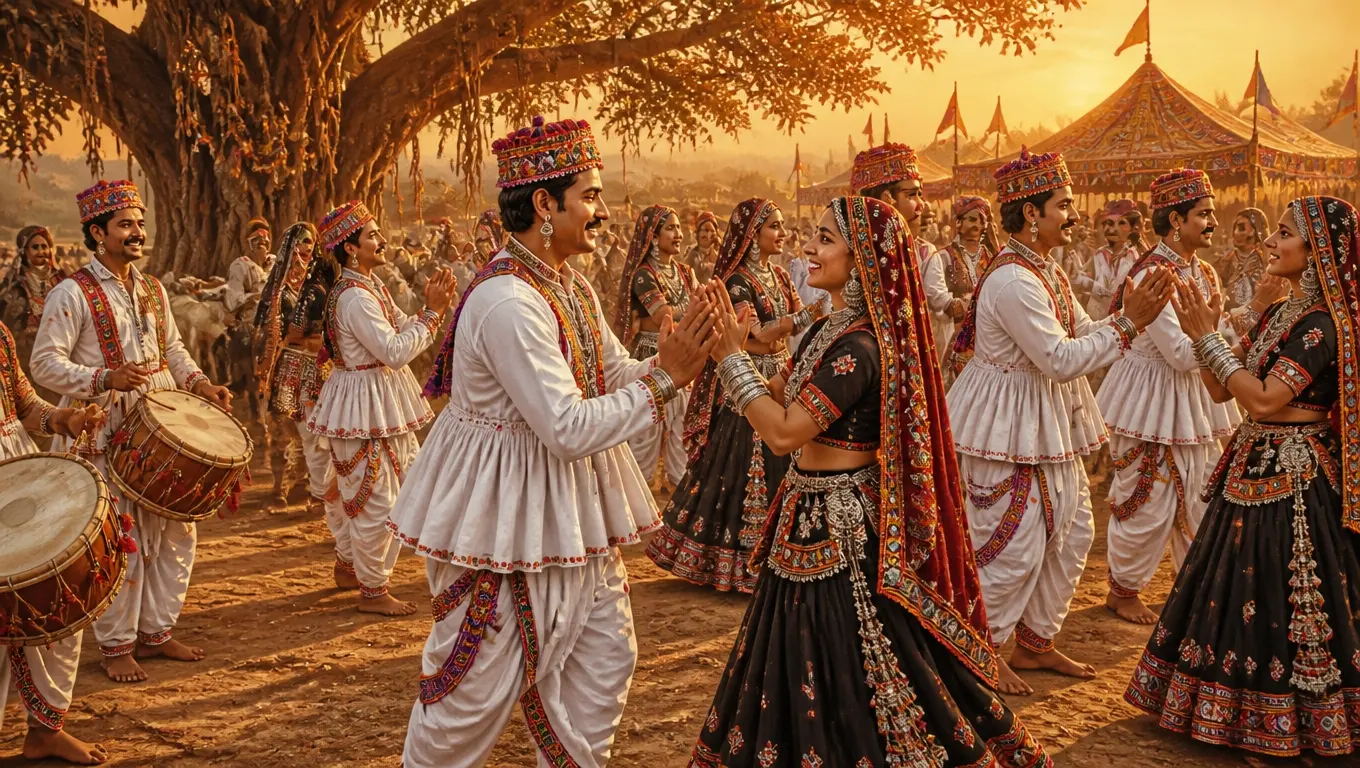
Hudo is the energetic clapping folk dance of the Bharwad shepherd community of Saurashtra — pairs of dancers face each other and answer every beat with forceful, playful claps. This guide explains its history, costumes, music and performance style, and how to arrange a traditional Hudo dance performance for your event.
Hudo at a glance
- RegionGujarat — especially the Saurashtra peninsula
- CommunityBharwad shepherd community; field records also note Rabari and Koli dancers
- Dance typeCompetitive, clapping-based group folk dance
- Signature movePairs facing each other, forceful rhythmic claps, ram-like forward play
- Known occasionsWeddings, village fairs and festivals — most famously the Tarnetar Fair
- DocumentationNo recorded founding date; transmitted orally through generations
What Is Hudo Dance of Gujarat?
Hudo is a traditional folk dance of Gujarat in which the rhythm is made as much by the dancers' hands as by any drum. Dancers — most often in pairs or small facing groups — strike their own palms and each other's palms in strong, synchronised patterns, moving forward and back with a bounce that carries the whole group along. The mood is energetic and competitive in the friendliest sense: each pair tries to out-clap, out-time and out-last the other, while spectators form a ring around the dancers.
The dance belongs to the Bharwad community, Gujarat's traditional shepherd and cattle-herding community, and its imagery comes straight from that pastoral world: the confrontational play of two rams butting heads is the movement dancers imitate. Field documentation from the Tarnetar area records that both men and women take part, with young men often dancing in competitive pairs, and that some village traditions also conclude a Hudo performance with the selection of life partners.
Unlike stage choreography, traditional Hudo is a community activity — the kind of dance that fills a village square during a wedding, a fair or a festival evening. That same group energy is what makes a staged Hudo dance performance so striking for audiences who have never seen it: a wall of rhythm created entirely by people, costumes and clapping hands.
History and Origin of Hudo Dance
Hudo's history has not been documented the way a classical art's history might be. There is no recorded founding date, no first teacher and no scripture that mentions it. What is well established is the form's cultural logic: the dance grew out of the pastoral life of the Bharwad community of Saurashtra, whose everyday work was herding sheep and goats.
Two widely described threads explain the dance's origin. The first is its name: the word hudo is often derived from the Gujarati hod, meaning competition or rivalry — a direct description of the paired, contest-style clapping at the centre of the performance. The second is its imagery: dancers imitate the confrontational stance and repeated forward thrust of two rams fighting for dominance, a behaviour every herding household knows well.
From there, the tradition passed the way folk traditions usually do — from fathers to sons and mothers to daughters, village by village. A documented Hudo artist from Tarnetar village, Ramjibhai Savajibhai Dholakia, described the sentiment simply: Hudo is "not just few steps of dance, it is in their blood", learnt from his father and passed on through generations. Elders and youth groups in the villages around Tarnetar continue to teach and perform it today.
Hudo Dance and the Bharwad Community
The Bharwad are a Hindu community found across Gujarat, traditionally engaged in herding sheep, goats and cattle, with a strong presence in Saurashtra and Kutch. Community tradition traces their ancestry to the cowherd companions of Lord Krishna, and their folk culture — dress, songs, festivals and dance — has grown around that pastoral identity.
Hudo is the community's signature dance. It is performed within the community's own celebrations — weddings, festival gatherings and village fairs — and field documentation from the Tarnetar belt records that Bharwad, Rabari and Koli communities in that area all keep the dance alive. Performing it is a statement of belonging: the costume, the clapping vocabulary and the songs are specific to the community's own repertoire, not borrowed from the better-known Garba tradition.
This is also why the dance matters for heritage. When a Bharwad family teaches its children Hudo, it is passing on pastoral knowledge, local rhythms and community history in a single practice. When troupes perform it on public stages, they carry that heritage to audiences far beyond the village.
Hudo Dance of Saurashtra
Hudo is firmly a folk dance of Saurashtra, the peninsular heart of Gujarat. Field documentation locates its living practice especially in the villages around Tarnetar in the Thangadh area — a belt recorded as part of Surendranagar district in older documents, now within Morbi district — and describes that countryside as the dance's home ground, with most villages in the area counting young dancers who know Hudo well.
Saurashtra's cultural landscape explains why. The region holds some of Gujarat's densest pastoral settlements, its fairs are famous for folk performance, and its communities have kept dance traditions that elsewhere survive mostly on stage. Within that landscape, Hudo sits alongside the region's other folk expressions — from the Tippani dance of the coast to the Raas traditions of the plains — each tied to its own community and occasion.
For event organisers, the practical takeaway is simple: an authentic Hudo performance comes from groups with roots in this belt and its tradition, and it sounds and looks different from the Garba-and-Dandiya programmes most audiences expect. That difference is precisely its appeal.
Hudo Dance at Tarnetar Fair
The Tarnetar Fair — Tarnetar no Melo — is one of Saurashtra's best-known melas, held every year around the Bhadar month of the Gujarati calendar (August–September) at the Trinetreshwar Mahadev temple near Thangadh. Popular legend connects the site to Draupadi's swayamvar, and the fair is famous for the tradition of young people meeting and, in many community accounts, choosing their life partners.
Hudo is closely associated with this fair: descriptions of Tarnetar regularly name it among the folk dances performed there, and field documentation identifies the Tarnetar belt as one of the dance's living homes. Accounts of the fair describe dancing in which girls and boys clap in answered rhythm, and the documented tradition of some Hudo performances ending with the selection of life partners fits the fair's celebrated swayamvar character.
What the fair demonstrates, though, is Hudo's natural habitat: a big, festive, community setting where group dancing, courtship songs and pastoral pride meet. Cultural fairs across the region provide similar stages, which is why folk performance troupes from this belt are experienced with festival audiences.
Hudo Dance Costumes and Traditional Appearance
The documented Bharwad costume for Hudo is distinctive and, for most audiences, instantly new. Men wear colourful dhotis with embroidered borders, a short jacket called the koti, and a traditional cap finished with a colourful frill. Silver ornaments complete the look — documented pieces include the kadu (armlets), tavij (amulet pendants) and kadi, along with bright garlands or malas.
Women wear dark-coloured jimy (the gathered skirt-and-blouse ensemble of the community), a kapdu (fitted bodice) and an odhani drawn over the head. Their silver jewellery is a highlight: long and short necklaces, earrings, chudla bangles, kadu and damani. The overall impression on stage is a rich, dark-and-silver palette set against the men's white and colourful dhotis — very different from the mirror-work brightness of Garba costume.
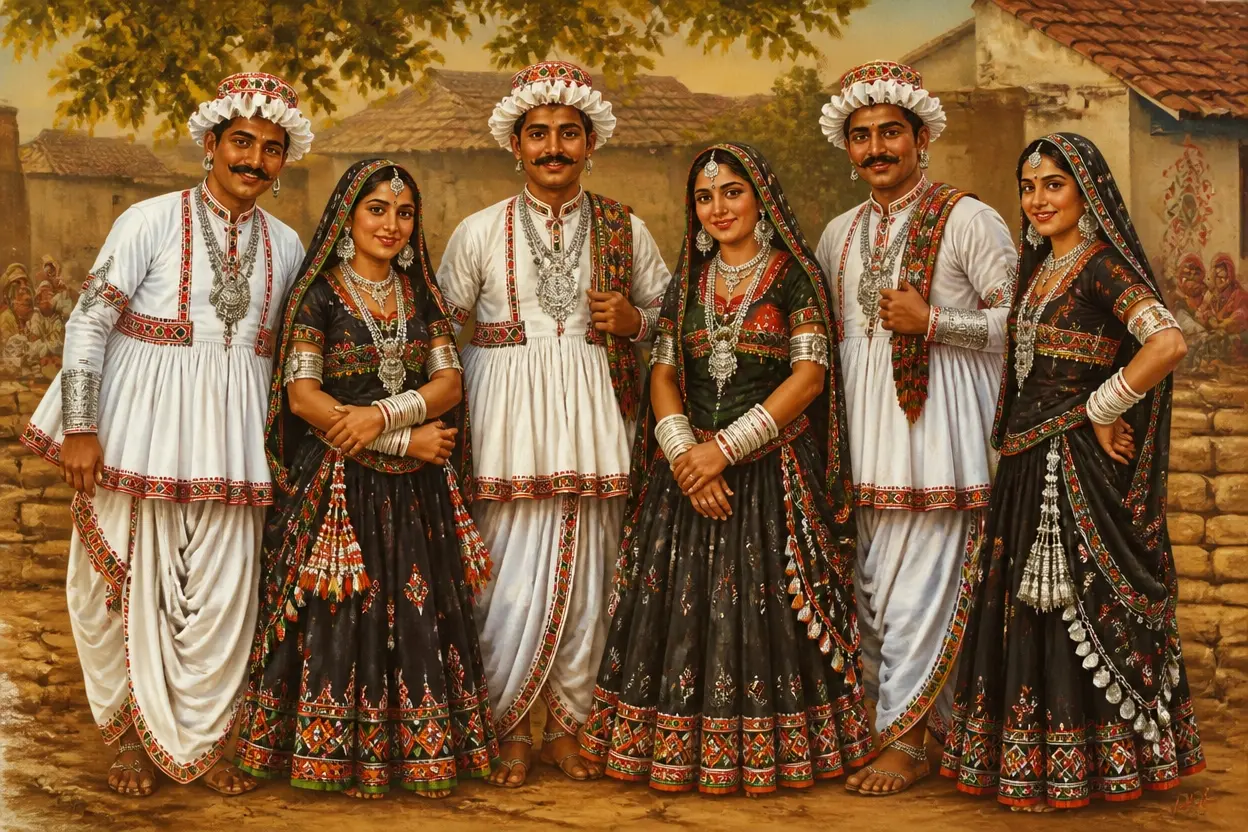
Exact outfits vary by village, family and budget, and stage troupes often adapt fabrics and colours for lighting and quick changes. If costume fidelity matters for your event, ask the group to share photographs of the actual performance dress they will bring — a reasonable and normal request.
Hudo Dance Music and Instruments
Hudo has its own songs and rhythms, distinct from the Garba repertoire. The documented accompaniment for the dance includes the dhol and dholak for percussion, harmonium and flute for melody, and the metallic shimmer of manjira — with kansi and joda also recorded among the traditional instruments of the form.
But the instrument that defines Hudo is the dancers' own hands. The clapping is not accompaniment; it is the dance — forceful, precise exchanges that answer the dhol beat and push the tempo forward. Watch a good group and you will hear the pattern before you see it: a crack of palms, an answering clap from the partner, and the whole line riding one shared rhythm.
For event planning, confirm the music arrangement with the group you book. Some troupes tour with their own dhol player and singer; others perform to a recorded track with a live clapping core. Both work — but the sound system and cueing plan should match whichever arrangement you choose.
Hudo Dance Steps and Performance Style
There is no single official syllabus of Hudo steps — like all living folk forms, it varies by village and troupe. But the performance logic described in field documentation is consistent, and it breaks down like this:
- Take your stance. Dancers form facing pairs or facing lines, close enough to clap each other's palms, with a crowd — or a ring of spectators — around them.
- Lock onto the dhol. The group settles onto the drum's beat before any movement, listening for the phrase the claps will answer.
- Build the clap pattern. Dancers strike their own palms, then their partner's, in repeating rhythmic patterns that grow longer and faster as the set progresses.
- Play the ram. Between clap exchanges, dancers mirror the confrontational play of fighting rams — a forward lean and thrust, a bounce back, then another approach.
- Compete. Pairs try to outlast each other in speed, volume and precision. The "contest" is friendly, but it is real — and it is what the name Hudo (from hod, competition) describes.
- Ride to the finish. The tempo climbs, the claps thicken, and the set ends on a shared climax — traditionally, in some village accounts, with the selection of life partners after the dance.
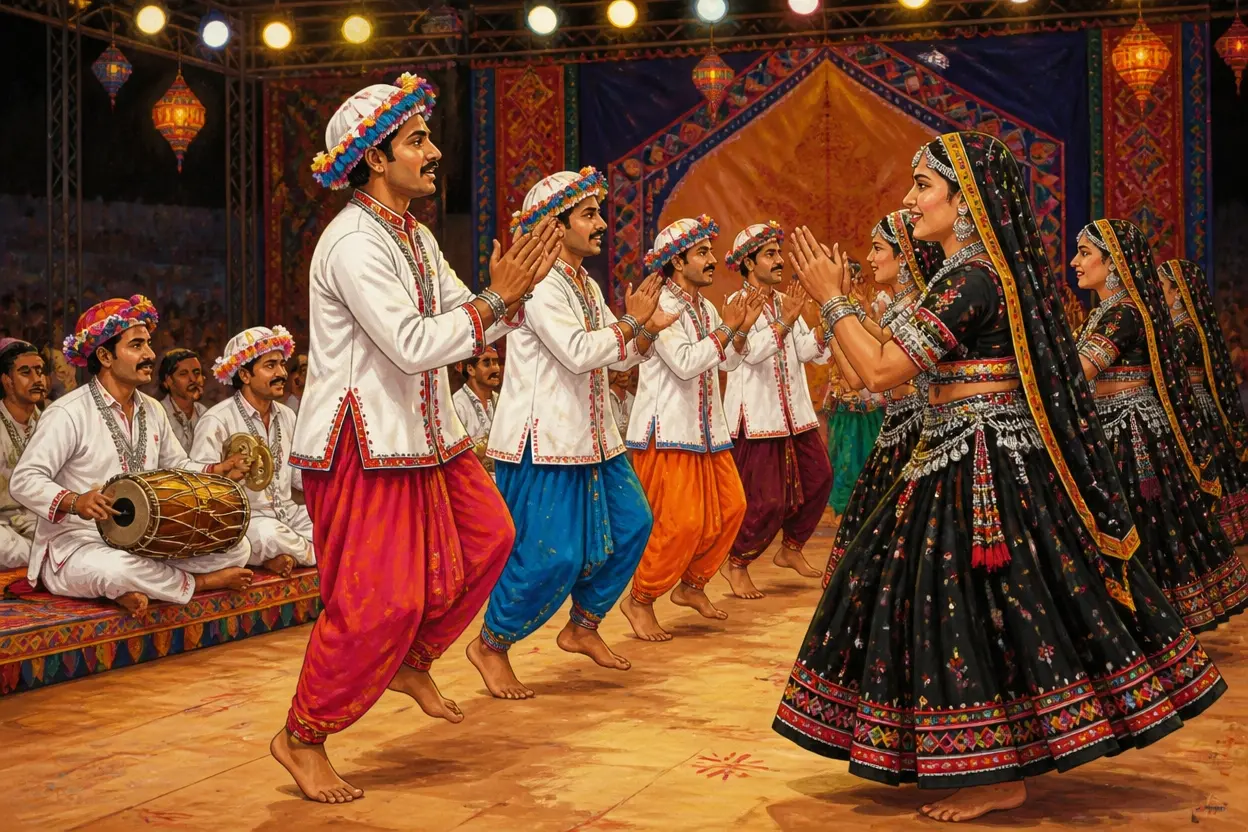
What an audience experiences is closer to a rhythm battle than a choreographed routine: raw percussion made by people, quick changes of pace and a contagious competitive energy. On stage, troupes adapt this logic into formations and fixed durations; in its village setting, a Hudo set simply continues for as long as the dancers — and the crowd — want it to.
Cultural Significance of Hudo Dance
Community identity
Hudo is the Bharwad community's own dance — a visible, audible marker of who the performers are and where they come from.
Pastoral heritage
Its movements preserve a picture of shepherd life — the ram's contest, the herding rhythm — inside a celebration.
Social bonding
Performed at weddings, fairs and festivals, and remembered for courtship traditions, Hudo has long helped community bonds form and renew.
Living transmission
Passed from parents to children and taught by village youth groups, the dance survives because each generation chooses to learn it.
In Gujarat's folk map — where traditional Garba dance performances have become globally famous — Hudo represents something rarer: a community-specific form still anchored in the villages that created it. Supporting performances like Hudo, and the artists who keep them, is how Gujarat's smaller folk traditions stay alive beyond their home ground.
Hudo Dance Performance for Festivals and Cultural Events
A Hudo dance performance for festivals and cultural programmes works wherever a group of performers and a clear floor can come together. Organisers most often consider it for:
Cultural festivals
Folk dance showcases and state festivals presenting Gujarat's village traditions.
Gujarati celebrations
Community gatherings and festive evenings that want a folk form beyond the usual Garba set.
Traditional fairs
Melas and heritage fairs where group folk performance is the main attraction.
College & school programmes
Youth festivals and annual days — the clapping format is instantly engaging for student audiences.
Corporate cultural events
Employee celebrations and diversity programmes looking for an authentic regional act.
Heritage & institutional events
Government cultural programmes, museum evenings and heritage celebrations documenting folk arts.
These are suitable contexts, not guarantees of tradition — Hudo is not a ritual requirement of any of them. It is a folk performance that adapts well to a stage, and groups from the Tarnetar belt are used to presenting it outside the village square. For programmes built around Gujarat's coastal and pastoral arts, you can also learn about Tippani dance, another Saurashtra speciality that pairs naturally with Hudo in a folk-arts lineup.
Book Hudo Dance Artists for Cultural Events
BookMyDance helps event organisers find and book traditional Hudo dance performers from Gujarat for festivals, cultural programmes and celebrations across India. Share a few details about your event and we will check availability with suitable Hudo dance groups, confirm their performance format and revert with a specific proposal — availability and pricing are always confirmed per event.
To quote and confirm quickly, it helps to have your event date and city, the number of performers you envision, the performance duration, your stage and venue arrangements, music and sound plans, and any costume or presentation preferences. You can send these on WhatsApp or through the contact page — whichever is easier.
Contact BookMyDance with your event details, or explore the Gujarat folk dance category if you are still choosing between art forms.
What to tell us
- Event date and city
- Number of performers
- Performance duration
- Stage, floor space and venue access
- Music: live dhol or recorded track
- Costume and presentation preferences
- Travel and stay, if outstation
We do not publish fixed artist rosters, photographs of specific troupes, ratings or standard prices for Hudo bookings — group line-ups change and every event is quoted individually. Once you share your requirements, we connect you with available performers and share their genuine performance videos and details.
Why Choose a Traditional Hudo Dance Performance?
- Cultural representation. A Bharwad folk dance presented by performers rooted in the tradition, not a generic "Gujarati folk" medley.
- Instant audience connection. Clapping is participation by instinct — audiences follow the rhythm within seconds, even when hearing Hudo for the first time.
- Group visual appeal. Facing lines, matched costume and synchronised palm-strikes read beautifully on stage and in photographs.
- Heritage value. Programming Hudo supports a community tradition and introduces audiences to a side of Gujarat's folk culture that rarely reaches city stages.
- A change from the expected. For events that already feature Garba or traditional Dandiya dance, Hudo adds a fresh, distinctive act.
For organisers comparing Gujarat's folk forms, the related Gop Raas dance performances and the Padhar folk dance of Gujarat offer other community-rooted options — each page describes its own tradition honestly.
Frequently Asked Questions About Hudo Dance of Gujarat
What is Hudo dance of Gujarat?
Hudo is an energetic clapping folk dance of Gujarat, performed by dancers in facing pairs or lines who strike their own palms and each other's palms in strong rhythmic patterns. It belongs to the Bharwad shepherd community of Saurashtra and is traditionally performed at weddings, village fairs and festivals.
Which community is associated with Hudo dance?
Hudo is the folk dance of the Bharwad community, Gujarat's traditional shepherd and cattle-herding people. Field documentation from the Tarnetar area also records Rabari and Koli communities performing the dance in the same belt.
What is the history and origin of Hudo dance?
Hudo has no documented founding date — it is an oral tradition passed down through generations of Bharwad families. Its movement imagery comes from pastoral life: dancers imitate the confrontational play of two rams butting heads, and the name is often derived from the Gujarati word hod, meaning competition.
Why is Hudo dance associated with the Bharwad community?
The dance grew directly out of Bharwad pastoral life. Their work herding sheep and goats supplied both the dance's imagery — the rams' contest — and its occasions: community weddings, fairs and festivals. Because the repertoire, costume and clapping vocabulary are specific to the community, Hudo functions as a cultural signature of the Bharwad people.
Where is Hudo dance traditionally performed?
In village settings across the Saurashtra region, with documented living practice in the villages around Tarnetar in the Thangadh belt. Performances traditionally take place at weddings, fairs and religious festivals such as Ashadhi Beej and Holi, and community accounts record that some Hudo gatherings ended with the selection of life partners.
Is Hudo dance associated with the Saurashtra region?
Yes. Hudo is firmly identified with Saurashtra, the peninsular heart of Gujarat, where the Bharwad community's settlements are concentrated. References to the dance in wider Gujarati folk culture almost always point to this region.
What costumes are worn during Hudo dance?
Documented Bharwad dress for Hudo includes colourful bordered dhotis, the short koti jacket, frilled traditional caps and silver ornaments for men; and dark-coloured jimy with kapdu, odhani and heavy silver jewellery — necklaces, chudla bangles, kadu and damani — for women. Village and stage troupes vary in detail, so confirm the exact performance dress with any group you book.
Which musical instruments are used in Hudo dance?
Field documentation lists dhol, dholak, harmonium, flute, manjira, kansi and joda among the traditional accompaniments. The defining sound, however, is the dancers' own clapping, which answers the dhol's beat and drives the rhythm forward.
Can I book Hudo dance artists for a cultural event?
Yes. BookMyDance connects organisers with available Hudo dance groups for festivals, cultural programmes and community events across India. Share your event date, city, group size, duration and stage and sound arrangements — through our contact page or WhatsApp — and we will confirm availability and a specific proposal.
Is Hudo dance suitable for traditional festivals and cultural programmes?
Yes — its group format, strong rhythm and short adaptable sets suit cultural festivals, Gujarati celebrations, fairs, college and school functions, corporate cultural days and heritage programmes. The dance is a folk performance, not a ritual of any of these occasions, so it is presented as a featured act within your programme.
Hudo Dance of Gujarat — a traditional clapping folk dance of the Bharwad community of Saurashtra, kept alive through generations and now available for cultural events through BookMyDance. This page describes an oral folk tradition; where documentation is limited, we have said so rather than invented detail.