Gop Raas Dance – Traditional Folk Dance of Gujarat
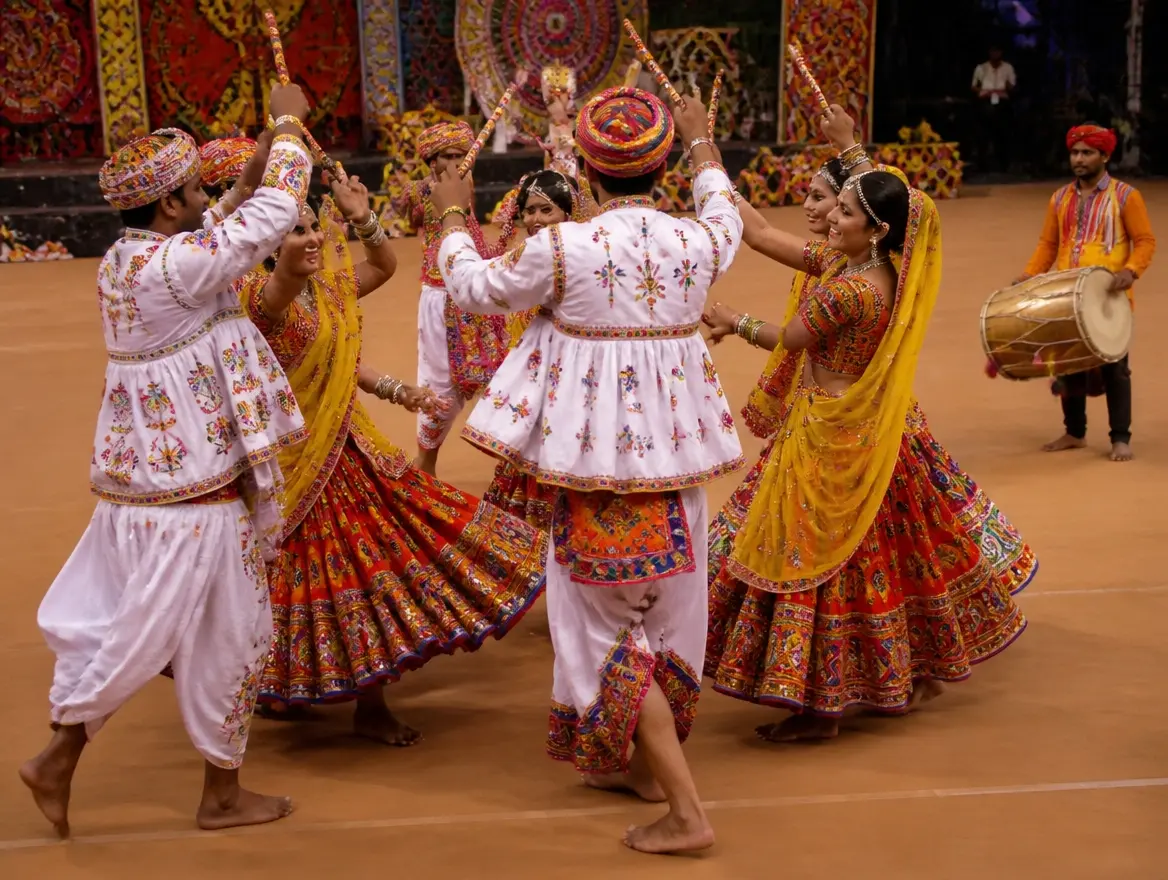
Gop Raas Dance is a vibrant group folk dance of Gujarat, rooted in the Raas traditions of Saurashtra and performed with dandiya sticks by men and women together. On this page you can explore its history, costumes, music and cultural significance — and book authentic Gop Raas dance artists for your next event in Delhi or anywhere in India.
What Is Gop Raas Dance?
Gop Raas Dance is a traditional Raas performance from Gujarat in which dancers — traditionally holding a pair of wooden dandiya sticks — move through coordinated formations while singing and keeping time with the music. The word Raas refers to group dancing, and the form belongs to the wider family of Raas traditions that have flourished for centuries in the Saurashtra region of Gujarat.
What sets Gop Raas apart within that family is its mixed character: unlike community-specific Raas styles that were traditionally performed only by men, Gop Raas — also known as Mishra Raas — is meant to be performed by both men and women dancing together. Cultural researchers note that in practice, many troupes in rural Saurashtra kept it an all-male tradition, while urban and stage presentations embraced the mixed format.
A typical Raas mandali (troupe) combines dancers with singers and musicians. The performance builds from a slow, measured opening to a fast, energetic climax, with dancers weaving intricate circular and criss-cross patterns as the rhythm accelerates. If you would like to compare it with other traditions, you can explore the wider dance culture of Gujarat on its dedicated page.
- State
- Gujarat, with its strongest roots in the Saurashtra (Kathiawad) region
- Performed by
- Men and women together (the defining "Mishra" or mixed character)
- Key prop
- Dandiya — a pair of wooden sticks used to mark the rhythm
- Typical occasions
- Navratri, Janmashtami fairs, weddings and cultural programmes
History and Origin of Gop Raas Dance
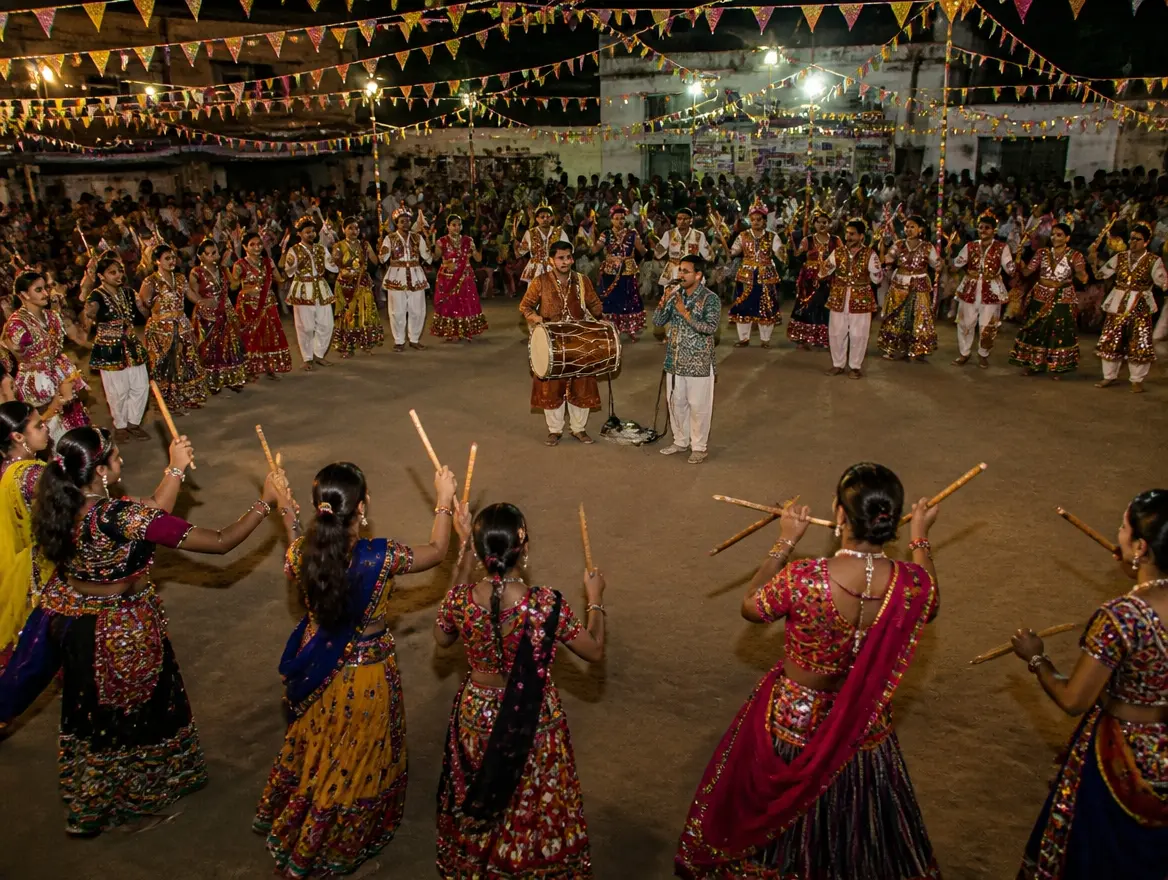
The origin of Gop Raas dance is best understood through the older Raas traditions it grew out of. Scholars of Gujarat's performing arts trace Raas back to the Hallisaka group dance described in the Harivamsha Purana, which even mentions stick-dancing styles such as Dand Raaska. Over the centuries, Raas became the characteristic group dance of the farming and pastoral communities of Saurashtra, performed during Navratri, Janmashtami fairs and weddings. As a folk form, it is also closely tied to the agricultural calendar — a dance of sowing, harvest and celebration.
Gop Raas itself is remarkably young by folk-dance standards. According to cultural documentation of Gujarat's Raas traditions, the form known as Mishra Raas or Gop Raas emerged around 1961, when the newly formed Government of Gujarat wanted to showcase Gujarati culture at Republic Day celebrations in Delhi. A troupe of boys and girls was assembled through Bhavnagar University, and the well-received performance popularised the mixed format, especially among urban youth. Stage performance then encouraged rural troupes to adopt mixed ensembles as well, so that both men and women could perform together for longer programmes.
This history makes Gop Raas, in the words of researchers, possibly the youngest traditional dance form of Gujarat — a reminder that "traditions" can be deliberately created and nurtured into durable cultural identity. We present this account as cultural documentation; like most folk forms, its deeper roots are preserved in legend and oral tradition rather than written records.
Cultural Connection Between Gop Raas Dance and Lord Krishna
Nearly every Raas tradition of Gujarat carries the cultural memory of Lord Krishna. The Puranas describe the Raas Leela — the joyful circle dance of Krishna with the gopis of Vrindavan — and the very name Gop Raas evokes the gops and gopis, the cowherd companions of Krishna. Devotional songs praising Krishna remain a core part of the Raas repertoire in Saurashtra, and Janmashtami fairs have long been among the traditional occasions for Raas performances.
It is important to read this connection in the right spirit: the Krishna stories are legend and devotional tradition, not documented history. What is historically verifiable is the cultural practice — generations of Raas dancers in Gujarat have treated their dance as a celebration woven into Krishna-related festivities, and the songs sung during Raas often follow a respectful protocol in his praise. Gop Raas inherits this devotional atmosphere while remaining, at heart, a folk celebration of community, rhythm and togetherness.
Gop Raas Dance – A Cultural Tradition of Saurashtra
Saurashtra — the peninsula that forms much of western Gujarat — is the heartland of Raas. Cultural researchers describe Raas as a dance tradition once common to communities across Saurashtra, which spread to the rest of Gujarat after Saurashtra merged with the newly formed state in 1960. Each community developed its own recognisable style: agrarian communities, warrior communities, seafaring and pastoral groups all danced "Raas", but with distinct footwork, costumes, songs and instruments shaped by their occupations and their land.
Within this landscape, Gop Raas holds a special place. Because it was not bound to any single caste or occupational community, it became a shared cultural presentation — a Raas that could represent the whole region on state and national stages. Saurashtra's organised Raas mandalis are noted for continuing the traditional choreography and regional costumes even as the form travelled to auditoriums and city festivals. When you watch a well-presented Gop Raas dance performance today, you are seeing that Saurashtra heritage carried onto the modern stage.
Understanding Mishra Raas Dance of Gujarat
Mishra Raas and Gop Raas are two names for the same mixed-format tradition. "Mishra" means mixed, and the name refers to the form's defining feature: men and women performing together, rather than the all-male or all-female divisions seen in many other Raas styles. Reliable cultural documentation of Gujarat's Raas traditions lists "Mishra or Gop Raas" as a single category in its classification of the state's Raas forms, so the two names can be used interchangeably.
What distinguishes Mishra Raas in practice is its flexibility. Because it is not the preserve of one community, its costumes, music and choreography vary from troupe to troupe, and its structure — typically opening with a doha (couplet), moving through the raas geet (song) and closing with a swift chhand — allows more freedom of presentation than the stricter community styles. This adaptability is precisely why the format spread so quickly after its early stage successes, and why Mishra Raas troupes today range from village mandalis to polished urban ensembles.
Visitors sometimes confuse Gop Raas with the stick dances they have seen at Navratri celebrations. The difference is one of depth and structure: recreational Navratri dancing is free-form, while a traditional Gop Raas cultural performance follows the composed choreography, song sequence and rhythmic patterns that Saurashtra's mandalis have preserved. To see how it sits alongside Gujarat's other famous forms, you can read about the Garba and Dandiya Raas performance tradition — a related but distinct style with its own page.
Traditional Gop Raas Dance Costumes
Gop Raas costume follows the classic Raas dress of Saurashtra, with room for individual and regional choice because the form is not tied to one community's strict tradition.
Men's attire
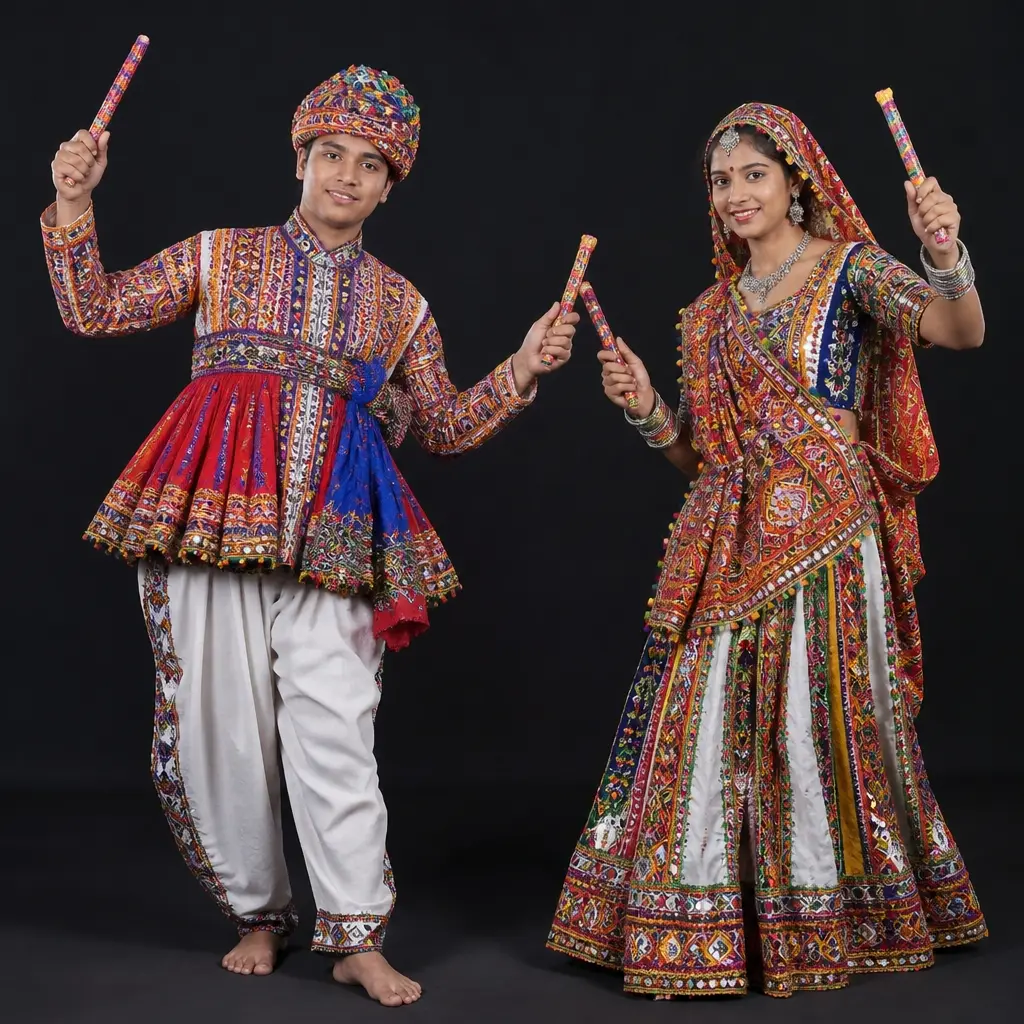
Male dancers traditionally wear the kediyu — a frilled, frock-like tunic covering the torso, often decorated with embroidery and mirror work — over the choyani, trousers that stay loose to the knee and fit close from the calf so the legs move freely. A paghadi (turban) or embroidered cap covers the head, and a bhet, a length of cloth tied at the waist that flows to the knees, completes the outfit.
Women's attire
Women dancers wear the chaniyo (full flared skirt) with a kapadu or blouse and an odhani or jimy drape. Bright colours, mirror work, silver jewellery and ghungroo-style embellishments make the swirling formations visually striking — an important part of the dance's stage appeal.
Because Mishra Raas troupes choose costumes "depending upon their choice", you will see regional and modern variations: some groups favour heavily embroidered festive sets, others simpler village attire. What stays constant is the silhouette that lets dancers spin, kneel and strike their dandiya without restriction.
Gop Raas Dance Music and Traditional Instruments
Music is the engine of every Raas performance — it does not merely accompany the dance, it dictates it. A Gop Raas cultural performance typically opens with a recited doha, followed by a chhand sung at double speed (chalati) as the dancers enter striking their sticks. The main raas geet follows, and the piece builds through slow and fast cycles until a rapid chhand brings the climax.
The instruments documented for Mishra Raas and the wider Raas tradition of Saurashtra include:
Dhol
The barrel drum that carries the main rhythm — every formation change lands on its beats.
Harmonium
Supports the lead singer's melody through the raas geet.
Zanz (cymbals) & Naragha/Tabla
Metallic accents and percussion that sharpen the dancers' stick-strikes.
Pav / Flute
The woodwind voice of Saurashtra's folk melody, echoing Krishna's iconic flute.
Violin & Ravan-hattha
Occasional additions — many Mishra Raas troupes expand their orchestra freely.
Singing is full-throated and communal: a lead singer carries the raas geet while dancers answer in chorus, keeping breath, stick and step locked to the same cycle. The dance famously begins slowly and accelerates — dancers weave ever more complex patterns as the tempo climbs, so the musicians and dancers must breathe together. That live, escalating coordination is exactly what a stage performance of Gop Raas brings to an event.
Traditional Gop Raas Dance Steps and Movements
Gop Raas is a group choreography rather than a sequence of named solo steps. Cultural studies of Saurashtra's Raas describe the shared movement vocabulary that Gop Raas troupes draw on:
- Circle formations — dancers move in a circle, striking their own sticks and their neighbours' in repeating rhythmic cycles.
- Paired stick patterns — the classic Raas exchange: own sticks, right partner, left partner, turn — the skeleton from which variations grow.
- Zig-zag and criss-cross weaves — lines of dancers thread through each other as the tempo doubles.
- Speed layers — sections danced at normal, one-and-a-half and double speed, giving the performance its rising arc from slow open to fast finale.
- Leaps and knee-bends — controlled hops and low postures that echo the energetic footwork of Saurashtra's village styles.
- Unison exits — the finale, where the mandali drives to a climax and exits in coordinated, swift movement.
Researchers emphasise that Raas allows "a great deal of freedom in the way movements are organised": each mandali builds its own choreography from this shared grammar. That is why two authentic Gop Raas dance groups can present noticeably different shows while both remain faithful to the tradition. Good synchronisation — every stick striking on the same beat — is the hallmark of a well-rehearsed troupe.
Cultural Significance of Gop Raas Dance
Gop Raas matters to Gujarat's cultural life in two ways. First, it is a living archive of Saurashtra's Raas heritage — its songs, stick grammar and costume traditions carry the occupational and devotional memory of the region's communities. Second, it is a story of cultural renewal: a form consciously shaped in the early years of Gujarat statehood, nurtured through university troupes and government cultural programmes, and adopted by ordinary dancers until it became tradition. Few folk dances let you watch that process so clearly.
Today the dance lives in village mandalis, Navratri arenas, school and college cultural programmes and state showcases. Organised Raas groups of Saurashtra are credited with keeping the traditional choreography alive even as Navratri celebrations popularised freestyle Raas-Garba dancing for entertainment. Supporting a traditional Gop Raas performance — at a festival, a heritage event or a cultural evening — therefore does more than entertain: it helps sustain a regional art and the artist communities who preserve it.
Book Gop Raas Dance Performance for Events
A Gop Raas stage performance is a natural centrepiece for events that want authentic Gujarati culture — visually rich costumes, live folk music and group choreography that builds to a fast, joyous climax. BookMyDance arranges traditional Gop Raas dance performers for events across formats and venues:
- Corporate events and cultural showcases
- Cultural festivals and state tourism programmes
- School and college annual functions
- Traditional celebrations and Navratri programmes
- Government and institutional cultural events
- Wedding functions and sangeet evenings
- Stage shows and ticketed cultural productions
- Tourism and heritage events
Every event is different, so performance arrangements — group size, duration, musicians, costume scale and stage requirements — are planned around artist availability, your event's requirements and your location. Share your date, city and programme outline, and the team will confirm what format works best. You can also explore dance performers available in Delhi for city-based events.
Arrange a Gop Raas Dance Performance
Tell us about your event — our coordinators will plan the right Gop Raas format for your stage.
Hire Traditional Gop Raas Dance Performers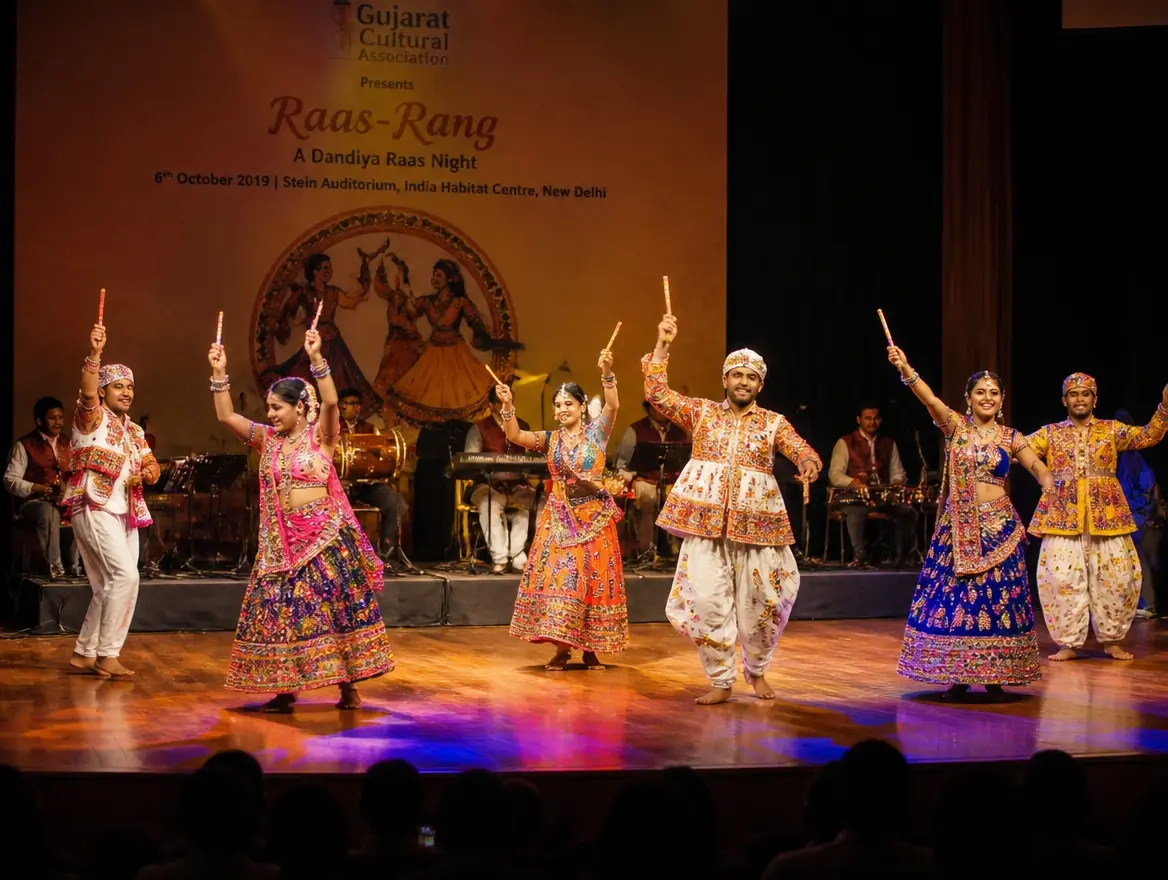
Hire Professional Gop Raas Dance Artists
BookMyDance works with traditional folk performers to present Gop Raas the way it deserves to be seen — as a complete cultural performance, not just a dance routine. Depending on your event, arrangements can include:
- Individual Gop Raas dance artists for intimate programmes
- Traditional Gop Raas dance groups with full mandali choreography
- Performers in authentic Saurashtra costumes and dandiya props
- Live musicians — dhol, harmonium, zanz, flute and vocals
- Stage presentation adapted to your venue and timing
- Customised duration, from a short cultural slot to a full showcase
Group presentations can be tailored for Delhi and NCR events as well as venues across India — subject to artist availability, travel feasibility and your event requirements. There are no fixed "packages" to force-fit: the troupe format, group size and programme length are chosen with you during planning.
Book Gop Raas Dance ArtistsWhy Choose BookMyDance for Traditional Dance Performances?
Booking a folk art form like Gop Raas takes more than finding dancers — it takes respect for the tradition and reliable event coordination. Here is what BookMyDance focuses on:
Artist Coordination
Direct liaison with folk troupes — availability, schedules, travel and stage logistics handled for you.
Performance Planning
Programme structure, duration, music and entry/exit choreography planned around your event flow.
Authentic Cultural Presentation
Traditional costumes, live folk instrumentation and choreography faithful to the Saurashtra Raas grammar.
Event-Specific Arrangements
Corporate galas, weddings, festivals and school functions each get a format suited to their audience and stage.
Flexible Event Formats
From a compact Delhi stage show to a large festival production — group size and scale adapt to your venue.
Frequently Asked Questions About Gop Raas Dance
What is Gop Raas Dance?
Gop Raas Dance is a traditional group folk dance of Gujarat, from the Raas family of the Saurashtra region, performed with dandiya sticks and live folk music. It is a mixed tradition — meant for men and women dancing together — and is also known as Mishra Raas.
What is the origin of Gop Raas Dance?
Gop Raas grew out of the centuries-old Raas traditions of Saurashtra. As a distinct mixed format, cultural documentation places its emergence around 1961, when a student troupe from Bhavnagar University performed it at Republic Day celebrations in Delhi under the newly formed Government of Gujarat's cultural promotion. Its deeper roots, like all Raas forms, are preserved in legend and oral tradition rather than written history.
Is Gop Raas a traditional folk dance of Gujarat?
Yes. Raas is one of Gujarat's principal folk dance traditions, and Gop Raas (Mishra Raas) is recognised as part of that heritage — researchers even describe it as possibly the youngest traditional dance form of Gujarat, having matured into a cultural identity within roughly two generations.
What is the connection between Gop Raas Dance and Lord Krishna?
The connection is cultural and devotional. The Puranas describe Krishna's Raas Leela with the gopis, and the name "Gop" Raas evokes Krishna's cowherd companions. Raas songs in praise of Krishna are part of the traditional repertoire, and Janmashtami fairs are classic performance occasions. These are legends and devotional traditions rather than recorded history.
What is the difference between Gop Raas and Mishra Raas?
They are the same form under two names. "Mishra" means mixed, referring to men and women performing together — the defining trait that separates it from community-specific, single-gender Raas styles of Saurashtra. Reliable cultural studies list "Mishra or Gop Raas" as one tradition.
What costumes are traditionally worn during Gop Raas Dance?
Men traditionally wear the embroidered kediyu tunic, choyani trousers, a paghadi turban or embroidered cap, and a bhet waist cloth. Women wear a chaniyo (flared skirt) with a kapadu or blouse and an odhani or jimy drape. Because the form is not bound to one community, costume colours and embroidery vary by troupe and region.
Which musical instruments are used in Gop Raas Dance?
Documented instruments for Mishra Raas include the dhol, zanz (cymbals), pav or flute, and harmonium, with some troupes adding violin and ravan-hattha. A lead singer performs the raas geet with the dancers joining in chorus.
What are the main movements of Gop Raas Dance?
The performance is group choreography: circular formations with rhythmic stick-striking, zig-zag and criss-cross weaving, layered speed sections from slow to double-fast, controlled leaps and knee-bends, and a coordinated fast finale. Each mandali builds its own choreography from this shared vocabulary.
Can I book a Gop Raas dance group for a cultural event?
Yes. BookMyDance arranges Gop Raas artists and groups for cultural festivals, corporate events, weddings, school functions and government programmes. Group size, duration and music are planned around your event requirements and artist availability.
Are Gop Raas dance performers available for events in Delhi?
Yes — Delhi is a key booking location for BookMyDance. Performances in Delhi and NCR are arranged subject to artist availability, travel feasibility and your event details; you can also explore dance performers in Delhi across other styles.
Ready to Bring Gop Raas to Your Stage?
Share your event date, city and programme — our coordinators will help you hire traditional Gop Raas dance performers who present this Saurashtra heritage beautifully.
Book Gop Raas Dance Artists Explore Traditional Dance Forms of Gujarat