Gujarat · Traditional Folk Dance
Garba Dance The Traditional Folk Dance of Gujarat
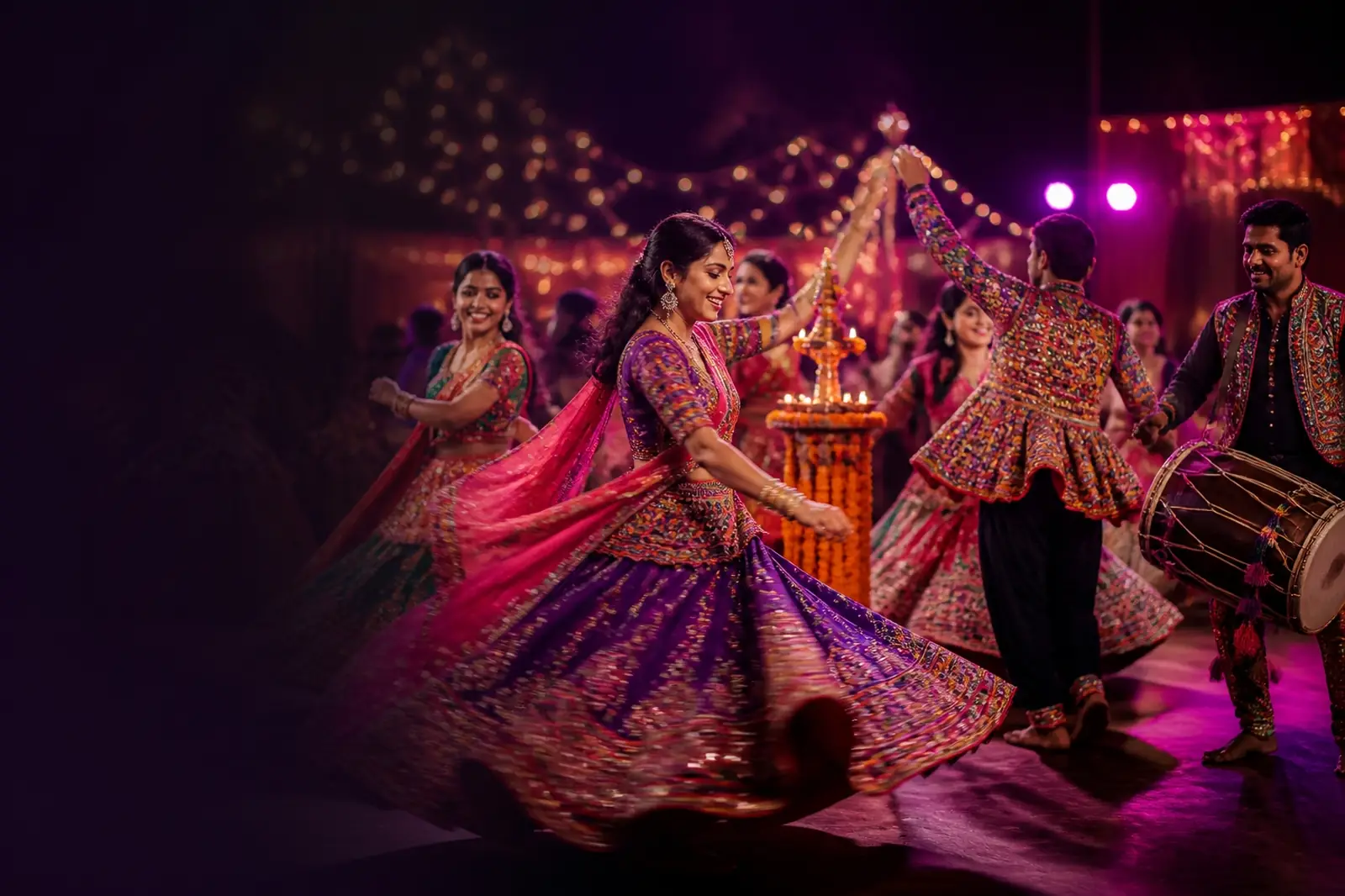
Garba Dance is Gujarat's circular folk dance: dancers move around a decorated garbo lamp to the beat of the dhol, clapping and turning in step with a shared rhythm. This guide explains its history and cultural meaning, its steps, costumes, music and instruments — and how to arrange an authentic Garba dance performance for a festival, wedding or corporate cultural programme.
Independent guide · Booking availability and pricing are confirmed per event.
Garba at a glance
- RegionGujarat, India — strongholds in Saurashtra, Kutch and north Gujarat
- Dance typeCommunity folk dance performed in circles
- Core ideaDevotional celebration of the Mother Goddess
- Traditional attireChaniya choli for women, kediyu and dhoti for men
- Main rhythm makersDhol, dholak, nagara, shehnai, manjira and claps
- Heritage statusUNESCO Representative List of the Intangible Cultural Heritage of Humanity, 2023
The basics
What Is Garba Dance?
Garba is a folk dance of Gujarat in which dancers form a circle and move around a central point — traditionally a garbo, an earthen or clay pot with a lamp inside, often decorated with mirrors and flowers. The dance is performed to live or recorded music, with singers, drummers and clapping dancers all contributing to one shared rhythm.
What separates Garba from a stage choreography is its structure. There is no single star performer and no fixed front row: the circle itself is the formation, and every participant is part of the pattern. Dancers step, tap, turn and clap together, and the circle often changes pace as the singers lift the tempo. Because the form is open, trained troupes and first-time participants can share the same floor.
In its traditional setting, Garba is devotional — a way of honouring the Mother Goddess during religious observances, most visibly in the nine nights of Navratri. Over time it has also become a widely performed folk dance on cultural stages, in colleges, at community gatherings and in wedding celebrations, where the same circular structure is adapted into shorter, choreographed presentations.
That flexibility is why event organisers look for Garba dance performers for events: a group can present a short stage piece, lead an audience-participation segment, or do both in the same evening. The sections below explain the tradition itself before turning to performance and booking.
Roots
History and Origin of Garba Dance
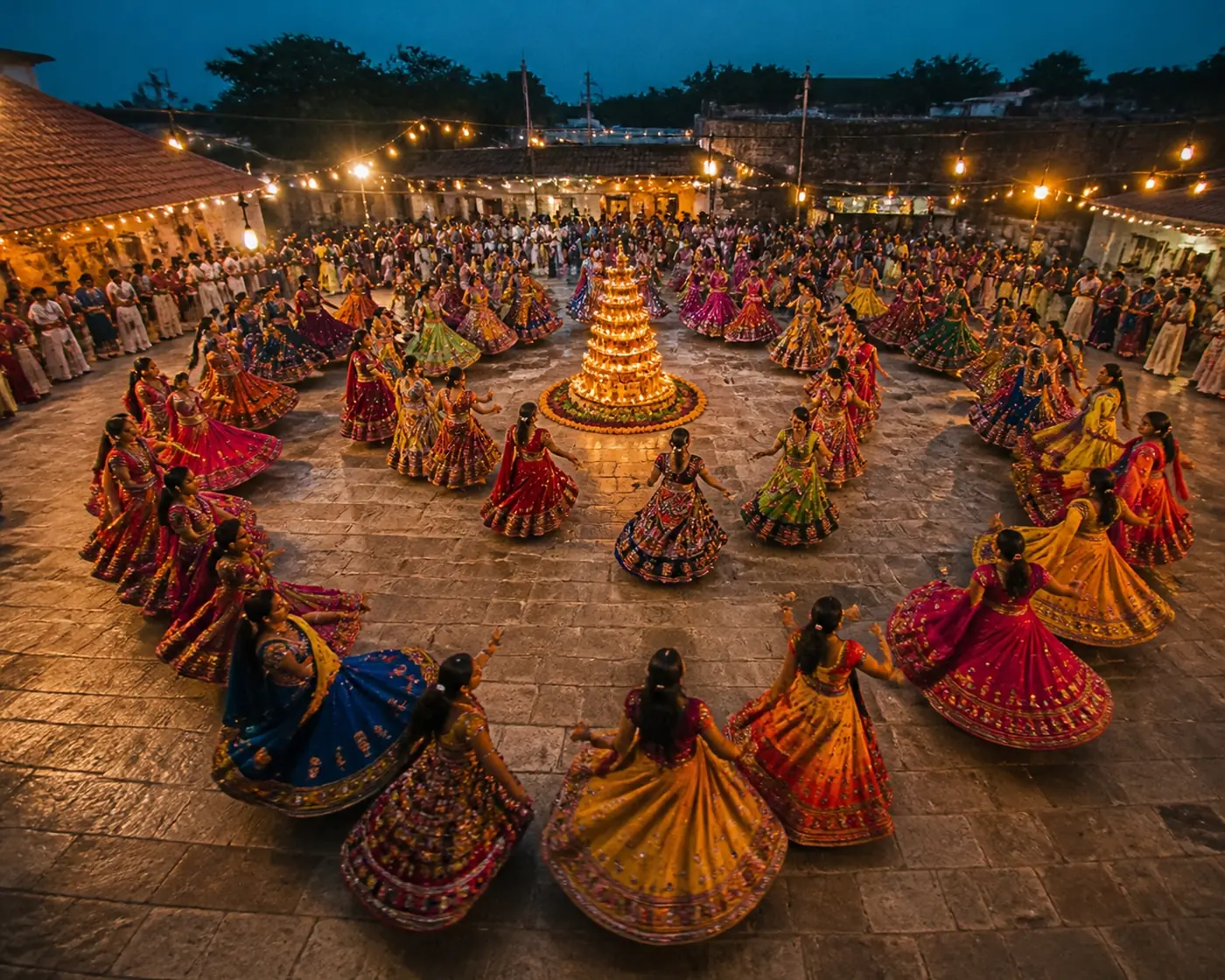
Garba's origins sit inside Gujarat's long tradition of goddess worship rather than in a single documented moment. The name is usually linked to the Sanskrit word garbha — womb — and to the garbo, the lamp-lit pot placed at the centre of the circle, a symbol of life and of the divine feminine.
The dance grew out of devotional practice: women gathering to sing garba geet in praise of the Mother Goddess, moving in a circle around the garbo through the night. Those gatherings were tied to the agricultural and religious calendar of Gujarat, and the nine nights of Navratri became the best-known occasion for them. Temple courtyards, village squares and family homes all hosted versions of the same idea — a circle, a lamp, a shared song and a repeating step.
What is genuinely uncertain is precise dating. Folk traditions evolve through generations of oral transmission, so claims of an exact founding year, a named inventor or a single place of origin should be treated with caution. What is well documented is the pattern: a devotional circle dance of Gujarat that absorbed local musical styles, regional costume traditions and, in the modern era, film and pop influences.
In the twentieth century the dance moved decisively beyond its devotional setting. Garba songs entered Gujarati cinema and commercial recordings; schools, colleges and cultural organisations built competitive and showcase formats; and the dance travelled with the Gujarati diaspora to cities across the world. Today a Garba performance may be a village observance, a stadium-scale Navratri night or a fifteen-minute item on a corporate stage.
In December 2023, UNESCO inscribed Garba of Gujarat on the Representative List of the Intangible Cultural Heritage of Humanity — recognition of the dance as living heritage carried by communities rather than a fixed historical artefact.
Meaning
Cultural Significance of Garba Dance
Garba carries more than entertainment value. It is one of the ways Gujarati communities mark time, express devotion and reaffirm a shared identity — and it does so through participation rather than spectatorship.
Devotion
The circle around the garbo is a form of worship. Songs address the Mother Goddess, and the act of dancing is offered as devotion rather than performance.
Community
Neighbours, relatives and strangers join the same ring. Age and skill level matter far less than taking part, which keeps the tradition socially open.
Season and harvest
Garba has long been tied to Gujarat's festive and agricultural calendar, giving villages a shared rhythm of celebration after the working season.
Identity and continuity
Costume, repertoire and dialect change from region to region, so the dance also records local identity — and passes it to the next generation.
For organisers, this matters practically. A Garba performance reads as authentic when it respects the circular logic of the form — a group moving together, live rhythm, and room for the audience to join — rather than treating it as background music with dancers facing front.
Form
Traditional Garba Dance Style and Formations
Traditional Garba is built on circular movement, a repeating step cycle and a tempo that rises as the singing intensifies. Within that frame, countless local variations exist.
The circle is the choreography
Dancers face inward or slightly towards the garbo and travel around it, so the ring rotates as one body. As more people join, a single ring becomes two or three concentric circles moving in the same direction. Keeping those rings from collapsing is a skill in itself, and experienced groups adjust spacing constantly.
Hands, claps and gestures
Hand movement ranges from gentle, graceful gestures and small circular wrist motions to crisp claps that mark the beat. Clapping patterns are one of the clearest identifiers of a Garba variant — be taali (two claps) and tran taali (three claps) are widely recognised names, though the exact counts, accents and footwork attached to them differ from place to place.
Tempo and variation
A Garba set usually begins at a comfortable pace and accelerates. Faster passages bring quicker footwork, sharper turns and the characteristic flare of the chaniya as the dancer spins. Some regional styles favour a low, grounded step; others emphasise upright posture and travelling turns. Contemporary troupes often blend both and add formations borrowed from stage choreography.
Because regional practice varies, a group's own repertoire is the best guide to its style. It is reasonable to ask a troupe which Garba traditions it performs before booking.
Learn the basics
Traditional Garba Dance Steps
Garba footwork looks complicated in a fast circle and surprisingly simple once broken down. The sequence below describes the general logic of the form in beginner-friendly language; exact steps, counts and names vary by region, by song and by troupe.
- Join the circle and find your space. Stand in the ring facing inward, with enough room to extend an arm. New dancers usually start on the outer ring, where there is more space to move.
- Lock onto the beat. Listen to the dhol and the claps before adding footwork. Garba cycles are counted in small groups of beats, and the whole circle resets on the same accent.
- Start with a step-and-tap. A common beginner pattern is a side step followed by a tap or a light heel touch, repeated on the other side. The feet stay close to the floor and the body stays relaxed.
- Add the clap. Clap on the accent beats — typically two or three claps per cycle in the widely known be taali and tran taali patterns. Claps mark the phrase and keep the ring together.
- Turn on the phrase, not mid-step. Turns and small spins come at the end of a cycle. Leading with the shoulder and keeping the head level makes the chaniya flare cleanly without losing balance.
- Follow the tempo up. As the singers raise the pitch and the dhol quickens, shorten the steps rather than rushing the claps. Most circles lose shape when dancers speed up their arms instead of their feet.
- Keep the ring breathing. Adjust spacing for the dancers beside you. Garba is a group form: a circle that stays even looks better than one dancer improvising at speed.
Two clarifications worth stating plainly: Garba's defining technique is circular movement with claps and footwork, not stick work. Sticks belong to Dandiya Raas, a related but separate tradition (see the comparison below). And there is no single official syllabus of Garba steps — teaching differs between regions, dance academies and families.
Attire
Garba Dance Costume
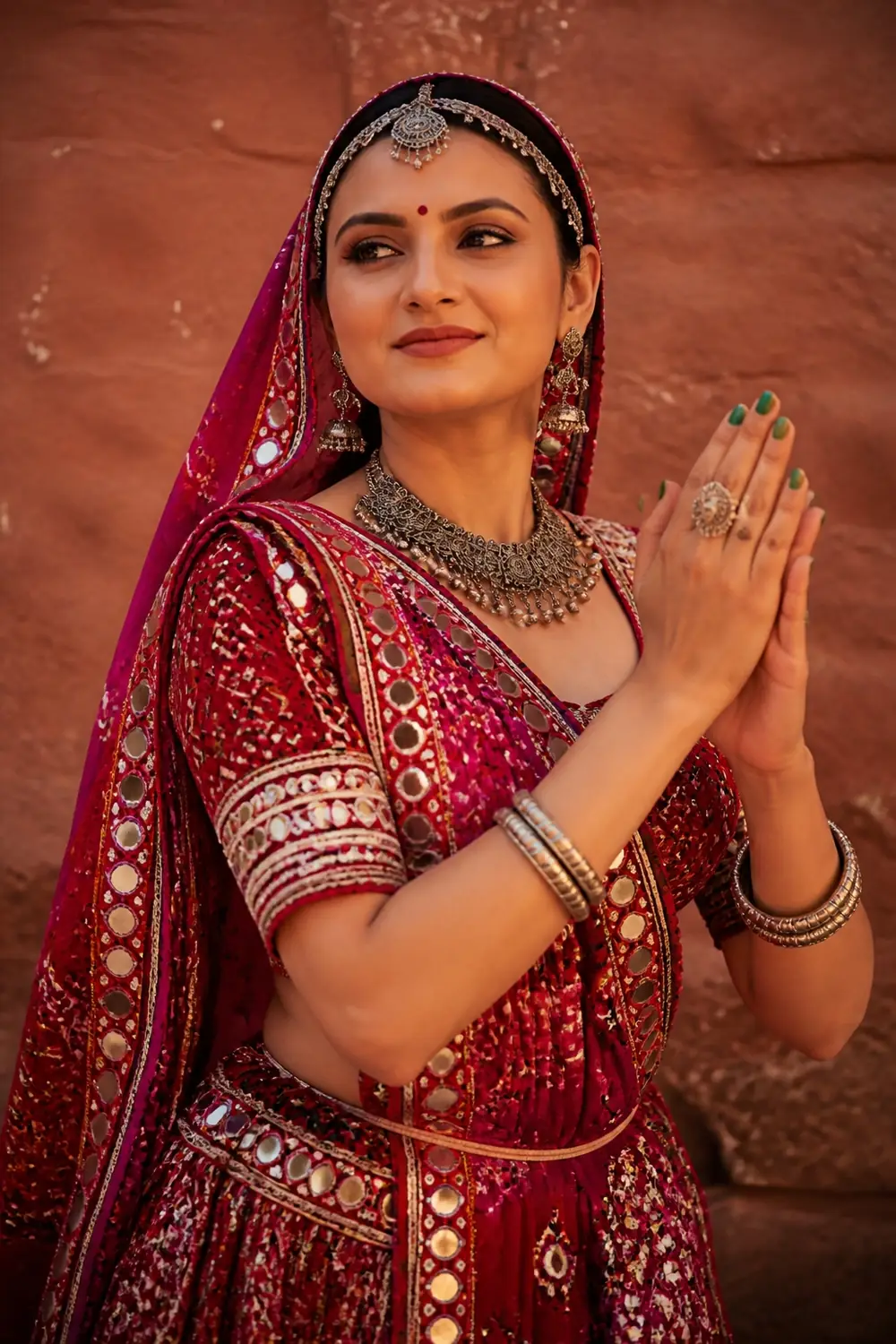
Garba costume is festive, embroidered and made to move. The silhouette matters as much as the decoration: a wide, pleated skirt exaggerates every turn, which is why the chaniya is central to how the dance reads on stage.
Women: chaniya choli
The classic women's Garba outfit is the chaniya choli — a long, heavily pleated skirt (chaniya), a fitted blouse (choli) and a draped odhni or dupatta. Decoration varies widely: mirror work (abhla bharat), bandhani tie-dye, zari and thread embroidery, sequins and patchwork all appear, often combined. Jewellery is typically oxidised silver or lacquer work, with bangles chosen to catch the light during turns.
Men: kediyu and dhoti
Men traditionally wear the kediyu — a short, flared, embroidered jacket that opens at the waist — over a dhoti or loose trousers, usually with a coloured scarf or turban. The kediyu's flare serves the same purpose as the chaniya: it makes turns and leaps visible from a distance.
How much variation is normal
Costume is not uniform across Gujarat. Kutch, Saurashtra and north Gujarat have different embroidery idioms, and fabric choices shift with climate and budget. Contemporary performance groups often simplify: coordinated colour palettes, lighter fabrics for touring, or a modernised chaniya that keeps the silhouette but reduces weight. For a stage show, coordinated costume colour is usually more important to the audience than absolute historical accuracy.
If costume authenticity matters for your event, ask to see photographs of the actual costumes the group will wear — not reference images of a different production.
Sound
Garba Dance Music, Songs and Instruments
Garba is sung as much as it is danced. The music sets the tempo the circle follows, and the words — usually addressed to the Mother Goddess — carry the meaning of the occasion.
Rhythm first
The dhol is the pulse of most Garba performances, with the dholak providing a lighter, more conversational rhythm. The nagara, a kettle drum, adds weight and accents in larger gatherings. Dancers themselves are part of the rhythm section: clapping patterns are not decoration, they lock the circle to the phrase.
Melody and song
Garba geet — the songs — are traditionally sung in Gujarati in a call-and-response style, with a lead singer and a group answering. Shehnai, harmonium, flute and, in modern arrangements, keyboards and electronic percussion fill out the melody. A live ensemble changes the feel of a performance: tempo can follow the room, and singers can extend a section when the circle is enjoying it.
Recorded versus live
Many event performances use a recorded track for tight timing, especially in a multi-act programme. Others tour with a small live unit of dhol, dholak, singer and harmonium. Neither is more "correct", but they suit different stages: live rhythm works well for audience participation, while a recorded set is easier to cue against lighting and announcements.
Not every Garba performance uses the same instruments, and contemporary productions often add drums and synth layers that have no traditional role. Worth confirming with any group you consider booking.
Clarifying the difference
Difference Between Garba and Dandiya Raas
Garba and Dandiya Raas are often spoken of together because they share an occasion, a region and an audience — but they are distinct dance traditions with different movement logic.
| Feature | Garba | Dandiya Raas |
|---|---|---|
| Movement style | Circular, grounded footwork with claps; the ring turns as one body | Percussive, stick-driven movement in pairs or facing lines |
| Common formations | One or more concentric circles around a garbo or lamp | Pairs, facing rows, or large groups moving through stick exchanges |
| Hands and props | Claps and expressive hand gestures; no sticks | Each dancer holds two dandiya sticks, struck against a partner's |
| Rhythm and music | Garba geet with dhol and dholak; tempo builds gradually across a set | Sharper, more insistent percussive rhythm timed to stick strikes |
| Typical context | Devotional observance and community Garba nights; also staged cultural shows | Festive social dancing, especially the Raas evenings of the Navratri period |
Scroll the table sideways on a narrow screen.
The two forms are culturally connected and frequently appear in the same programme — which is exactly why producers pair them. Our Garba-Dandiya Raas performances page covers the combined format and its Navratri context; this page stays focused on Garba itself.
On stage
Garba Dance Performance for Events
A Garba performance can be adapted to almost any stage size, but the format should be chosen deliberately. The three broad options below behave very differently for an audience.
Stage presentation
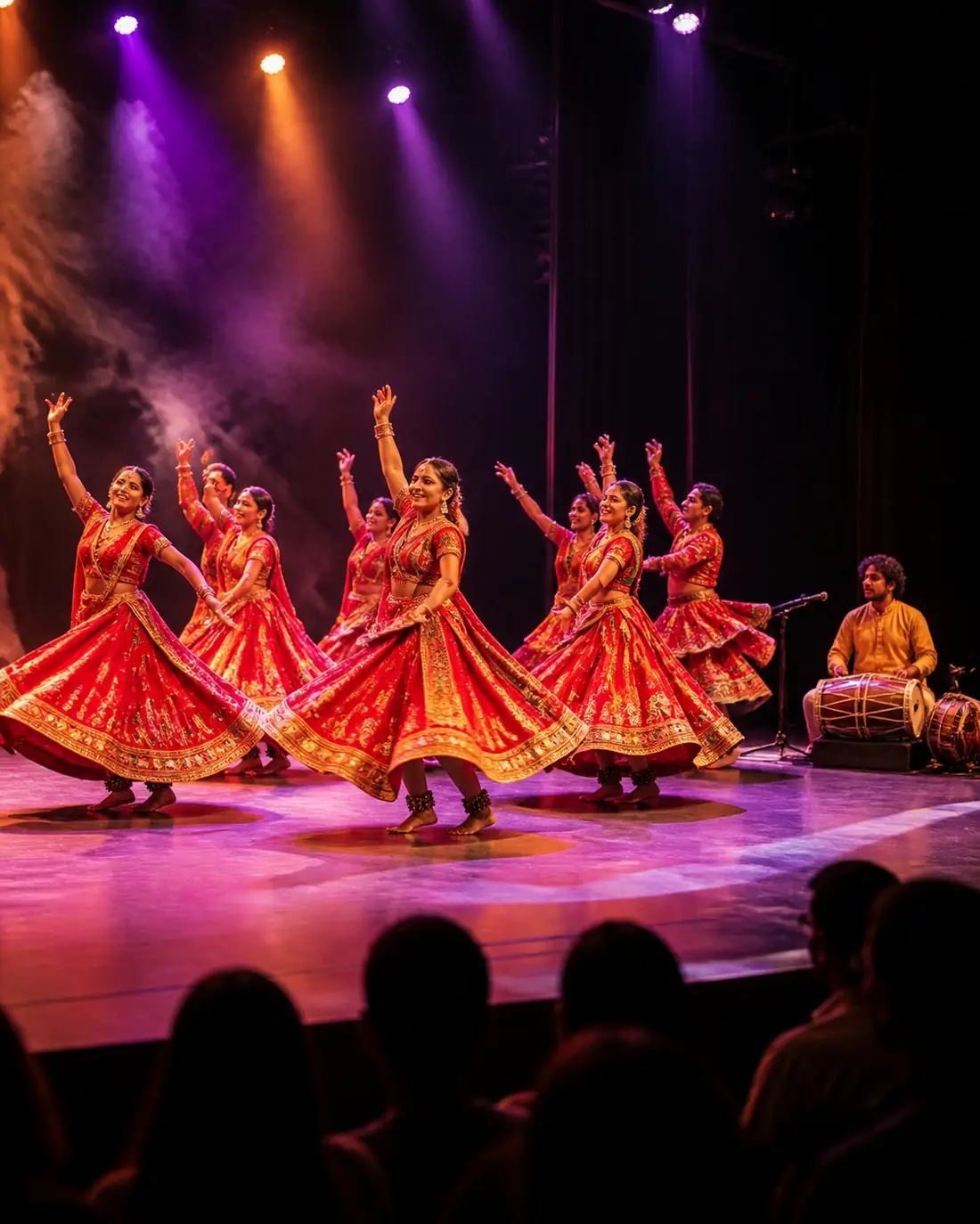
A choreographed piece, usually five to fifteen minutes, with entry, formations and a musical climax. Best for a formal programme where the audience watches rather than joins.
Coordinated group performance
A larger troupe performing extended Garba sets, often with changing formations and costume colour. Suited to festive evenings where the performance is the main attraction.
Audience participation segment
Performers open the circle and teach a simple step or clap pattern to guests. Effective at weddings and corporate cultural days, where involvement is the point.
Events where Garba works well
Booking
Book Garba Dance Performers for Events
Arranging a Garba dance group is mostly a matter of matching the performance to the room. The points below are what a troupe will need before it can confirm availability or quote.
- Number of performers — a small ensemble, a mid-size group or a full troupe with musicians
- Event date and venue — city, indoor or outdoor, and access timings
- Performance duration — a single short piece or a longer multi-set programme
- Stage or floor space — a circle needs a clear, level area, not a narrow ramp
- Music and sound — recorded track or live rhythm section, plus PA and green room needs
- Costume and choreography — colour palette, theme, and whether custom choreography is required
- Travel and logistics — outstation travel, stay and local transport
- Audience participation — whether guests will be invited into the circle
Availability and pricing depend entirely on these requirements and on the performers selected. There is no standard rate for a Garba performance, and any quote should be treated as specific to one event.
Plan your Garba performance
Share the date, city, audience size and the kind of format you have in mind, and the team can tell you what is possible for your event.
Discuss Your Garba Performance Requirements See dance forms of GujaratNo enquiry form on this page — the link above opens our existing contact page.
Selection
How to Choose a Garba Dance Group for Events
Most Garba bookings go wrong over practicalities rather than talent. Use the checklist below to compare groups on the things that actually decide how the performance lands.
Repertoire and authenticity
Ask which Garba traditions the group performs and whether the set is traditional, contemporary or mixed. Watch a full video of a live performance, not only a highlight reel.
Experience with your event type
A troupe that excels at a festival stage may be less suited to a wedding sangeet. Match experience to the occasion and to the audience's expectations.
Group size and configuration
Confirm the exact number of dancers and whether musicians are included. A quoted "group" can mean six performers or sixteen.
Costumes
Ask for photographs of the specific costumes for your event, including colour options and how many changes are included.
Music arrangement
Decide between live rhythm and a recorded track early. If live, confirm which instruments and whether the venue's sound system can support them.
Space and logistics
Share the stage dimensions and floor surface. Circular movement needs a clear, level area, and outdoor events need a plan for wind, rain and power.
Choreography fit
If you need a themed piece or a specific duration, confirm the group can adapt rather than assuming a standard set will fit.
Communication
Clear, prompt answers before booking are usually a good signal for how the group will handle event-day changes.
Practicalities
Performance Planning Considerations
A Garba set is short, but the preparation around it is not. These are the practical points that most often need a decision before the event day.
Space and sightlines
A circle needs width as well as depth. For a staged piece, allow clear floor area for travelling turns and skirt flare; for an audience-participation segment, plan how guests will be brought in and out safely. Raised stages should be checked for edge protection.
Sound and cueing
Confirm who runs the playback or the live mix, and agree cue points with the anchor or MC. If the performance follows a speech, leave a buffer — Garba starts on a musical phrase, not on a hand signal alone.
Costume changes and green room
Chaniya choli sets are bulky. A group of ten needs real changing space and time, and heavy embroidery restricts quick changes. Build that into the running order.
Weather, power and flooring
Outdoor Garba is vulnerable to wind (dupattas, backdrops), rain and uneven ground. Confirm covered performance area, power backup for sound, and a floor surface that supports turns.
Questions
Frequently Asked Questions About Garba Dance
What is Garba Dance?
Garba is a traditional folk dance of Gujarat in which dancers form a circle and move around a central garbo — a decorated pot with a lamp — to the rhythm of dhol and dholak, clapping and turning in step. It is a participatory community dance rather than a solo performance, and it is closely associated with devotional observance and with Navratri.
What is the origin of Garba Dance?
Garba developed within Gujarat's tradition of goddess worship, with the word linked to the Sanskrit garbha (womb) and to the lamp-lit garbo at the centre of the circle. It has no reliably documented founding date or single inventor: it evolved through generations of oral tradition, regional practice and, later, film and stage adaptations. In 2023 UNESCO inscribed Garba of Gujarat on its Representative List of the Intangible Cultural Heritage of Humanity.
Why is Garba Dance culturally significant in Gujarat?
It combines devotion, community and identity. The circle allows people of different ages and skill levels to take part together, the songs carry devotional and regional meaning, and the costume and repertoire record local traditions. For Gujarati communities abroad, Garba also functions as a way of maintaining cultural continuity.
What are the traditional costumes used in Garba Dance?
Women traditionally wear the chaniya choli — a pleated skirt, fitted blouse and draped dupatta — often with mirror work, bandhani or embroidery and oxidised jewellery. Men wear the kediyu, a short flared embroidered jacket, with a dhoti and scarf. Exact styles vary by region, troupe and event, and contemporary groups often adapt fabrics and colours for stage use.
Which instruments are commonly used in Garba Dance?
The dhol is the main rhythm instrument, supported by the dholak and, at larger gatherings, the nagara. Shehnai, harmonium and flute carry melody in traditional ensembles, with manjira adding a light metallic beat. Dancers' claps are part of the rhythm too. Modern performances may use recorded tracks or add keyboards and electronic percussion, so instrumentation varies by group.
What is the difference between Garba and Dandiya Raas?
Garba is circular: dancers move around a garbo, using footwork and claps, without sticks. Dandiya Raas is percussive and stick-based, performed in pairs or facing lines where dancers strike dandiya sticks against a partner's. The two share a region, a festive season and often a stage, but their movement logic and formations are different.
Can Garba dance performers be booked for events?
Yes. Garba dance groups perform at cultural festivals, corporate cultural programmes, weddings, college functions and community gatherings, in formats ranging from a short stage piece to an audience-participation segment. Availability depends on the date, city, group size and format you need, so requirements are confirmed per event.
What factors affect the cost of a Garba dance performance?
Cost depends on the number of performers and whether musicians are included, the event date and city, performance duration, costume and choreography requirements, stage and sound arrangements, and travel or accommodation for outstation bookings. Because these vary so widely, no standard rate applies — a quote is specific to one event's requirements.