Tippani dance is one of coastal Saurashtra's most striking folk traditions — a rhythmic group dance in which women strike long wooden sticks against the ground in facing rows, turning everyday labour into music, movement and celebration.
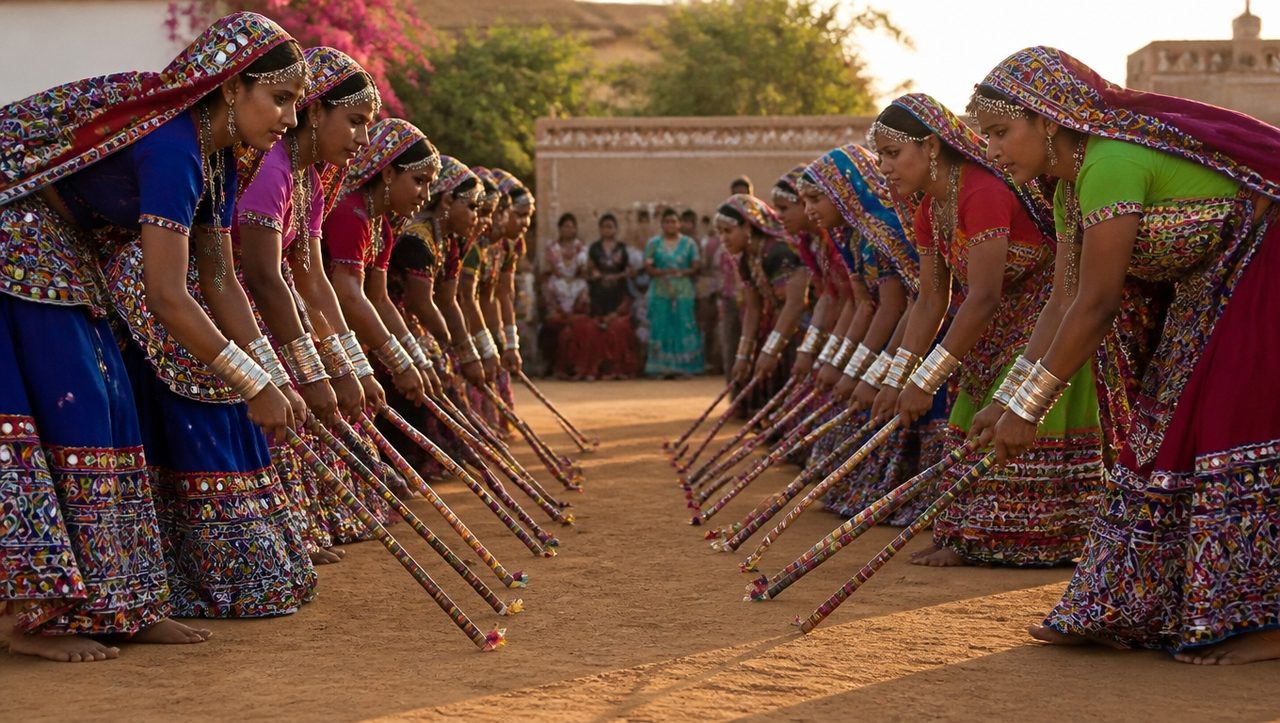
Tippani dance is a folk dance of Gujarat performed by women in two facing rows, each holding a long wooden stick called a tippani. Dancers strike the ground in shared rhythm while singing folk songs, so the floor itself becomes the beat. What began as a way for working women to lighten a hard day's labour has grown into one of Saurashtra's most recognisable cultural performances.
The form is traditionally associated with coastal Saurashtra — especially the Chorwad and Veraval region — and with the working communities who built and maintained its homes and courtyards. Its movements are simple and grounded: coordinated stomping, swinging strokes of the sticks, and rows of dancers moving as one. That collective quality is the point — no single performer leads for long, and the effect depends on every row keeping time together. It is one of many distinct Gujarat dance traditions preserved across the state.
Today the dance appears in two settings. Community performances at festivals and weddings keep the traditional pace and songs, while staged Tippani dance performances for events adapt the choreography, formation and duration to the venue and audience. Both keep the same core: sticks, rhythm, rows and song.
Tippani dance comes from the Veraval and Chorwad region of Saurashtra in coastal Gujarat. Accounts of its origin point to the labour behind house-building in the region: workers broke stone and levelled ground, and women pressed lime into new floors using long wooden tools. To ease the monotony of that work, they sang and beat the floor in rhythm — and the work pattern itself became a dance.
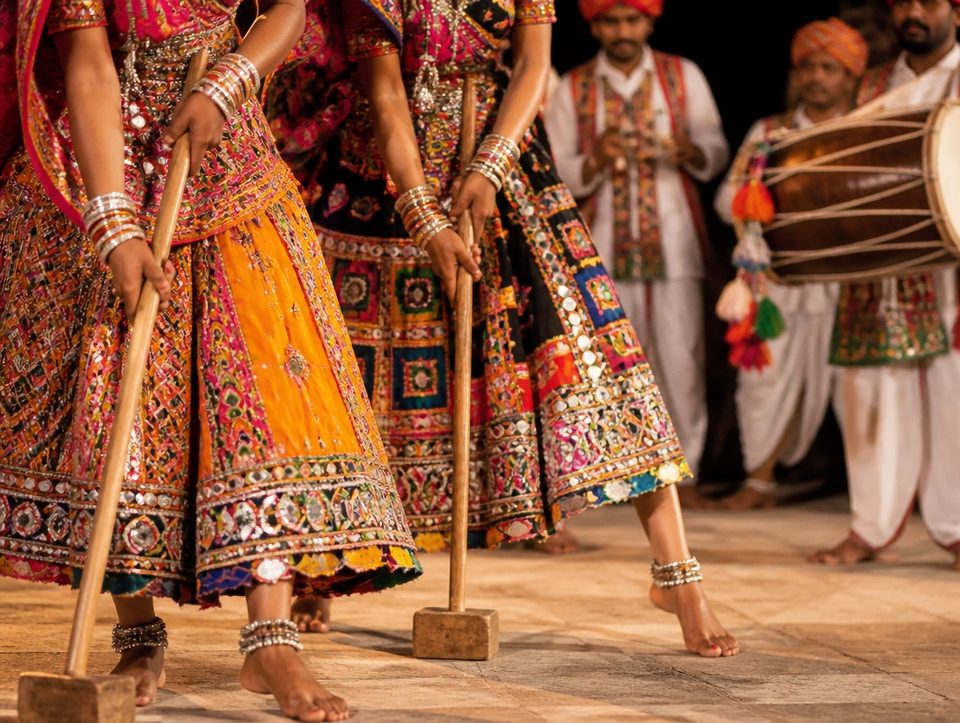
The tool at the centre of it is the tippani: two long wooden sticks, roughly 175 cm, joined at the lower end by a square wooden or iron block known as the garbo. Pressed and struck against the floor, it packed lime foundations firm — and its sound gave the workers a shared beat. Labour traditions like this run deep in Gujarat's coastal communities; the same Koli communities whose fishing-life celebrations survive today as Koli folk dance performances.
Over time the dance moved from the worksite to the celebration. Regional references record it being performed at festivals and weddings, and today it stands as a marker of Saurashtra's cultural identity. Exact dates for the dance's early years are not recorded — what is well documented is its origin among the labouring communities of coastal Saurashtra and its journey into Gujarat's wider cultural life.
Tippani dance carries a rare idea inside a folk form: that shared work can become shared art. Its two facing rows are a picture of collective effort — the dance only works when everyone strikes, steps and sings together. For the communities that kept it alive, it celebrated cooperation, endurance and the dignity of everyday labour.
As a Tippani folk dance tradition, it also preserves a specifically women's voice in Gujarat's cultural memory. The songs that accompany the sticks carry the humour, weariness and warmth of the women who worked with them, passed down through generations by performance rather than by writing.
That living quality is why the dance has stayed relevant. When a Tippani group takes a stage today, audiences are not watching a museum piece — they are watching a working rhythm, kept alive by the people who inherited it, presented with pride at festivals, weddings and cultural programs across Gujarat.
Tippani dance performers traditionally wear bright Gujarati folk attire. The typical look is a colourful ghagra-choli or saree in vivid fabrics, rich with mirror work and embroidery, paired with stacked bangles on the forearms, necklaces, earrings and anklets that add their own ring to the rhythm. Performers usually dance barefoot, close to the ground they strike.
Because the tradition was performed exclusively by women, the traditional Tippani dance costume is a women's ensemble. On stage, troupes adapt the clothing in different ways — brighter palettes for large venues, lighter fabrics for long programs, matching sets for coordinated formations — so the exact attire varies from group to group rather than following one fixed standard.
This mix of tradition and stagecraft is common across Gujarati folk forms. Neighbouring traditions such as Bhavai's balancing performances follow the same pattern: documented folk roots, adapted presentation.
What makes Tippani dance music unusual is that the lead percussion is built into the dance itself. Every dancer holds the tippani — two long wooden sticks joined by the square garbo block — and its strikes on the floor set the pulse for the whole group. The implement is the rhythm section.
Around that foundation, regional references describe a small, specific set of accompanying instruments rather than a generic folk orchestra. Metal and brass sounds from the turi and the thali (a brass plate) cut through the floor-beats, while percussion and reed instruments support the songs that the dancers sing.
The dance's own wooden sticks with a square base — struck on the floor as the lead percussion.
A pipe-like instrument and a brass plate, adding bright metallic tones above the floor rhythm.
Cymbals that mark the cycle and accent the singers' phrases.
Drums that carry the deeper pulse for group performances on stage.
The ceremonial reed instrument, noted among the dance's major accompanying instruments.
Sung in local dialects, leading the rhythm as much as following it.
The classic Tippani dance steps are built on the tradition's working origins. Dancers arrange in two facing rows, swing the tippani down in shared patterns, and strike the ground between steps — a grounded stomp, a swing, a beat, repeated in waves. The rows answer each other, so the sound comes in call-and-response pulses rather than a single drum line.
There is no single, universally standardised choreography. Traditional performances follow the row-and-beat structure with songs leading the pace; stage presentations arrange the same elements into formations — facing lines, semicircles or staggered rows — sized to the group and the venue. What stays constant is the coordination: the strike lands where the step lands, for every dancer at once.
Alongside better-known Gujarati forms such as Garba and Dandiya Raas, Tippani gives audiences a different texture of folk culture — percussive, grounded and rooted in work rather than ritual. For anyone planning an event, that makes it a strong contrast piece in a folk program, not a repeat of the usual circle dances.
A Tippani group brings colour, percussion and a story of Gujarat's working heritage to a stage. Because it is a group form with strong rhythms and a clear visual pattern, it suits a wide range of occasions — from cultural festivals to weddings and school functions. Availability naturally varies by troupe and date, so every program is confirmed with the artists before booking.
A percussive showcase of Saurashtra's working heritage for festival stages.
An energetic, easy-to-follow group form for annual days and heritage weeks.
Strong rhythms and formations that hold a big youth audience.
A distinctive regional act for annual days, offsites and diversity programs.
Folk performance that invites audiences to clap along with the rows.
A Gujarati folk touch for sangeet, mehendi and reception stages.
Represents coastal Saurashtra in programs of Gujarat's many dance forms.
Adaptable formations and duration for produced stage programs.
Through BookMyDance you can explore Tippani dance performers and request details about availability for your event. Every enquiry is handled by the platform's team, who connect you with suitable artists and confirm the practical details before anything is finalised. You can also browse the full range of folk dance categories on BookMyDance if you are building a larger program.
Arranging a performance follows the same straightforward path as any booking on BookMyDance — share the details, confirm the plan, finalise.
Send your event details through BookMyDance's existing contact channel — by phone or WhatsApp — including the date, city and occasion.
Confirm the event date, location, type of performance and the artist requirements — solo or group, duration and stage details.
Review the artists' availability, the final quotation, technical requirements and any travel or accommodation logistics.
Once the details and inclusions are agreed, the booking is confirmed and the performance is set for your event.
BookMyDance is a dancer booking platform that lists performers across more than 100 dance forms and connects event hosts with verified artists across India. Availability, quotations and inclusions are always confirmed with you before any booking is finalised.
From classical to folk and beyond — one request covers the whole program, not just one act.
Verified performers reachable for events across Indian cities, with logistics planned case by case.
Artists are checked for credentials and experience before they are listed for bookings.
The team helps confirm availability, quotations and requirements before you commit.
Tell us about your event and we will connect you with verified Tippani dance artists — availability, quotation and every detail confirmed before you book.
Prefer to browse first? Explore all Gujarat dance traditions on BookMyDance.