Gujarat Folk Dance Guide
Dandiya Dance – Traditional Folk Dance of Gujarat
Dandiya Dance is the vibrant stick dance of Gujarat, performed in joyful partner and group formations to the beat of the dhol. Known in its classical folk form as Dandiya Raas, it fills Navratri nights, weddings and cultural festivals with rhythm, colour and community spirit. This guide explains the dance's roots, cultural meaning, steps, sticks, music and costumes — and shows how BookMyDance helps you book traditional Dandiya performers for events across India.
Rhythmic stick work, spinning formations and centuries-old Gujarati folk tradition — on one stage.

Dandiya Dance at a Glance
- Home region Gujarat, celebrated across India
- Folk name Dandiya Raas — the stick dance
- Signature element Decorated wooden dandiya sticks
- Typical setting Navratri nights, festivals, weddings, stage shows
- Formation Partners, circles and coordinated rows
- Music Dhol, dholak and Gujarati folk vocals
What Is Dandiya Dance?
Dandiya Dance is a traditional folk dance of Gujarat in which dancers hold a decorated stick — a dandiya — in each hand and strike them rhythmically against their partner's sticks, creating a lively percussion of their own while they move.
The Dandiya folk dance of Gujarat grows out of the state's community traditions, where whole villages gathered to celebrate harvests, festivals and auspicious occasions. Dancers arrange themselves in pairs or facing rows, often within a large circle, following the music through coordinated steps, turns and stick patterns — performed with partners, in small groups, or as a grand circle of dozens.
What makes Dandiya instantly recognisable is its partnership of movement and sound: every dancer is also a percussionist, and the crisp clack of the sticks becomes part of the music. In its traditional home anyone can join the circle; on contemporary stages, the same vocabulary is presented by trained troupes in polished choreographed formats.
History and Origin of Dandiya Dance
Dandiya Raas has been part of Gujarati folk life for centuries, flourishing in the villages and towns of Gujarat and neighbouring regions as a celebratory group dance.
Documented tradition. Raas — group dances of partnered dancers — developed as a folk tradition of Gujarat and nearby regions, and the stick-dance form, Dandiya Raas, became one of its best-loved expressions. Danced by communities at festivals and passed down through practice, it travelled with Gujarati communities across India and the world.
Devotional associations. Popular tradition links the dance to two beloved stories: the Raas echoes the playful dance of Krishna with the gopis, and the striking of sticks symbolises the mock battle between Goddess Durga and Mahishasura — one reason the dance is woven into Navratri. These are living legends carried by the tradition, not precisely dated history.
From village greens to the stage. Over the twentieth century, Dandiya Raas moved from community squares to competitions, cultural festivals and televised events. Choreographed troupes and professional artists refined the formations for the stage, while community circles kept the everyone-can-join character of the original — both worlds thrive today on the same rhythmic foundation.

Cultural Significance of Dandiya Dance
Dandiya Dance survives and thrives because it is a dance of togetherness — no audience member is more than a step away from joining the circle.
Community participation
Dandiya Raas is danced by people together, not at them. Circles welcome newcomers, and the joy of the dance lies in collective rhythm rather than solo display.
Coordination and interaction
Every dancer answers a partner. The stick exchanges demand listening, timing and eye contact — a conversation in rhythm that builds quick rapport.
Cultural identity
For Gujarati communities in India and abroad, the Dandiya folk dance is a living link to home — performed at festivals, weddings and gatherings as an expression of belonging.
Music, attire and formation
Folk songs, traditional attire and sweeping group formations give the dance its visual and musical identity, with mirror-work costumes catching the light as the circle turns.
Beyond the festival season, the same celebratory power makes Dandiya a sought-after highlight in cultural programmes, weddings and corporate events. Its devotional associations are treated by performers and hosts with warmth and respect, keeping the dance's festive, thankful character at its heart.
Traditional Dandiya Dance and Performance Styles
One dance, many presentations. From open community circles to polished stage choreography, Dandiya adapts to the occasion without losing its core grammar.
Traditional community Dandiya Raas
The classic form: dancers in concentric circles, paired and exchanging sticks to live folk music, open to every member of the community. Here the dance is participation, not spectacle.
Coordinated group performances
Trained groups of eight to twenty-plus dancers perform rehearsed stick patterns, level changes and formations — the format most events book, balancing authenticity with polish.
Stage-based folk presentations
Folk dance festivals and competitions present Dandiya Raas in staged arrangements, often blended into larger Gujarati folk suites that showcase costume, formation and rhythm.
Event-adapted performances
Weddings, corporate celebrations and themed nights use shorter, high-impact Dandiya sets — sometimes with audience participation segments — adapted to stage sizes and event timelines.
Today's choreographed event versions are staged adaptations, not identical continuations of village practice: traditional community Raas was spontaneous and participatory, while stage performances are rehearsed for timing and visual impact. Good performers honour both.
Dandiya Dance Steps and Movements
Dandiya looks wonderfully complex from the outside, but its building blocks are simple. Beginners who master a few basics can already join a circle or perform a short routine.
The fundamentals
- Basic footwork — light, even steps that keep time with the beat; the feet stay simple so the hands can work.
- Stick movements — strike your own sticks together, then your partner's, in alternating patterns that follow the music's cycle.
- Partner coordination — watch your partner's sticks as much as your own; the exchange only works when both keep the same rhythm.
- Rhythm and spacing — keep your place in the circle or row; even spacing lets formations breathe and turns flow safely.
- Group formations — circles, facing rows and rotating partnerships; advanced sets add level changes and travelling patterns.
- Safe practice — start slowly with lightweight sticks, keep a relaxed grip, and give every dancer room to swing freely.
A simple beginner sequence
The sequence below is a straightforward teaching pattern used to introduce newcomers to the dance's logic. It is offered as a practice aid — community troupes carry many regional variations, and this is not a single authenticated traditional choreography.
- Set up. Stand facing your partner at a comfortable stick's distance, one dandiya in each hand, feet a shoulder's width apart.
- Find the beat. Play four even counts on your own two sticks — right over left — while stepping gently in place, until the pattern feels natural.
- Exchange. Keep the same four-count and strike your partner's right stick on each count, so your sticks alternate: own, partner, own, partner.
- Add the step. Let the feet follow the sticks: a light tap to the side on counts one and three, closing on two and four.
- Turn and travel. On a repeated eight-count phrase, both partners turn a quarter-circle, then resume the exchange — a simple way to rotate the whole circle.
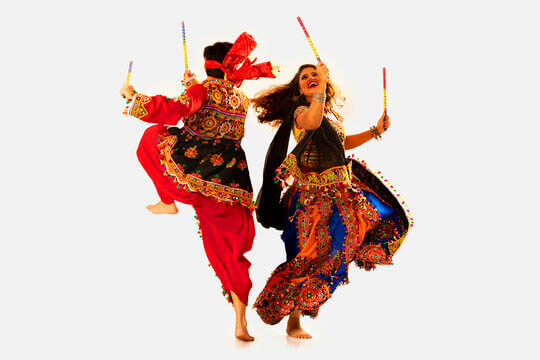
Dandiya Dance Sticks and Their Role
The dandiyas are what set this dance apart — part prop, part percussion instrument, part symbol of the celebration itself.
Dandiya sticks are typically short wooden batons, long enough to reach comfortably between two dancers and light enough to be played quickly for a full evening. For performances they are often decorated — painted, wrapped in colourful tape, or finished with bands that match the dancers' costumes — though simple undecorated sticks are equally common in practice sessions.
In the dance, the sticks do the talking: each pair of dancers strikes their own sticks together and each other's in repeating patterns, so dozens of pairs become the dance's rhythm section. Every strike is also a step in the choreography, so timing is everything. Safe handling matters too — dancers learn to strike cleanly, keep their swing inside their own space, and respect the distance that lets both partners play freely.
Performers choose sticks for the setting: lighter sticks for fast practice patterns, sturdier well-finished pairs for stage shows. Event organisers usually leave selection to the troupe — professionals bring their own, matched to the choreography and costumes.
Dandiya Dance Music and Rhythm
Dandiya Dance is built on a lively partnership between folk music and the dancers' own stick percussion — the band and the circle answer each other all night.
The dance rides the driving, celebratory rhythms of Gujarati folk music. A percussion core — commonly the dhol or dholak, supported by hand-held manjira clappers — keeps the cycle steady, while melodic instruments such as the harmonium and shehnai, and a lead singer, carry the song. Because the dancers' dandiyas strike in patterns, the music is written and chosen to leave space for the sticks: the result is a layered rhythm of drum, song and clacking wood.
Tempo shapes the choreography: stately cycles suit a Raas's graceful openings, faster ones drive the spinning exchanges that close a set. Community music is usually live, with the singer lifting tempo as the circle finds its flow; on stage, troupes perform to a live band or recorded tracks, with live dhol a perennial favourite because it answers the sticks in real time. Organisers need only a sound system that carries percussion cleanly and music matched to the troupe's rehearsed tempo.
Dandiya Dance Costumes
The visual joy of Dandiya owes much to traditional Gujarati dress — swirls of colour, shimmering mirror work and jewellery that moves with every turn.
Women most often dance in the chaniya choli — a full, flared skirt (chaniya) with a fitted blouse (choli), richly decorated with embroidery, mirror work, beads and shellwork, finished with a dupatta draped across the body. Men typically wear the kediyu, a short, pleated, flared tunic, with a turban and matching lower garments. Silver-type jewellery, bangles and waist bells complete the festive picture — and add their own gentle sound to the performance.
These are commonly seen Gujarati-inspired outfits rather than a mandatory uniform: regions and troupes vary in colour, fabric and ornamentation, and stage shows sometimes adapt silhouettes for comfort and movement. Troupes booked through BookMyDance coordinate their own attire; organisers only need to confirm the look and any theme preferences.
Dandiya Dance vs Garba Dance
The two great Gujarati folk dances are often mentioned together — and they do share festive roots — but they are distinct forms with their own movement logic.
| Aspect | Dandiya Raas | Garba |
|---|---|---|
| Defining movement style | Partnered stick play: structured exchanges, turns and travelling patterns | Circular, graceful movement around a garbo (lamp or image), danced by individuals in concentric circles |
| Use of sticks | Central — every dancer plays two decorated dandiyas throughout | None — hands clap or hold them free; the rhythm comes from feet and song |
| Typical group interaction | Pairs and facing rows within a circle; partners answer each other's patterns | A whole circle dancing in shared, individual steps — everyone moving as one ring |
| Performance character | Percussive, playful and energetic — the stick strikes make the dance audible | Flowing, devotional and hypnotic — grace built from continuous circular motion |
Swipe the table horizontally on small screens.
In short: Garba is a devotional circle dance without props, while Dandiya Raas is the rhythmic stick dance of partners — the two are regularly performed at the same celebrations, each with its own character. Explore our dedicated Garba Dance page for a full guide to that tradition.
Dandiya Dance Performance for Events
Few folk forms lift a room like Dandiya. A well-led performance draws guests into the rhythm — and often onto the dance floor.
Dandiya performances adapt naturally to all kinds of occasions:
- Corporate cultural events — Navratri celebrations, annual days and diversity programmes that end with the whole room clapping in rhythm.
- Wedding celebrations — sangeet and mehendi evenings where a Dandiya set brings Gujarati festive energy to the celebration.
- College and school cultural programmes — high-energy sets, plus optional basics workshops that get students dancing.
- Cultural festivals — folk dance showcases and community Navratri nights with full traditional formation work.
- Private celebrations — birthdays, anniversaries and society events that want an interactive, all-ages highlight.
- Stage shows and themed events — polished choreographed productions with coordinated costumes and live or recorded music.
Practical factors shape each booking: group size, the stage or open space available, the music arrangement (live dhol versus recorded tracks), performance duration, and costume coordination with your theme. Availability, pricing and inclusions vary by troupe and date — discussing these early keeps planning smooth.
Book Dandiya Dance Performers for Events
BookMyDance helps you explore traditional Dandiya dance groups and performers for events across India — from community-style Raas circles to polished stage troupes with live dhol. Share a few details about your event and the team will help you find performers who fit your date, venue and budget, subject to availability.
- Define your event — the occasion, audience and the style of Dandiya performance you have in mind.
- Share the essentials — event date, city and expected audience, through the contact page, phone or WhatsApp.
- Discuss the details — number of performers, duration, music arrangement and costume requirements.
- Confirm the booking — availability, pricing and logistics are finalised directly with the provider.
Ready to book?
Tell BookMyDance about your event and get help finding traditional Dandiya performers for your date.
Book Dandiya Dance Performers WhatsApp UsPerformer availability, pricing and inclusions are confirmed at the time of booking.
Why Choose BookMyDance?
BookMyDance is a dedicated platform for exploring and booking dance performers in India, with listings that span classical and folk traditions, Bollywood formats and international styles. For event organisers, that breadth matters: you can compare traditional Dandiya performers with other Gujarati folk options, browse related forms, and arrange the booking through one consistent contact channel — by enquiry form, phone or WhatsApp.
The platform's Gujarat pages specialise in the state's folk heritage, and enquiries are handled by people who work with these troupes regularly — so recommendations match your event rather than a generic catalogue. Availability, pricing and inclusions are confirmed directly during booking.
Frequently Asked Questions About Dandiya Dance
What is Dandiya Dance?
Dandiya Dance is a traditional folk dance of Gujarat in which dancers hold two decorated sticks (dandiyas) and strike them rhythmically against their partner's, combining movement with live percussion. It is commonly known as Dandiya Raas and is performed in paired, group and circular formations at festivals and celebrations.
What is the origin of Dandiya Dance?
Dandiya Raas developed as a folk tradition of Gujarat and neighbouring regions, passed down through community celebration. Popular tradition associates it with the playful Raas dance of Krishna with the gopis and, during Navratri, with a symbolic retelling of Goddess Durga's battle — living legends carried by the dance itself rather than precisely dated history.
Why is Dandiya Dance associated with Gujarat?
The dance grew from Gujarati community life — its village celebrations, its music and its festive calendar — and remains central to Navratri festivities across the state. Gujarati communities carried it across India and abroad, so today a Dandiya folk dance performance is one of the most recognisable expressions of Gujarati culture anywhere.
What are the basic steps of Dandiya Dance?
Beginners start with even, light footwork; simple stick patterns alternating between their own pair and their partner's sticks; and steady partner coordination within the group's rhythm. A short beginner sequence — set up, find the beat, exchange sticks, add the step, turn and travel — is outlined in the steps section above.
What sticks are used in Dandiya Dance?
Dancers use a pair of short wooden batons called dandiyas, usually light enough for quick, comfortable play. Performance sticks are often painted or colourfully finished to match costumes, while simpler sticks serve daily practice. Troupes generally bring their own, matched to their choreography and attire.
What costumes are traditionally worn for Dandiya Dance?
Women typically wear the flared, mirror-work chaniya choli with a dupatta and festive jewellery; men wear the pleated kediyu, often with a turban. Colour, fabric and ornamentation vary by community, region and troupe — the shared intent is celebratory attire that allows free movement and reads beautifully on stage.
Can I book a Dandiya dance group for an event?
Yes. BookMyDance helps organisers explore traditional Dandiya dance groups and performers for weddings, corporate events, cultural festivals and private celebrations across India. Share your event date, city and requirements through the contact page, phone or WhatsApp, and availability, pricing and inclusions are confirmed directly with the provider.
What should I consider before booking a Dandiya dance performance?
Consider your venue's performance space, the group size that suits your audience, whether you want live dhol or recorded music, the duration and number of sets, and how costumes should coordinate with your event's theme. Confirming availability, pricing and logistics early keeps the booking smooth.