Meghalaya · Khasi Heritage
Nongkrem Dance – Traditional Khasi Dance of Meghalaya
Nongkrem Dance is the ritual dance at the heart of Ka Pomblang Nongkrem, the five-day Khasi thanksgiving festival held at Smit in the East Khasi Hills. Unmarried women dance barefoot in silk and gold inside a ring of men carrying swords and white yak-hair whisks. It is not a stage show for visitors, but a religious act offered for a good harvest and the well-being of the community.
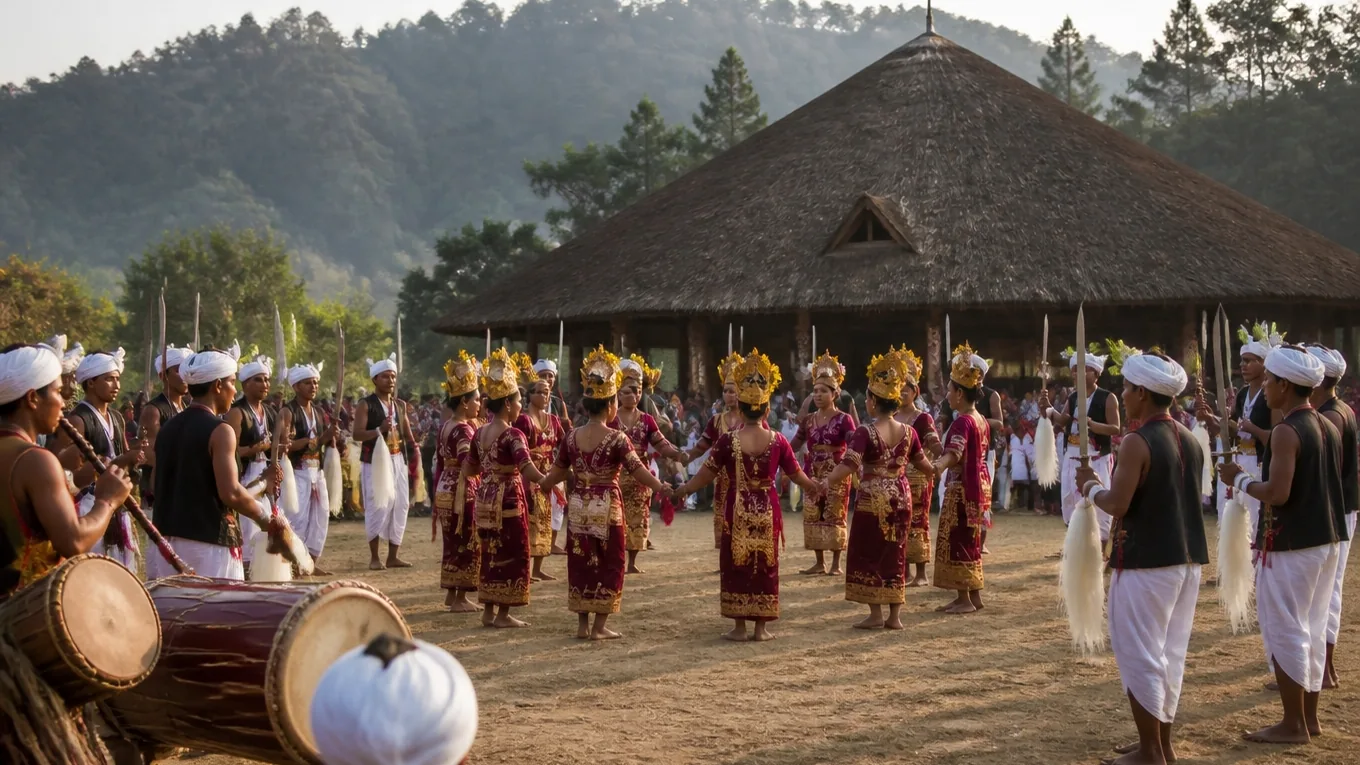 Smit · East Khasi Hills
The public dance in the courtyard of the Ing Sad: women in the inner circle, men on the outside. Illustrative image.
01 · Introduction
What is Nongkrem Dance?
Nongkrem Dance is the ceremonial dance of the Khasi people, performed as part of Ka Pomblang Nongkrem — the annual religious festival of Hima Khyrim, one of the traditional Khasi states. The name comes from Nongkrem, the village that was once the seat of the Khyrim kingdom; the festival itself is now held at Smit, the capital of the Khyrim Syiemship, about 11 to 15 kilometres south-west of Shillong.
The dance has two parts. Ka Shad Kynthei is danced by young unmarried women, who form an inner circle in the courtyard of the Ing Sad, the traditional thatched hall of the ruling house. Ka Shad Mastieh is the men's dance, performed in a wider ring around them. The women's steps are slow and restrained; the men move quickly, turning and stopping with the drums, a sword in the right hand and a whisk in the left.
Although it is one of the most photographed traditions in Meghalaya, the dance belongs to a religious occasion rather than a tourism calendar. The rites come first, the dancing follows, and the community takes part as worshippers and hosts rather than as an audience. That is the single most useful thing to understand before you watch it, research it, or plan a cultural programme around it.
For a wider view of the state's repertoire, see the guide to traditional dances of Meghalaya, which places this festival alongside the state's Garo and Jaintia traditions.
02 · The Festival
The Nongkrem Dance Festival of Meghalaya
The Nongkrem Dance Festival is a five-day Khasi religious festival held every autumn at Smit. Its formal name, Ka Pomblang Nongkrem, refers to the goat sacrifice at its centre; the public knows the whole event as the Nongkrem festival, and the dance as Nongkrem Dance or Shad Nongkrem. Shad simply means dance in Khasi, which is why the name is used for both the ceremony and the performance inside it.
The festival is a thanksgiving. The community gives thanks for the harvest and prays for peace and prosperity, asking the goddess Ka Blei Synshar for a rich crop in the year ahead. It is also an obligation of the Hima Khyrim: the Syiem of Khyrim presides, the priests and the council of ministers take part, and the ruling house performs the duties that custom assigns to it each year.
Most of the first days belong to ritual. Meghalaya Tourism records the public dance by young men and unmarried women as taking place on the fourth day, in front of the Ing Sad. On that day the courtyard fills with families from the surrounding villages, weavers and craftspeople set up stalls, and the ceremony becomes visible to everyone who has come to watch.
Why it is celebrated?
- Thanksgiving: gratitude for the harvest and for the community's wellbeing over the year.
- Prayer: a request for prosperity, protection and a good season to come.
- Continuity: the annual renewal of the ruling house's customary and religious duties.
- Community: a gathering that brings the villages of the Hima together in one courtyard.
03 · History
History of Nongkrem Dance
There is no single founding date for Nongkrem Dance, and any page that offers one should be read with caution. What the record does show is a tradition carried by institutions rather than by documents: a ruling house, a priestly class, a council of ministers and a body of customary law that have passed the ceremony from one generation to the next.
The name preserves the geography of that history. Nongkrem was the original seat of the Khyrim kingdom, and the festival is still identified with it even though the venue moved to Smit, the capital of the Khyrim Syiemship. Smit remains the cultural centre of the Khasi Hills and the official home of the ceremony.
The most visible historical object at the site is the Ing Sad, the ruling house's hall. Meghalaya Tourism describes it as a thatched building constructed entirely without metal — a detail that says a great deal about how Khasi building craft and royal ritual were designed to work together. The Syiem also dances before a wooden pillar known as U Rishot Blei, one of the fixed points around which the ceremony is organised.
The season has shifted. The Meghalaya Department of Arts and Culture notes that the festival was once celebrated in mid-summer and later moved to the autumn months, in line with agricultural and practical considerations. Today it falls in October or November. An older government calendar still lists Shad Nongkrem under July; that entry reflects the earlier timing, not the current one.
What has not changed is the relationship between the dance and the ritual. The steps are learned within families and villages, the costumes are commissioned rather than bought, and the right to perform certain parts belongs to specific roles in the Hima. In that sense the history of Nongkrem Dance is the history of Khasi customary governance, expressed in movement.
04 · Significance
Significance of Nongkrem Dance
For the Khasi community, Nongkrem is first a religious observance. The festival is performed to appease Ka Blei Synshar and to ask for a bumper harvest and the prosperity of the people. Offerings are made to Lei Shyllong, the deity of Shillong Peak, and to the ancestor and ancestress of the ruling clan, including the first maternal uncle. These are acts of traditional Khasi faith, and they set the tone for everything that follows.
The dance carries that meaning rather than replacing it. When the women take the inner circle, they are not performing a folk item for an audience; they are completing a ritual sequence in a place that has hosted it for generations. The men's outer ring, with swords drawn, is best understood in the same frame: a ceremonial guard around the centre, not a display of bravado.
Social and cultural meaning
Nongkrem also does the work that festivals do everywhere. It marks the agricultural year, brings scattered villages into one space, gives young people a role in a shared tradition, and confirms the standing of the Hima's institutions. The Syiem Sad, the senior woman of the ruling house, is the custodian of rites, while the Myntries, the council of ministers, are the caretakers of the ceremonies — a division of responsibility that is itself part of what the festival demonstrates.
For visitors, the practical consequence is simple: this is a living religious event, not a scheduled performance. Photography, movement around the courtyard and behaviour during prayers should follow the cues of the community and the organisers.
05 · Ritual
Ka Pomblang Nongkrem – Rituals and Traditions
Ka Pomblang Nongkrem means, literally, the goat-killing ceremony of Nongkrem. It is the ritual core around which the five days are built, and it is performed by the Syiem of Khyrim together with the high priest. The Syiem offers oblation to Lei Shyllong, the god of Shyllong Peak, with a cock; goats are sacrificed as part of the Pomblang; and further offerings are made to the ancestor and ancestress of the ruling clan and to the first uncle.
The rites are not a single public spectacle. Some take place inside the Ing Sad, others at sacred sites nearby, and several are closed to visitors. The dance in the courtyard is the part the public sees, and it comes after the religious work has been done — a sequence that the state's own festival pages make explicit when they say the religious part of the festival precedes the dances.
How the five days are structured
Published accounts agree on the shape of the festival rather than on a minute-by-minute programme, and the Hima does not issue a visitor timetable. What can be said reliably is this:
- 01
Opening rites
The festival begins with ceremonies at the Ing Sad and at sacred points associated with the ruling house. These are religious obligations first, and access is limited.
- 02
Offerings and sacrifice
The Pomblang ceremonies take place, with offerings to Lei Shyllong and to the clan's ancestors. This is the part of the festival most often misdescribed in travel writing.
- 03
Community observance
Villages of the Hima gather, families host relatives, and the courtyard and surrounding ground fill with people, stalls and preparations for the dance.
- 04
The public dance
Young men and unmarried women perform in front of the Ing Sad. This is the day most visitors come for, and the day the costumes and music are seen at their fullest.
- 05
Closing ceremonies
The festival concludes with final rites and the dispersal of the gathering. Reports differ on how the days are counted, so treat this as a sequence rather than a fixed itinerary.
06 · Dress
Nongkrem Dance Traditional Costumes
The dress is ceremonial, not everyday, and it is one of the clearest markers of the dance's status. Descriptions vary slightly between Khasi festivals and between villages, so the details below are given as the general form rather than a single authorised version.
Women — Ka Shad Kynthei
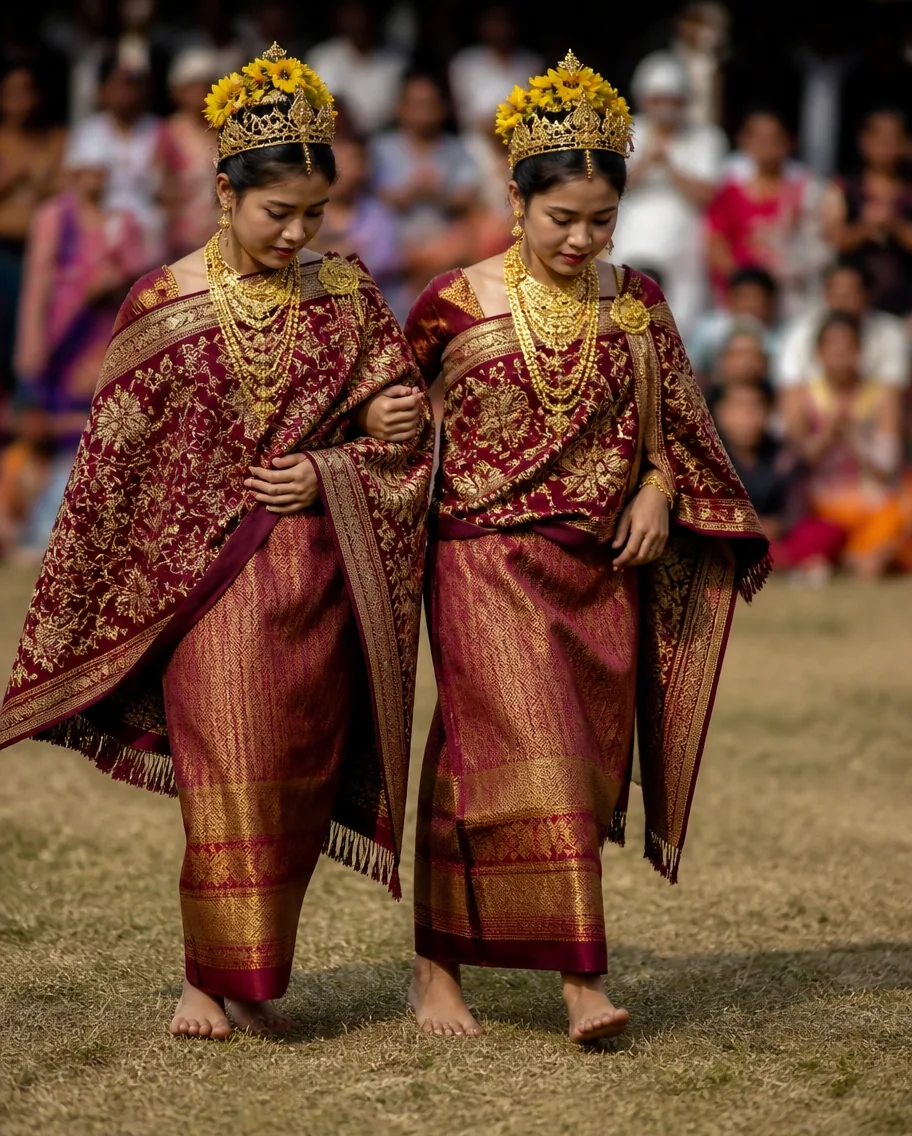
Unmarried dancers- JainsemA two-piece silk garment wrapped from the waist down, usually in deep maroon, blue or black with a gold border.
- DharaAn embroidered cloth pinned across the shoulders; two may be worn crossed, one over the other.
- CrownA tall gold or silver filigree headpiece, often with fresh yellow flowers tucked into it.
- NecklacesLayered gold chains and strings of coral or foil-covered beads, worn in parallel lines.
- Earrings and banglesGold earrings, armlets and wristlets complete the set.
- Bare feetDancers move barefoot on the earth of the courtyard.
Men — Ka Shad Mastieh
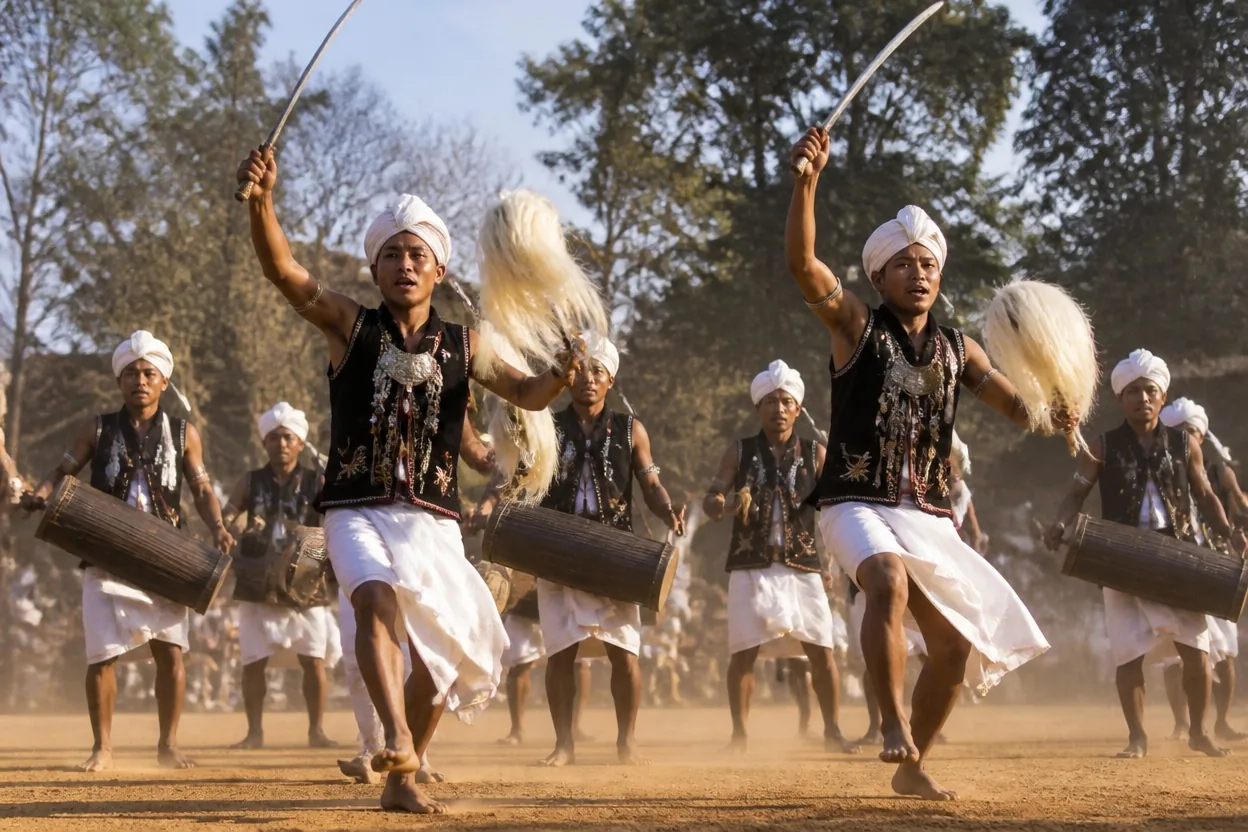
Ceremonial regalia- TurbanA golden silk turban, sometimes with a plume, wrapped in the Khasi style.
- JacketA sleeveless, richly embroidered jacket over a white or maroon cloth worn like a dhoti.
- Silver ornamentsA semi-circular collar, a chain across the shoulders and a silver-mesh belt at the waist.
- SwordKa waitlam, carried in the right hand and used in the mock duels of the outer circle.
- WhiskA white yak-hair whisk held in the left hand, moving with the rhythm of the drums.
- HandkerchiefA small cloth carried by dancers, traditionally used to wipe the face.
The colours are not decorative choices. Deep silk with gold thread signals ceremonial standing, and the quantity of gold and silver a family can assemble is a visible statement of the household's position. The yellow flowers in the crown are a small, deliberate note of the season.
It is worth being precise about what this dress is not. Nongkrem costume is Khasi, and it should not be confused with the feathered headdress and drum-led dress of the Garo Wangala dance, or with Naga ceremonial dress from the neighbouring states. Each belongs to a different community and a different festival.
07 · Music
Nongkrem Dance Music and Instruments
The music is not background. It sets the pace, signals the changes and tells the dancers when to stop. A small group of musicians stands at the edge of the courtyard, and the whole performance is timed to them.
A double-reed pipe with a piercing, reedy tone, usually played in pairs. It carries the melody over the open ground and is the sound most associated with Khasi religious dance.
The Khasi drum family, described in the state's cultural record as ksing shynrang and ksing kynthei — male and female drums — which play against each other rather than in unison.
The big drum, listed among Khasi percussion instruments. Its deeper beat anchors the ensemble and can be heard across the courtyard.
A smaller drum used for the faster figurations. Together with the cymbals it marks the shifts in tempo that the men's dance follows.
Small cymbals that keep the rhythmic cycle steady and add a bright edge to the drum pattern.
A bamboo flute used in Khasi music, including solo settings. It appears in the wider musical life of the community rather than as the lead instrument of this dance.
There is no written score and no fixed duration. The drummers watch the dancers and the dancers listen to the drums, and the tempo rises as the afternoon goes on. When the beat changes, the men stop, turn and resume; when the light goes, the dance ends. Any staged presentation of Nongkrem Dance therefore depends on live musicians — a recording flattens exactly the cues the dancers rely on.
08 · Performance
Nongkrem Dance Movements and Performance Style
The dance is built on two concentric circles. Women form the inner circle, close together and facing the centre; men form a wider ring around them. The arrangement is the choreography, and almost everything else follows from it.
The women's circle
The women keep their bodies upright and their eyes lowered. The steps are small — forward and back, a little to the side — with the toes bent as if gripping the ground. The arms stay loose from the shoulders and the upper body barely moves. The circle turns slowly on itself, so that the dancers seem to revolve rather than travel. Restraint is the point: the effect is dignified rather than expressive.
The men's ring
The men's movement is the opposite in energy. They gallop around the outer circle, slow down and speed up with the drums, stop on a change of beat and set off again in the other direction. Swords are raised and turned in mock duels, and the whisk traces the rhythm in the left hand. The outer ring faces outward as often as inward, which is why the formation is usually described as a guard around the women at the centre.
Nothing about this is improvised in the modern sense. The steps are inherited, the positions are fixed by custom, and the dancers learn them long before they are old enough to take part. What changes from year to year is the tempo, the crowd and the light.
09 · Location
Where Is the Nongkrem Dance Festival Celebrated?
The festival is held at Smit, a village in the East Khasi Hills of Meghalaya and the capital of the Khyrim Syiemship. It sits south-west of Shillong: the state government gives the distance as about 11 km, while Meghalaya Tourism gives about 15 km. Either way it is a short drive of roughly half an hour from the city, which makes Shillong the practical base for visitors.
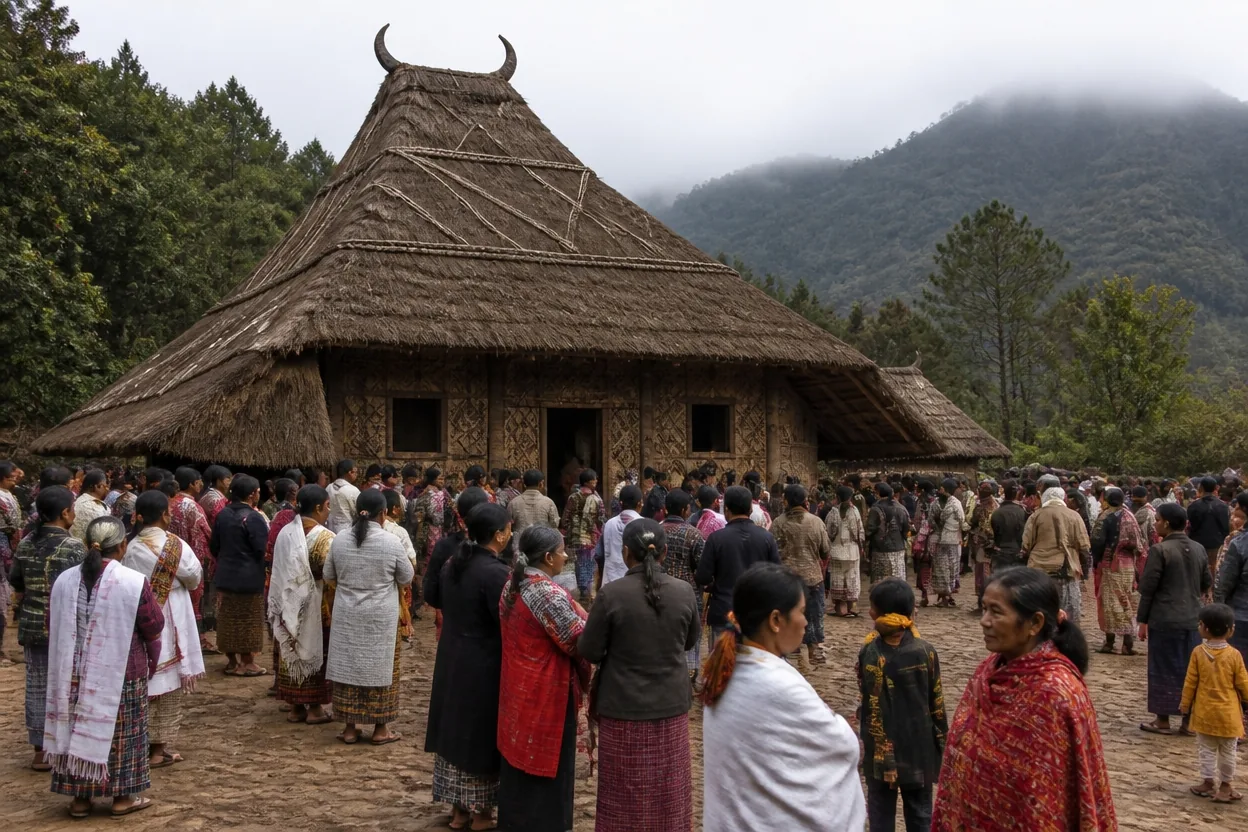
The main venue is the Ing Sad, the ruling house's hall, and the courtyard in front of it. The building is thatched and, according to the state tourism department, constructed entirely without metal — a detail worth noticing when you arrive. The dance takes place on the open ground in front of it, not on a stage.
Getting there
Most travellers fly into Guwahati and drive to Shillong, then continue to Smit by taxi or shared vehicle. Shillong's own airport at Umroi has limited connections, and there is no railway station in Shillong; Guwahati is the usual railhead. On the day of the public dance, allow extra time for traffic and parking, and confirm local arrangements before setting out.
If you are building a longer cultural itinerary, Smit pairs naturally with Shillong's museums and markets, and with the state's other festival traditions covered in the Meghalaya dance guide.
10 · Timing
Nongkrem Dance Festival Date and Celebration
The festival is held annually in October or November, over five days. Meghalaya Tourism places it in November; the state government's festival page says generally November each year; the Department of Arts and Culture notes that it now falls in October or November, having once been a mid-summer celebration.
There is no fixed Gregorian date, and this page does not publish one. The Hima Khyrim sets the timing according to its own customary calendar, so the days shift from year to year, and reports sometimes count the five days differently. If you are planning travel, confirm the current schedule with Meghalaya Tourism or the district administration in Shillong before booking transport or accommodation.
Two practical points follow. First, the public dance is generally the fourth day, so a single-day visit should be planned around that rather than the opening. Second, the festival is an active religious event: the dates may be adjusted for local reasons, and a published date is an indication rather than a guarantee.
11 · Heritage
Cultural Importance of the Nongkrem Festival
Nongkrem matters to the Khasi community for reasons that go well beyond the visual spectacle. It is one of the few occasions on which the institutions of the Hima — the Syiem, the Syiem Sad, the Myntries and the priests — appear together in public and perform their customary roles. Remove the festival and those roles lose their most visible rehearsal.
It is also a mechanism for passing knowledge down. The dance steps, the drum patterns, the wrapping of the jainsem, the making of the crown and the sequence of the rites are all learned by participation. Khasi society is matrilineal, with clan membership and inheritance passing through the mother, and festivals such as this one give the younger generation a structured place inside that system.
For Meghalaya more broadly, the festival is part of a cultural tourism economy that supports weavers, craftspeople, musicians and transport operators around Smit and Shillong. That economy depends on the ceremony remaining a ceremony: the moment it becomes a daily show for visitors, the reasons people travel to see it disappear.
How it differs from other Khasi festivals
| Detail | Nongkrem Dance | Shad Suk Mynsiem |
|---|---|---|
| Community | Khasi, Hima Khyrim | Khasi, organised by Seng Khasi |
| Season | October–November | April, the spring thanksgiving |
| Venue | Smit, East Khasi Hills | Shillong and Khasi villages |
| Duration | Five days | One main day of dance |
| Focus | Ritual obligation of the ruling house | Thanksgiving for harvest and sowing |
The comparison is worth keeping in mind, because the two are often blended together online. For a detailed account of the spring festival, see Shad Suk Mynsiem dance.
12 · On Stage
Nongkrem Dance Performances for Cultural Events
A festival courtyard and an event stage are not the same thing, and good cultural programming respects the difference. What travels well is the dance as a cultural presentation: a short excerpt of Ka Shad Kynthei and Ka Shad Mastieh, introduced with a clear explanation of the festival, the Khyrim Syiemship and the meaning of the rites that stay at Smit. What does not travel is the ritual itself, which belongs to the Ing Sad and to the community that performs it.
Presented that way, a Khasi dance performance works in a range of settings:
- Cultural festivals and heritage events that need an authentic Northeast Indian programme rather than a generic folk medley.
- School and college cultural days, where a short demonstration with commentary teaches more than a costume parade.
- Museums and cultural exhibitions, particularly where Khasi textiles, jewellery and music are on display.
- Traditional celebrations and community gatherings hosted by Khasi families and associations outside Meghalaya.
- Corporate cultural programmes built around regional themes, foundation days or India-focused conferences.
- National and international cultural exchanges where the brief is accuracy, not spectacle.
Two practical requirements are worth flagging early: live musicians, because the dance is cued by the drums, and enough floor space for two concentric circles. A stage that only allows a line of dancers will not show the form. For a broader set of regional options, see North-East tribal dance performances.
13 · Booking
Book Nongkrem Dance Performers Through BookMyDance
If you are arranging a Khasi cultural performance for a festival, a college programme, a corporate event or a community celebration, BookMyDance connects you with traditional dance performers across India. Share your date, city, audience size and the kind of presentation you have in mind, and the team can help you plan a programme that represents the tradition accurately — with live music wherever possible and an introduction that explains what the audience is watching.
14 · Questions
Frequently Asked Questions About Nongkrem Dance
Q1. What is Nongkrem Dance?
Nongkrem Dance is the ceremonial Khasi dance performed during Ka Pomblang Nongkrem, a five-day thanksgiving festival held at Smit in Meghalaya's East Khasi Hills. Unmarried women dance in an inner circle in silk and gold, while men form an outer ring with swords and white yak-hair whisks. It is a religious observance, not a staged folk performance.
Q2. Which tribe performs Nongkrem Dance?
The Khasi people, and specifically the community of Hima Khyrim, one of the traditional Khasi states. The festival is presided over by the Syiem of Khyrim. It is not a Garo tradition — the Garo communities of Meghalaya have their own festivals, such as Wangala.
Q3. Where is the Nongkrem Dance Festival celebrated?
At Smit, the capital of the Khyrim Syiemship in the East Khasi Hills, about 11 to 15 km south-west of Shillong. The main venue is the Ing Sad, the ruling house's thatched hall, and the courtyard in front of it.
Q4. What is the significance of Nongkrem Dance?
It is a prayer for a good harvest and prosperity, offered to the goddess Ka Blei Synshar, with offerings to Lei Shyllong and to the ancestors of the ruling clan. Socially, it renews the customary duties of the Hima and gives the community a shared annual occasion.
Q5. What is Ka Pomblang Nongkrem?
It is the ritual core of the festival, and the name means the goat-killing ceremony of Nongkrem. The Syiem of Khyrim and the high priest perform it, including an oblation to Lei Shyllong with a cock, the sacrifice of goats, and offerings to the clan's ancestors. The public dance follows the rites.
Q6. What costumes are worn during Nongkrem Dance?
Women wear the jainsem, a two-piece silk wrap, with an embroidered dhara across the shoulders, a tall gold or silver crown decorated with yellow flowers, layered gold necklaces and bangles, and no footwear. Men wear a silk turban, a sleeveless embroidered jacket, a dhoti-style cloth, silver ornaments, a sword in the right hand and a yak-hair whisk in the left.
Q7. When is the Nongkrem Dance Festival celebrated?
Annually in October or November, over five days, with the public dance usually on the fourth day. The Hima Khyrim sets the dates by its own customary calendar, so they change each year. Confirm the current schedule with Meghalaya Tourism before planning travel.
Q8. What music and instruments are used in Nongkrem Dance?
Live drums, cymbals and the tangmuri, a double-reed pipe usually played in pairs. Khasi instruments include the ksing drums, the larger nakra and the smaller ksing padiah, with shaw shaw cymbals keeping the rhythmic cycle. The drummers control the tempo and cue every change in the dance.
Q9. What is the difference between Shad Nongkrem and Ka Pomblang Nongkrem?
Shad means dance, so Shad Nongkrem refers to the dance itself. Ka Pomblang Nongkrem refers to the sacrificial ceremony at the centre of the festival. The Nongkrem Dance Festival is the public name for the whole five-day event, which includes both.
Q10. Can Nongkrem Dance performers be booked for cultural events?
Yes. Trained Khasi performers can present an adapted stage version for cultural festivals, school and college programmes, exhibitions and corporate events. The ritual elements remain at Smit, and a good presentation includes live musicians and a short explanation of the tradition. BookMyDance can help you plan this through its booking team.
Explore more