Assamese Folk Dance · Assam

Bihu Dance of Assam

Bihu dance is the traditional Assamese folk dance of the Bihu festivals — a joyful group performance where men and women dance to the live beat of the dhol and the call of the pepa. This page explains the dance, its festivals, music and costumes, and how to book authentic Bihu dancers for your event.

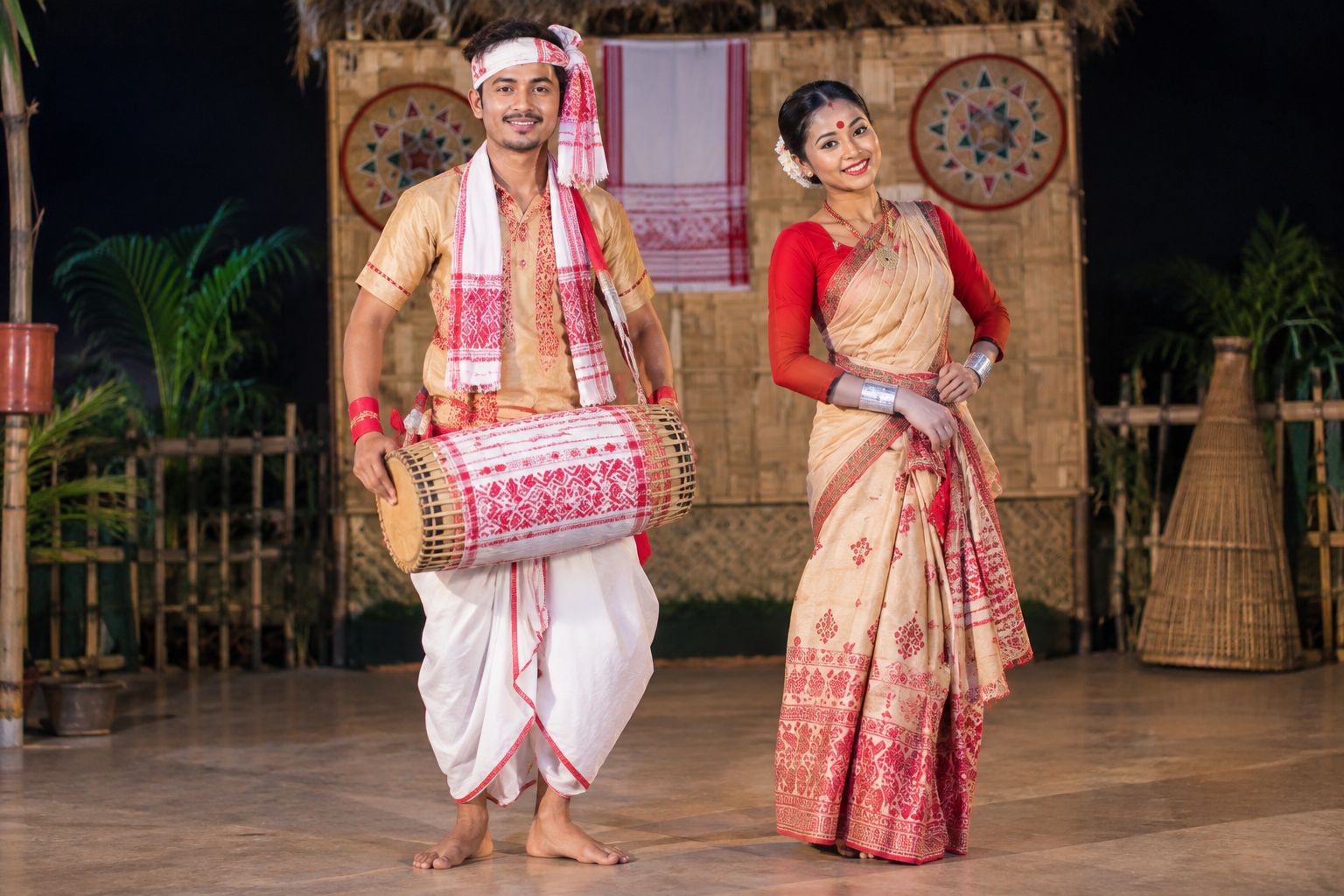
Bihu dancers of Assam in traditional mekhela chador performing with a dhol player
Dance form
Group folk dance of Assam
Main festival
Rongali / Bohag Bihu, mid-April
Key instruments
Dhol, pepa, gogona, toka, taal
Traditional attire
Mekhela chador · dhoti & gamosa

The Folk Dance of Assam

What Is Bihu Dance of Assam?

Bihu Dance of Assam is a traditional Assamese folk dance performed as part of the Bihu festivals — a group dance in which men and women move together to live folk music, led by the dhol player and answered by quick, springy footwork and expressive hand movements.

The dance belongs to the whole community, not to a professional class of performers. It grew out of village gatherings that marked the seasons, the harvest and the Assamese New Year, and the songs that accompany it — known as Bihu geet — speak of love, nature, youth and rural life. Unlike formal classical styles, there is a playful, open exchange between dancers and musicians: the dholiya sets a rhythm, dancers respond, and the energy builds with the music rather than following a fixed script.

Today you will see Bihu both ways — danced in village courtyards and open fields during the spring festival, and staged by trained cultural troupes at events across India. If you are exploring the dance traditions of Assam, Bihu is the tradition most people picture first when they think of Assamese culture.

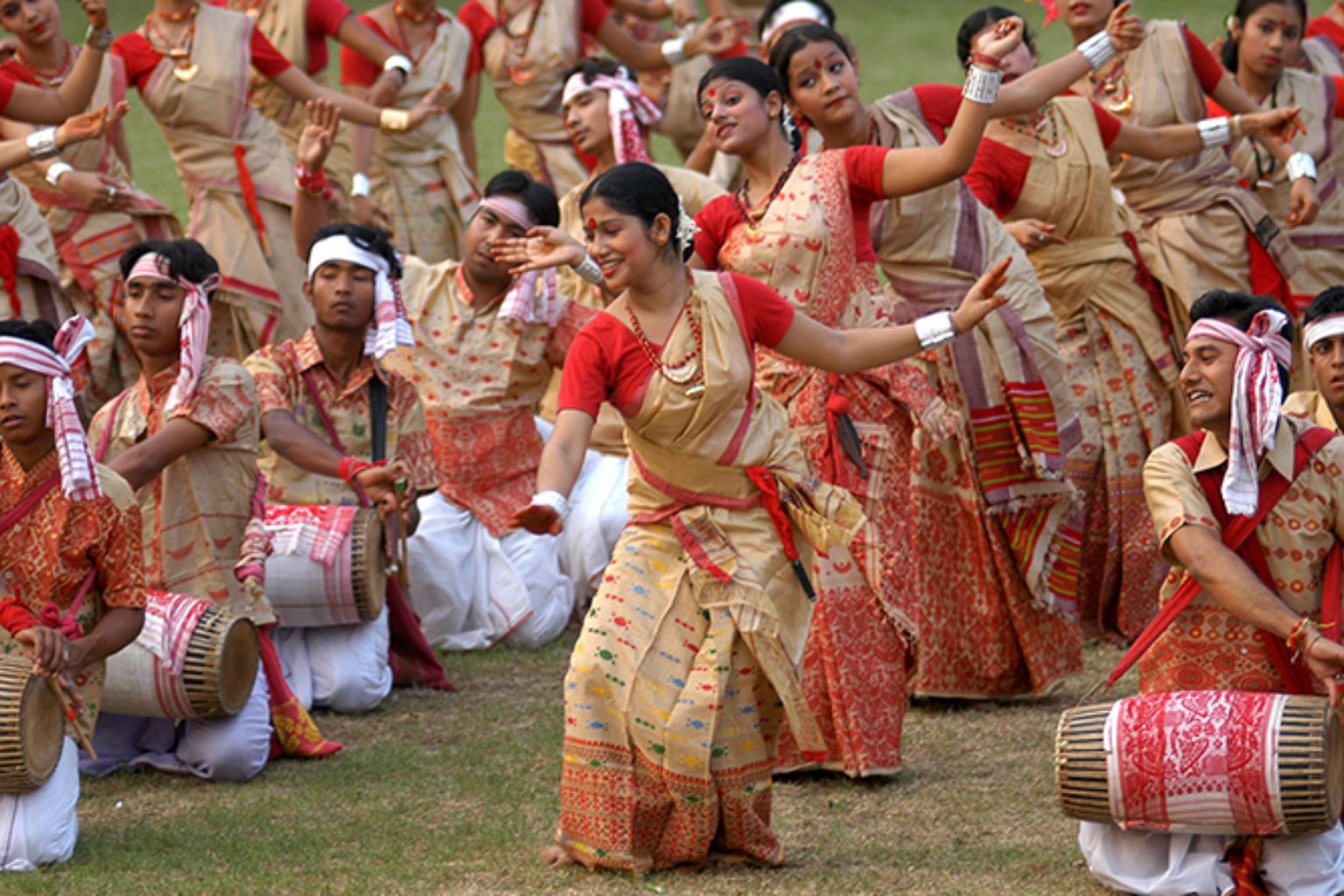
Group of Bihu dancers performing in traditional formation with live dhol accompaniment
Bihu dancers in group formation, performing to live folk music.

Culture & Identity

Why Is Bihu Dance Important in Assamese Culture?

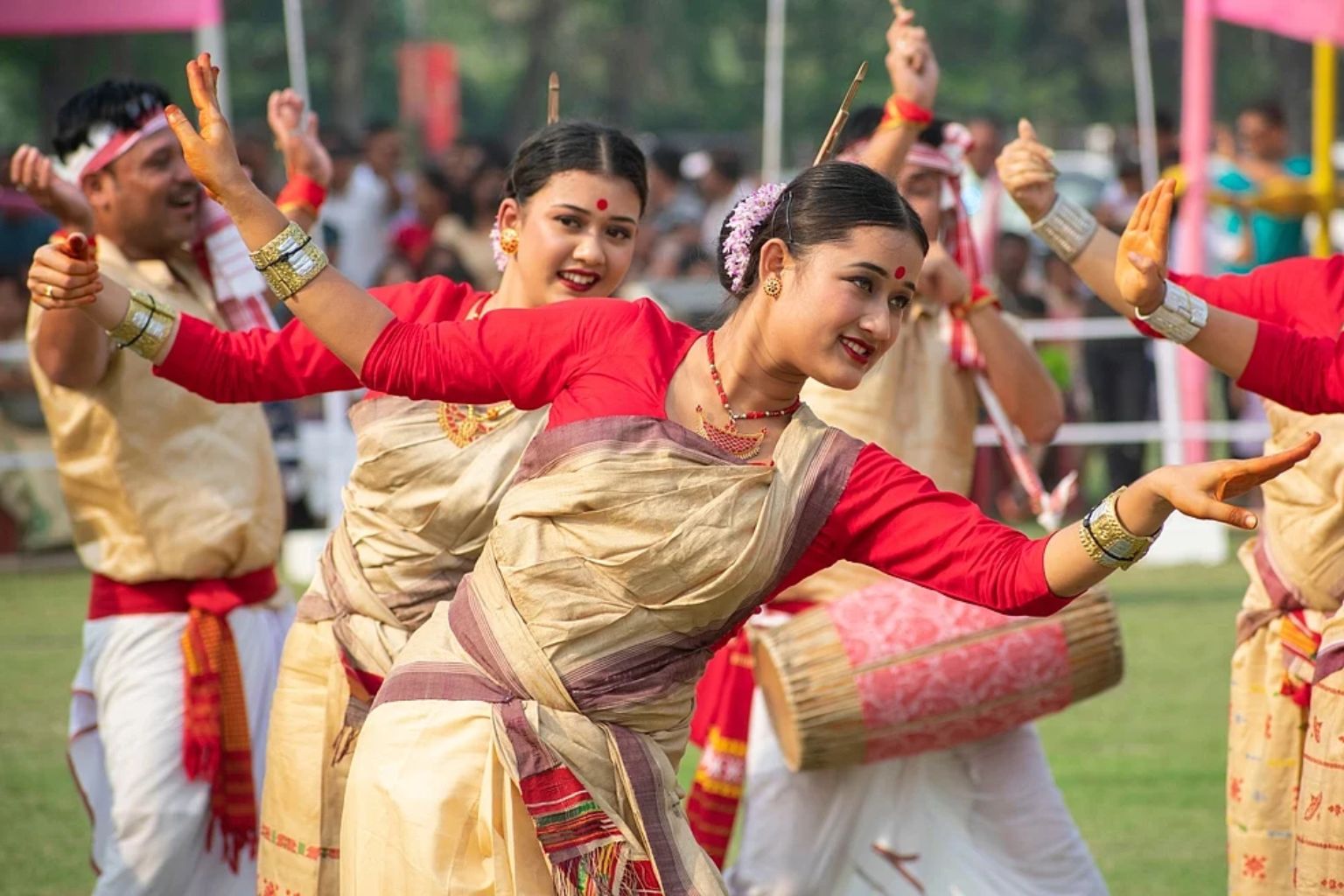
Bihu dancer dressed in traditional Assamese attire with jewellery and flowers in her hair

Bihu is not just a performance in Assam — it is a marker of cultural identity. The dance is tied to the agricultural rhythm of the state and to the turning of the seasons, and it grew around community gatherings that celebrated the land, the harvest and the New Year.

What keeps it alive is how openly it belongs to everyone. It has traditionally been danced in fields, courtyards and community spaces, with participation across age groups. Elders pass the songs and steps to younger generations, and neighbourhoods organise Bihu celebrations together every April. Music, dance and social participation are woven into one occasion rather than kept separate.

That is why a Bihu performance at an event carries more than entertainment value — for Assamese audiences it is a piece of home, and for everyone else it is a genuine introduction to the culture of the North-East.

Festival Calendar

Types of Bihu Celebrations and Their Dance Traditions

Assam celebrates three Bihu festivals in a year, and each has its own character. The dance most people know as "Bihu dance" comes chiefly from the spring festival.

Rongali / Bohag Bihu

Mid-April · Assamese New Year

Rongali Bihu marks the arrival of spring and the Assamese New Year, and it is the festival most closely associated with Bihu songs and Bihu dance. Communities come together for days of feasting and music, and in the countryside groups traditionally perform from house to house and in village gatherings. This is the dance form staged at cultural events.

Kongali / Kati Bihu

October · Lean season

Kati Bihu is a quieter, more austere occasion observed when the standing crop is still growing. It is marked with lamps, prayers and rituals rather than the joyful dancing of spring, and it should not be confused with the Rongali Bihu celebration most audiences picture.

Bhogali / Magh Bihu

January · Harvest festival

Magh Bihu celebrates the completed harvest — a time of feasting, community meals and gatherings around bonfires. Its mood is festive and communal, and it has its own food and social customs; the dance tradition most associated with staged performances still traces back to the Rongali spring celebration.

In short: "Bihu" is a festival family, not one single occasion — and the stage-style Bihu dance you see at events draws its steps, songs and energy chiefly from the Rongali/Bohag tradition.

Style & Performance

What Makes Bihu Dance Unique?

A Bihu dance performance is easy to recognise and hard to forget. The footwork is quick and springy, with dancers rising on their toes and tapping the ground in rhythm. Hands and arms do much of the storytelling, flowing outward and rising with the melody, while the body keeps a gentle, continuous sway.

  • Energetic rhythm — live dhol beats audiences feel as much as hear
  • Group spirit — men and women perform together in formations
  • Live traditional music — musicians play in the middle of the action, not behind a track
  • Distinctive costumes — mekhela chador, gamosa and Assamese jewellery
  • Playful interaction — dancers and musicians respond to each other in real time
  • Festive atmosphere — expressive faces and gestures that draw the audience in

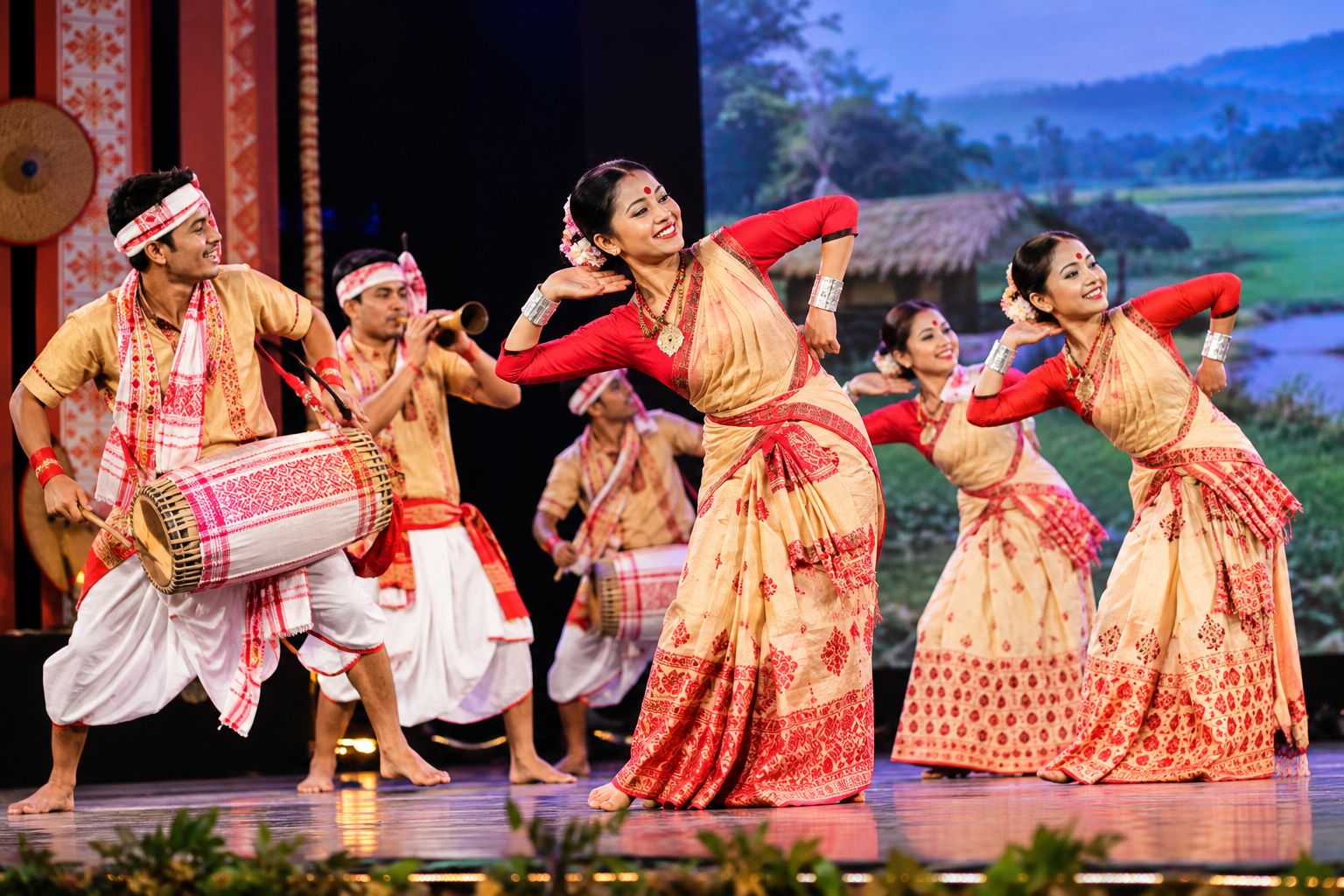
Most performances are group performances, with dancers arranged in lines or circles, often in complementary men's and women's formations. For event planners, the practical takeaway is simple: Bihu translates very well to the stage, whether the audience knows Assam well or is watching the folk dance of Assam for the first time.

Bihu dance performance on stage with Assamese dancers in traditional costume and a dhol player leading the rhythm

Traditional Attire

Traditional Bihu Dance Costume

The traditional Bihu dance costume is a large part of the performance's visual charm — colourful without being loud, and every piece rooted in Assamese daily life and weaving tradition.

Women's attire

Women dancers typically wear the mekhela chador, Assam's elegant two-piece drape, often handwoven in cotton or silk. Red and golden accents on a white or natural base are a familiar Assamese combination, though exact colours and motifs vary by region and troupe. Traditional Assamese jewellery such as the junbiri necklace adds a festive touch, and dancers often tuck fresh flowers — most famously the foxtail orchid, kopou phul — in their hair. Some performances also feature the jaapi, the decorated bamboo hat associated with Assamese tradition.

Men's attire

Men usually perform in a traditional dhoti with a kurta or a suitable traditional upper garment, with the gamosa — the red-and-white handwoven cloth that is a proud symbol of Assamese identity — tied around the head or waist. Musicians accompanying the dance dress in similar traditional attire.

Costumes are not identical everywhere: Assam's weaving traditions differ across communities, and troupes adapt their attire for stage conditions. The overall look, however, is unmistakably Assamese — and professional troupes arrive in full traditional dress.

Live Folk Music

Music and Instruments Used in Bihu Dance

Live folk music is the soul of Bihu. The exact combination of instruments varies from troupe to troupe, but these are the ones most associated with Bihu dance performances:

Dhol

The rhythmic anchor

A barrel drum played with hands and sticks. The dholiya sets the tempo of the whole performance and often leads the dancers with both beats and calls.

Pepa

The signature voice

A small pipe made from a buffalo horn. Its bright, reedy call is instantly associated with Bihu and gives the performance its unmistakable Assamese character.

Gogona

The bamboo hum

A bamboo jaw-harp held between the teeth and plucked to produce a resonant drone, traditionally handcrafted from a special variety of bamboo.

Toka

The bamboo beat

A pair of simple bamboo clappers that keep the rhythm light and crisp — a small instrument with a big contribution to Bihu's cheerful tempo.

Xutuli

The whistle tone

A small bamboo whistle-like instrument whose high, airy tone threads through the ensemble and echoes the sounds of nature celebrated in Bihu songs.

Taal

The shimmer

Pair cymbals that add metallic accents and help mark the rhythm cycle, layering the dhol's beat into a fuller soundscape.

Not every performance uses every instrument — a small group may perform with just a dhol and a singer, while larger troupes bring the full ensemble. Either way, the music at an authentic Bihu show is live, traditional and made for dancing.

Bihu Geet

Bihu Songs and Dance Performance

Bihu songs (Bihu geet) and Bihu dance are two halves of one tradition. The songs are folk lyrics about love, the seasons, youth and rural Assam, sung live rather than played from a recording. The dholiya and singers carry the melody while the dancers move with it — so a Bihu show is really a combined song-and-dance performance, not a dance set to background music.

This is also why group choreography in Bihu has a natural, flowing feel rather than a rigid count: dancers follow the singer and the drummer, responding to calls and shifts in tempo. At staged events, troupes usually present a structured set of popular Bihu melodies woven into the choreography, keeping the traditional feel while fitting the event's time slot.

Occasions & Venues

Where Is Bihu Dance Performed?

Bihu dance belongs to Assam's own festival season first — village gatherings, community celebrations and Rongali Bihu events across the state every April. Beyond Assam, it now appears wherever Indian audiences celebrate culture:

  • Cultural festivals and state-level programs in Assam and across India
  • Community events and Assamese association celebrations
  • Corporate annual days, client evenings and brand events
  • School and college annual functions and cultural fests
  • Weddings, receptions and sangeet evenings
  • Government and institutional cultural programs
  • Public stage shows and ticketed cultural evenings

Because Bihu troupes travel for bookings, audiences well outside Assam — from Delhi to Bangalore — can experience the performance live at their own event.

The Performers

Bihu Dancers and Bihu Dance Groups

Bihu performances are built around the interplay of dancers and musicians. A professional booking can include:

  • Solo Bihu dancers — a single performer, usually paired with a dhol player, for compact stages and short slots
  • Male and female performers — traditional Bihu choreography often features complementary men's and women's formations
  • Small groups — four to six dancers with one or two musicians, the most requested format for corporate and wedding events
  • Full troupes — eight or more dancers with dhol, pepa, gogona and taal for festival main stages
  • Traditional musicians — dholiyas, pepa players and singers who anchor the performance's authenticity

Professional Bihu dance groups arrive stage-ready: costumes, props and instruments included, with choreography suited to the slot length and stage size. For a full evening of variety, organisers often pair a Bihu show with other folk styles such as Bhangra and Giddha performers or Garba and Dandiya dancers, building a multi-state folk showcase from a single booking.

Artist Booking

Bihu Artist Booking for Events

Through BookMyDance you can book Bihu dancers, Assamese folk performers and full troupes with live musicians for events across India — for cultural programs, corporate events, festivals, college fests, school functions, weddings and receptions, annual functions, government cultural programs and private celebrations.

You can share your requirement with the booking team, or message directly on WhatsApp. The team suggests suitable Bihu artists based on your event date, city, audience and format, helps you finalise group size and duration, and confirms the booking with clear terms.

Share your requirement

Tell us your event date, city, event type and the kind of Bihu dance performance you have in mind — group size, duration and format.

Get suitable Bihu artists

We identify suitable Bihu dancers, groups or troupes based on your requirement, budget and location, and share options with you.

Discuss performance details

Finalise duration, number of dancers, format, costume requirements and whether you want live musicians with the show.

Confirm the booking

Once you are happy, we confirm artist availability, performance details and booking terms — clearly and in writing.

Plan Ahead

Things to Consider When Booking a Bihu Dance Performance

A short checklist that makes booking smoother and prevents last-minute surprises:

  • Number of performers — solo, duo, small group or full troupe, matched to your stage and budget
  • Event location and date — earlier booking secures artist availability, especially in April
  • Performance duration — a typical stage slot runs roughly 15–30 minutes; confirm the length you need
  • Stage size — group formations need open floor space; share your stage dimensions
  • Music requirements — live dhol and folk instruments, or a mixed setup with your sound operator
  • Sound system — microphones for singers and instruments, coordinated with the venue
  • Costume requirements — professional troupes arrive in full traditional attire; confirm if you need anything extra
  • Travel arrangements — outstation bookings involve artist travel; agree logistics in advance
  • Rehearsal needs — for interactive or joint segments, allow a briefing before the event
  • Performance format — pure dance showcase, song-and-dance set, or an interactive cultural presentation
  • Audience type — families, students, corporate guests or festival crowds shape the right format
  • Run order — where the Bihu slot sits in your program, for smooth transitions

By Occasion

Bihu Dance for Different Events

Corporate Events

Annual days, client evenings and product launches get a premium cultural moment that stands apart from usual entertainment. Group formats scale from a compact showcase to a convention main stage, and the live dhol keeps the energy high throughout.

Cultural Festivals

Bihu was born for festival stages. Full troupes with live musicians deliver the colour, formations and call-and-response energy that festival crowds gather for — from state-level cultural festivals to community fairs and Rongali Bihu celebrations.

College & School Events

Students respond to Bihu's energy instantly. For annual functions and college fests, the show works as both entertainment and a live lesson in Assamese folk culture — and interactive formats where artists teach a few steps are especially popular.

Weddings

Bihu dancers bring festive, family-friendly energy to sangeet evenings, mehndi functions and wedding entrances. Celebration-themed songs and joyful group choreography fit Indian wedding festivities beautifully — see our wedding and sangeet dance performances for complete options.

Private Events

Birthdays, anniversaries and family reunions become memorable with a surprise Assamese cultural performance. Small Bihu dance groups adapt easily to homes, terraces and banquet spaces — no formal stage setup required.

Government & Institutional Programs

State celebrations, department annual functions and institutional cultural programs often need an authentic regional folk act. A structured Bihu stage performance with announced segments fits formal auditorium and official settings well.

Context

Bihu Dance and Assamese Folk Culture

Bihu dance is the most widely performed folk tradition of Assam, but it is one part of a much larger cultural landscape. The state's dance heritage includes tribal and community forms such as the Bodo community's Bagurumba and the tea-tribe communities' Jhumur, each with their own costumes, music and cultural settings.

Assam is also home to Sattriya, the classical dance of Assam, which grew out of the Vaishnavite monasteries (Sattras) and is devotional and classical in character — a very different tradition from Bihu's open-air folk celebration, and not another name for it. Neighbouring North-East states have their own classical and folk styles, such as Manipur's Manipuri classical dance. Knowing these distinctions helps when planning a cultural program: Bihu brings community celebration and festive energy, while classical forms bring devotional depth.

Questions & Answers

Frequently Asked Questions About Bihu Dance

What is Bihu Dance of Assam?

Bihu Dance of Assam is a traditional Assamese folk dance performed during the Bihu festivals. Men and women dance together in groups, moving to live folk music led by the dhol, pepa and gogona. It is most closely associated with Rongali (Bohag) Bihu, the spring festival that marks the Assamese New Year.

Why is Bihu dance famous in Assam?

Bihu dance is famous because it is the most widely performed expression of Assamese culture. It is danced by communities across the state during the Bihu festivals, passed down through generations, and has become the most recognised cultural symbol of Assam.

When is Bihu dance performed?

Traditionally, Bihu dance is performed during the Bihu festivals — Rongali or Bohag Bihu in mid-April, Kati or Kongali Bihu in October, and Magh or Bhogali Bihu in January. The dance is especially associated with Rongali Bihu, which welcomes spring and the Assamese New Year. Staged Bihu performances are also presented at cultural events throughout the year.

What are the main features of Bihu dance?

Quick, springy footwork led by the dhol beat, expressive hand and body movements, group formations of men and women dancing together, playful interaction between dancers and musicians, and traditional Assamese attire are the features people most associate with Bihu dance.

What costume is worn for Bihu dance?

Women dancers usually wear the mekhela chador, the traditional Assamese two-piece drape, often handwoven with red accents, along with Assamese jewellery and sometimes flowers in the hair. Men typically wear a dhoti with a kurta or traditional upper garment and a gamosa tied around the head or waist. Exact styles vary by region and troupe.

Which instruments are used in Bihu dance?

Common Bihu instruments are the dhol (drum), pepa (a buffalo-horn pipe), gogona (a bamboo jaw-harp), toka (bamboo clappers), xutuli (a bamboo whistle) and taal (cymbals). Not every performance uses every instrument — the dhol is the rhythmic heart of most Bihu shows.

Can I book Bihu dancers for an event?

Yes. BookMyDance helps you book professional Bihu dancers, Bihu dance groups and full troupes with live musicians for cultural programs, corporate events, weddings, school and college functions, festivals and private celebrations across India.

How can I book a Bihu dance group?

Share your event date, city, event type and performance requirement through the enquiry form, WhatsApp or a phone call. Suitable Bihu dancers or groups are then suggested based on your format, group size and duration, and the booking is confirmed with transparent terms.

Can Bihu dancers perform outside Assam?

Yes. Bihu dance groups travel for events across India, including Delhi, Mumbai, Bangalore and other major cities, with travel and logistics coordinated as part of the booking.

What type of events are suitable for a Bihu dance performance?

Bihu performances suit cultural festivals, corporate events and annual days, college fests and school functions, weddings and receptions, government and institutional cultural programs, and private celebrations. Formats range from a solo dancer with a dhol player to a large troupe with the full folk ensemble.
Bring the Energy of Assam to Your Event

The dhol beat, the pepa's call, dancers in traditional Assamese attire — a live Bihu performance gives your guests something they will talk about long after the event.