Cultural significance
Thanksgiving to Misi Saljong after the harvest, and a public expression of Garo identity.
Read the historyGaro Hills · Meghalaya
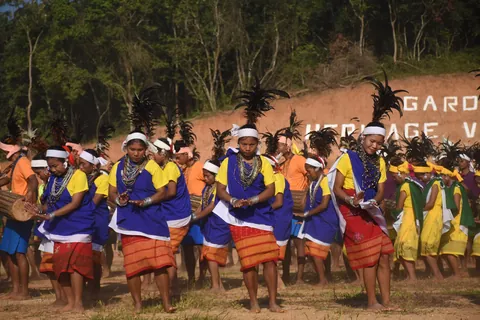
Wangala dance is the heartbeat of Wangala, the great post-harvest festival of the Garo people of Meghalaya. After the year's crop is gathered, villages across the Garo Hills give thanks to Misi Saljong — the Sun god, associated with fertility and prosperity — with days of music, feasting and dance. Men carry the dama, a long oval drum slung across the body, and beat out a steady rhythm; women move beside them in hand-woven cloth and feathered headgear, arms swaying in time. It is less a show put on for spectators than a community celebrating together, and that is exactly what makes it worth watching.
The dance
A harvest dance of the Garo community, performed as an act of thanks rather than a staged spectacle — and one of the most distinctive traditions in Meghalaya.
Wangala dance is the group dance performed at Wangala, the post-harvest festival of the Garo people, who call themselves A'chik Mande. The Garo are one of the major indigenous communities of Meghalaya, and their homeland — the Garo Hills — lies in the western part of the state. The dance is the closing and most visible act of the festival: after rituals of thanksgiving have been offered, men and women form lines and dance to the sound of drums for hours.
The occasion is agricultural at its core. Wangala marks the end of the year's work in the fields and the arrival of the harvest, and the dance gives that relief a public shape. It is also a statement of belonging: the dress, the instruments, the songs and the steps are all recognisably Garo, passed down through families and villages rather than taught in a formal syllabus.
What makes the performance special is that it is not built around a soloist. Everyone has a part — the drummers set the pace, the dancers answer it, elders and children join the line, and the whole gathering moves together. A troupe performing on a city stage may compress the experience into minutes, but the form comes from that shared, community-scale celebration. For a broader view of the state's traditions, see traditional dances of Meghalaya.
Thanksgiving to Misi Saljong after the harvest, and a public expression of Garo identity.
Read the historyThe dakmanda, the gando, feathered headgear and layers of bead jewellery.
See the costumesThe dama drum sets the pulse, joined by gongs, flutes and buffalo-horn trumpets.
Explore the instrumentsVillage celebrations run for days; the 100 Drums Festival brings troupes together.
About the festivalTwo lines — men drumming, women dancing — moving as one community.
How it is performedTraditional Garo troupes for cultural festivals, campuses and public programmes.
Booking informationOrigins & meaning
The dance has no single founding date. Its story sits inside the older story of Garo agriculture, ritual and community life in the hills.
Wangala belongs to an agricultural world. For communities practising shifting cultivation, the harvest was the moment when a year of uncertainty ended, and gratitude had to be expressed properly. The festival was — and in some villages still is — an occasion for offering the first fruits of the field to Misi Saljong, the Sun god associated with fertility and prosperity, and for asking his blessing on the next cycle of cultivation.
Because the tradition was carried orally, its precise age is not documented, and it is more honest to describe it as an inherited practice than to date it. What is clear is the rhythm of the celebration: rituals first, dance last. In Songsarek (followers of the old animist faith) villages, a priest known as the Kamal leads the opening rites at the house of the Nokma, the village head, before the community moves to the dance ground. The final day belongs to Dama Gogata — literally the dance with drums.
The first harvest is offered with rice beer and cooked rice, in a rite of thanks led by the village priest at the Nokma's house.
Two or three neighbouring villages celebrate together; feasting, sports and visiting fill the days between the opening rites and the dance.
Drummers, dancers and onlookers assemble on the last day, and the ground fills with the sound of the dama.
The twentieth century interrupted this continuity. As Christianity spread through the Garo Hills, many families withdrew from rituals tied to the old faith, and by the middle of the century Wangala observances had narrowed to a small number of Songsarek villages. The 1976 revival at Asanang was, in part, a response to that loss — an effort by Garo leaders to keep the dance and its music visible for a generation growing up away from the old agricultural calendar.
That history explains why Wangala today has two faces. In remote villages it remains a ritual observance with a fixed place in the farming year. At the 100 Drums Festival it is a public cultural showcase, with troupes, prizes and an audience. Both are genuine expressions of the same tradition, and understanding the difference is the key to reading any performance you see.
“The original styles and moves are inspired by the crab, and the girls swaying and waving their hands symbolise plants rejoicing in the rain.” — Garo historian Milton S. Sangma, recounted in The Hindu's account of the Hundred Drums Wangala
The festival
The best-known stage for the dance is a three-day gathering at Asanang, where troupes from across the Garo Hills and beyond come to perform.
The Wangala 100 Drums Festival is the public, state-level form of the harvest celebration. It was first organised on 6 and 7 December 1976 at Asanang, near the Rongram block office about 18 km from Tura, and has been held every year since. What began as a cultural rescue effort is now one of Meghalaya's biggest annual events, with dance competitions, food stalls, sports and a large audience of visitors.
The name is often misunderstood. It does not mean that every Wangala celebration must use exactly one hundred drums. At the Asanang festival the figure comes from its organisation: ten participating troupes, each of ten drummers. Village Wangala celebrations may involve far fewer drums and far fewer people — the scale changes, the form does not.
For a visitor, the festival is a compact introduction to Garo culture. Troupes arrive in matched costumes, the drum lines compete on timing and footwork, and the arena fills with the sound of dama drums, gongs and horns. Troupes from Karbi Anglong, Tripura and even Bangladesh — places with sizeable Garo populations — have taken part, which says something about how far the tradition travels.
If you are planning to attend, keep in mind that the festival is usually held in November at Asanang, while individual villages set their own dates through the September–December harvest season. Confirm the current year's schedule locally before travelling, as dates and venues can change.
Dress & ornament
Garo festival dress is hand-woven, brightly coloured and specific — and it is one of the clearest ways to tell an authentic Wangala performance from a generic "tribal" costume.
The centrepiece of a woman's Wangala dress is the dakmanda (also written dokhmanda), a hand-woven wrap-around skirt worn with a fitted blouse and a shoulder cloth. The cloth is woven in strong horizontal bands of red, yellow, green, blue and black, and the finest pieces are family possessions rather than costumes bought for an event. A lighter wrap known as daksari is also worn, and the overall combination varies from village to village.
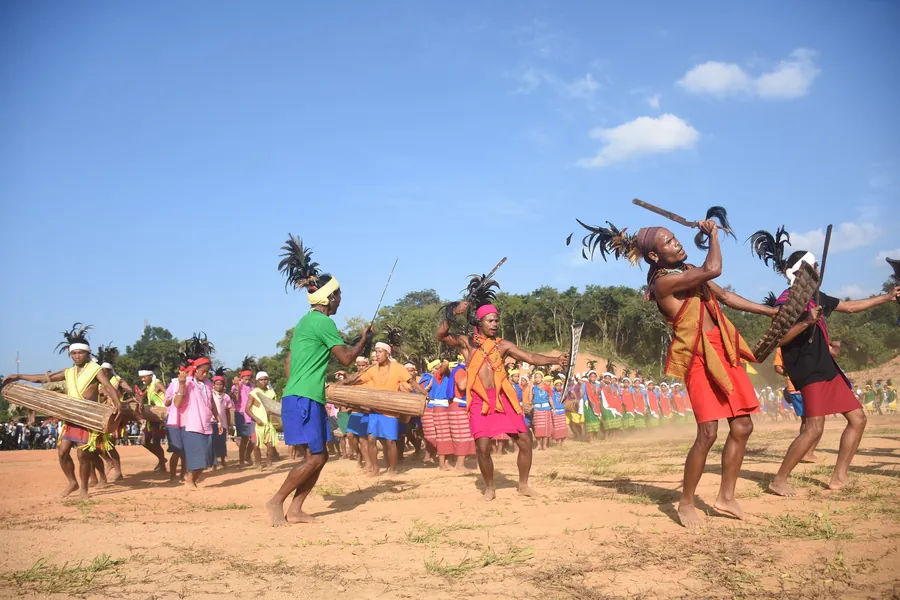
Men wear the gando, a loincloth or short wrap, usually with a shirt or jacket above it. The most photographed element of male dress is the feathered headgear: a turbanned kotip carrying tall black feathers, often with a coloured scarf known as a pandra tied around the head or shoulders. A Nokma leading his troupe may carry a milam, the traditional Garo dagger, along with a shield.
Jewellery is layered rather than minimal. Women wear multiple strings of beads across the chest, bangles on both wrists, earrings and hair ornaments, and a feathered headpiece completes the look. Colours are not random: troupes often dress in a consistent palette so that the line reads as one body in motion.
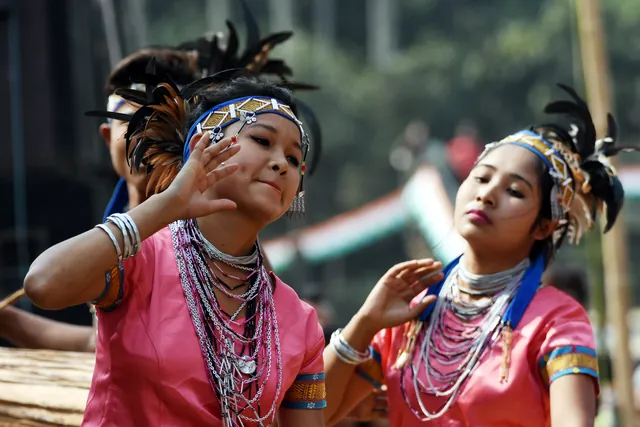
Woven, wrapped and layered — the visual anchor of the dance line.
Practical dance clothes, finished with feathers and a blade.
Garo dress is not uniform across all villages and clans. Patterns, colours and the specific pieces worn differ between communities, and modern festival troupes sometimes use machine-printed fabric where earlier generations used homespun cloth. Those differences are part of a living tradition, not mistakes — but a performer claiming to present "authentic" Garo dress should be able to explain which community the costume comes from.
Rhythm
In Wangala the music is not accompaniment. The drum line leads, and the dancers follow its tempo for as long as the celebration lasts.
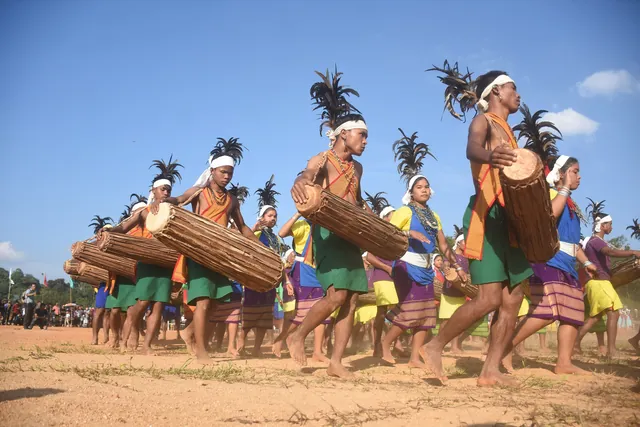
The defining instrument of Wangala is the dama, a long, oval-shaped wooden drum covered with hide. It is carried slung across the body and played while the drummer walks or dances, which is why the drum line can move with the dancers instead of sitting at the edge of the ground. Drum-makers traditionally favour light wood such as Gambare (Gmelina arborea) for the body.
Around the dama sits a small ensemble: gongs that mark the pulse, bamboo flutes that carry the melody, and the deep, breathy call of a trumpet made from a buffalo horn. In some communities a short bamboo instrument called the chigring adds a softer texture, and modern festival troupes sometimes add brass instruments to fill a large arena.
The rhythm does more than keep time. It sets the length of each step, signals a change of direction, and lifts the tempo as the line warms up. Experienced dancers read those shifts without a conductor, which is why a good Wangala performance looks unrehearsed and tightly coordinated at the same time.
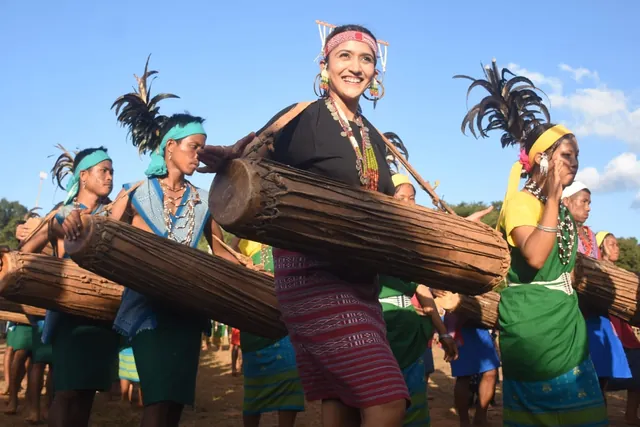
Long oval wooden drum covered with hide; the lead instrument of the dance.
Marks the beat and gives the ensemble its metallic, carrying edge.
Carries melody lines above the percussion, often played by younger musicians.
A deep, breathy call used to open the dance and punctuate its sections.
A small bamboo instrument that adds a soft rhythmic texture to the ensemble.
Larger festival troupes sometimes add brass instruments to project across an arena.
Movement
There is no single choreographed routine. There is a shared grammar of lines, steps and drum calls that each village and troupe interprets in its own way.
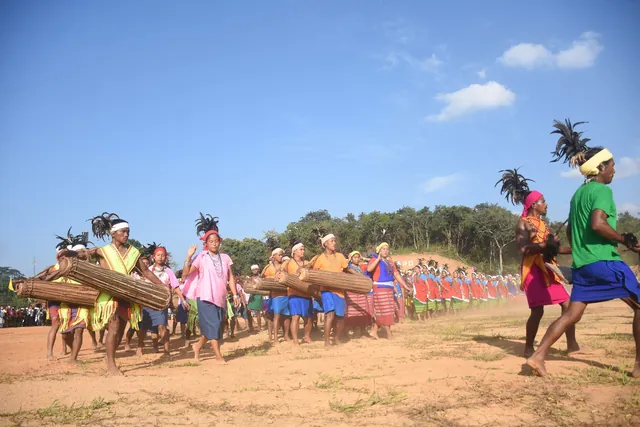
The classic formation is simple and striking: two parallel lines, one of men and one of women, facing the same direction or moving toward each other. The men carry and beat the dama; the women dance alongside with small, grounded steps and wide swaying arm movements. The line advances and retreats in rhythm, so the whole group appears to breathe together.
At the head of a traditional troupe walks the Nokma or a senior man, carrying the milam dagger and shield. His movement is more aggressive than the dancers' — including celebratory war cries that lift the energy of the group. Behind him the drummers set the pace, and the women's line answers it.
The women's gestures are often described as imitating plants swaying in the rain, a reading offered by Garo historians and consistent with the dance's harvest setting. The steps themselves are low and repetitive rather than virtuosic; the skill lies in keeping time and staying in line for a long performance.
Because the tradition is transmitted by participation, the movements are not standardised or formally named. A troupe from one village may emphasise footwork, another the sway of the arms, and a third the interplay between the drum line and the dancers. When a troupe performs on stage, expect a shortened, tightened version of this village form — the same vocabulary, arranged for an audience with a fixed running time.
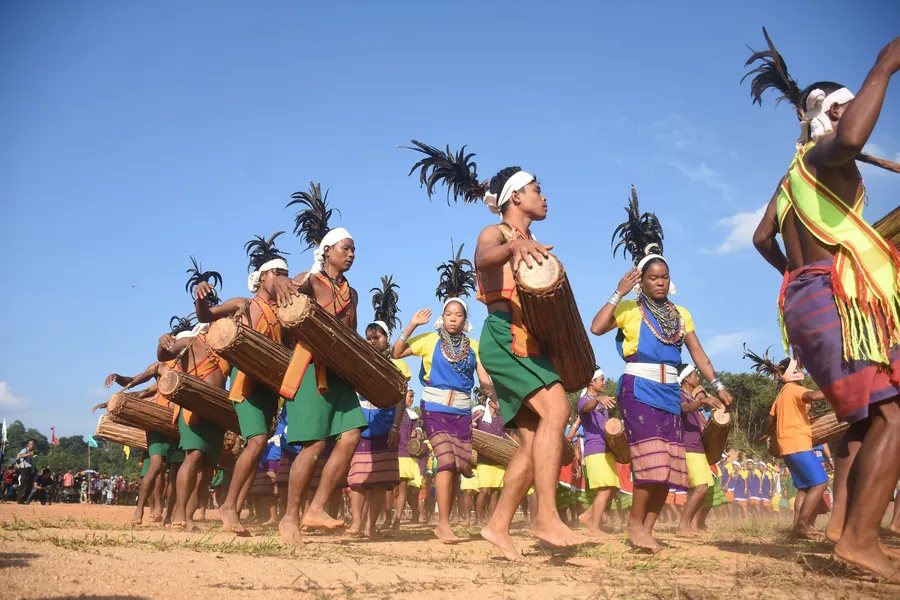
Living heritage
For the Garo community, the dance is a form of memory — of language, weaving, agriculture and the shared life of a village.
Wangala does cultural work that a museum cannot. It puts the Garo language, the loom, the drum, the agricultural calendar and the kinship system in the same place at the same time, and hands them to the next generation as an experience rather than an exhibit. Children who grow up watching and joining the line learn the steps, the songs and the etiquette of the festival without anyone formally teaching them.
The dance also carries identity beyond the Garo Hills. Garo communities live in parts of Assam, Tripura, Nagaland and Bangladesh, and Wangala is one of the occasions that draws them back together. At the Asanang festival, troupes from outside Meghalaya perform alongside local ones — a reminder that the tradition is regional, not confined to one state boundary.
In recent decades the dance has moved onto new stages: school and college cultural programmes, Republic Day folk festivals, tourism events and professional cultural showcases. These appearances have made Wangala better known, and they have also changed it — performances are shorter, costumes are sometimes simplified, and the ritual context is left behind. Both the village observance and the stage adaptation can be valid, as long as the difference is acknowledged. You can see how contemporary troupes blend tradition with staging in tribal folk fusion performance, and compare other traditions from the region in Northeast Indian folk dances.
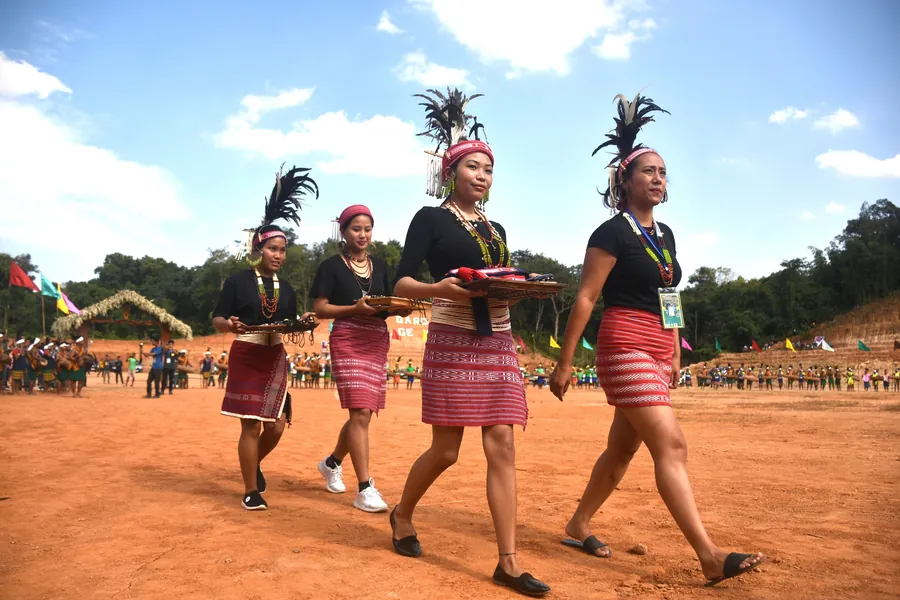
Performances
Planning a cultural programme? BookMyDance helps event organisers discuss traditional dance performances, including Garo troupes from Meghalaya.
A Wangala dance performance works best when it is treated as culture rather than entertainment filler. The drum line needs room to move, the costumes need to be seen, and a short introduction helps an audience understand what they are watching. If you are organising a cultural festival, a college programme or a public event with a Northeast India theme, a traditional Garo troupe can anchor the evening.
Share your requirement with the BookMyDance team and they will discuss what is possible for your date and city. Group size, travel from the Garo Hills, performance duration and pricing all depend on the event, so the arrangement is worked out case by case rather than sold as a fixed package.
Heritage weeks, state cultural days and community festivals.
Harvest, village and community functions with a cultural focus.
Annual days, cultural weeks and inter-school events.
Cultural fests, departmental seminars and student conclaves.
Diversity days and offsites built around regional themes.
Public cultural showcases, tourism outreach and state events.
Programmes spotlighting the cultures of the Seven Sisters.
Destination promotions, hotel events and ticketed cultural evenings.
Event date and city · venue type (indoor or outdoor) and stage size · length of the performance slot · approximate audience size · whether you want a spoken introduction to the dance · your budget range. The more the team knows, the more accurately they can tell you what a Garo troupe can deliver.
Wangala troupes are busiest during the harvest and festival season, roughly October to December, and travel from Meghalaya takes time to arrange. Group size varies with the format — a compact stage presentation needs fewer performers than a full drum line. Prices are quoted for the specific event rather than published here, because travel, duration and troupe size change the cost. BookMyDance does not guarantee availability until a requirement has been discussed and confirmed.
Authenticity
A traditional troupe brings the actual practice — the drums, the dress, the rhythm and the context — rather than a choreographed approximation of it.
The performance comes from the Wangala celebration itself, not from a generic tribal dance routine.
Dama drums played on stage create a physical sound that recorded music cannot match.
Woven dakmanda, gando, beadwork and feathered headgear, worn the way the community wears them.
Two lines moving as one is the form's signature, and it needs a real troupe to work.
A short explanation of the harvest festival and the instruments makes the performance mean more.
Duration, staging and group size are discussed around your programme rather than squeezed into a template.
In pictures
Drum lines, procession and festival dress, photographed at Wangala celebrations in the Garo Hills.
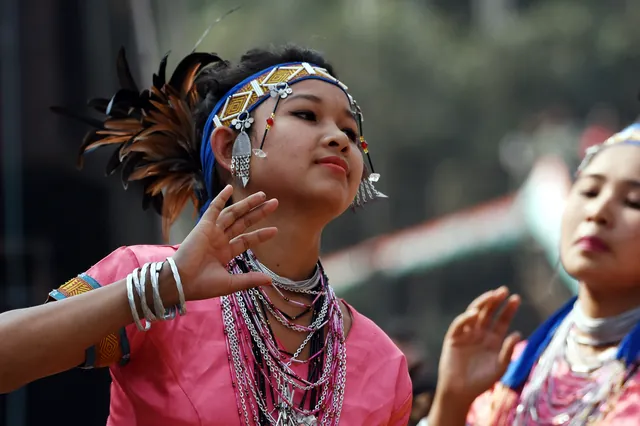
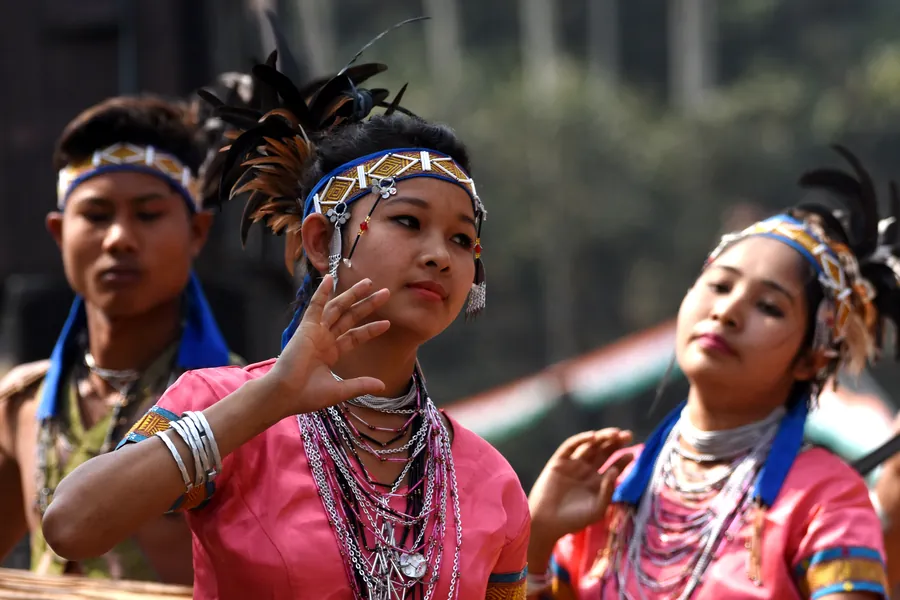
Photographs by Visma Kumar and Vishma Thapa, via Wikimedia Commons. Images are used under CC BY-SA 4.0 and CC0 licences and have been cropped and resized for this page. They show Wangala celebrations in the Garo Hills, not staged studio sessions.
Questions
Wangala dance is the traditional harvest dance of the Garo community, performed at the Wangala festival. Men play long oval drums called dama while women dance beside them in woven skirts and feathered headgear. It is a dance of thanksgiving, not a theatrical performance, and it is one of the best-known cultural traditions of Meghalaya.
It belongs to Meghalaya, specifically the Garo Hills in the western part of the state. Garo communities also live in parts of Assam, Tripura, Nagaland and Bangladesh, and Wangala is celebrated there as well, but the dance is most closely associated with Meghalaya.
The Garo people, who call themselves A'chik Mande. Within the Garo community, both Songsarek families who follow the old animist faith and Christian families take part, though the ritual portions of the festival are most fully observed in Songsarek villages.
It is an act of gratitude to Misi Saljong, the Sun god associated with fertility and prosperity, offered after the harvest. It also reinforces Garo identity: the language, the handloom, the instruments and the kinship ties of a village are all expressed in one shared event.
It is the state-level Wangala celebration held at Asanang, about 18 km from Tura in West Garo Hills. First organised in 1976, it brings together troupes from across the Garo Hills and beyond for three days of dance, music, food and sport. The "hundred drums" name comes from ten troupes of ten drummers each.
Women wear the dakmanda, a hand-woven wrap skirt in bright horizontal bands, with a blouse, shoulder cloth, layered bead necklaces, bangles and a feathered headpiece. Men wear the gando, a loincloth or short wrap, with a feathered turban called a kotip and a coloured scarf. A Nokma leading a troupe may also carry a milam dagger and shield.
The dama, a long oval wooden drum, is the lead instrument. It is joined by gongs, bamboo flutes, a trumpet made from buffalo horn and, in some communities, a small bamboo instrument called the chigring. Larger festival troupes sometimes add brass instruments.
The Garo agricultural year ends with the harvest, and Wangala marks that moment. The first produce is offered in thanks, blessings are sought for the next cultivation cycle, and the dance closes the festival. Its timing follows the crop, which is why villages set different dates between September and December.
Yes. BookMyDance can discuss a traditional Garo dance performance for your event. Group size, travel from Meghalaya, duration and pricing depend on your date, city and stage, so share the details through the contact page and the team will confirm what is possible. Availability is not guaranteed until the requirement is confirmed.
Cultural festivals, school and college programmes, university events, corporate cultural days, government and public programmes, Northeast India showcases, tourism and heritage events, and ticketed stage performances all suit a Garo troupe. An outdoor stage with room for the drum line works better than a cramped indoor platform.
Cultural details in this guide draw on the Meghalaya Government's Wangala festival page, reporting on the Hundred Drums Wangala published in The Hindu, and published ethnographic accounts of the Garo community. Festival dates and arrangements should be confirmed with local organisers before you travel or book.
Tell BookMyDance about your programme — the date, city, stage and the kind of cultural moment you want to create — and the team will discuss a traditional Garo dance performance with you.