Meghalaya · Khasi heritage
Shad Suk Mynsiem Dance – Traditional Khasi Dance of Meghalaya
Every April, the Khasi community of Meghalaya gathers at Weiking Ground in Shillong for a dance that asks for nothing and gives thanks for everything. Women in silver crowns move in an inner circle, men circle them with swords and whisks, and drums set the pace until sunset. This is Shad Suk Mynsiem — the dance of the peaceful heart.
Below you will find what the dance means, how it is performed, what the dancers wear and which instruments carry it. If you are planning a cultural programme, we also help organisers arrange a Shad Suk Mynsiem performance by a traditional Khasi troupe.
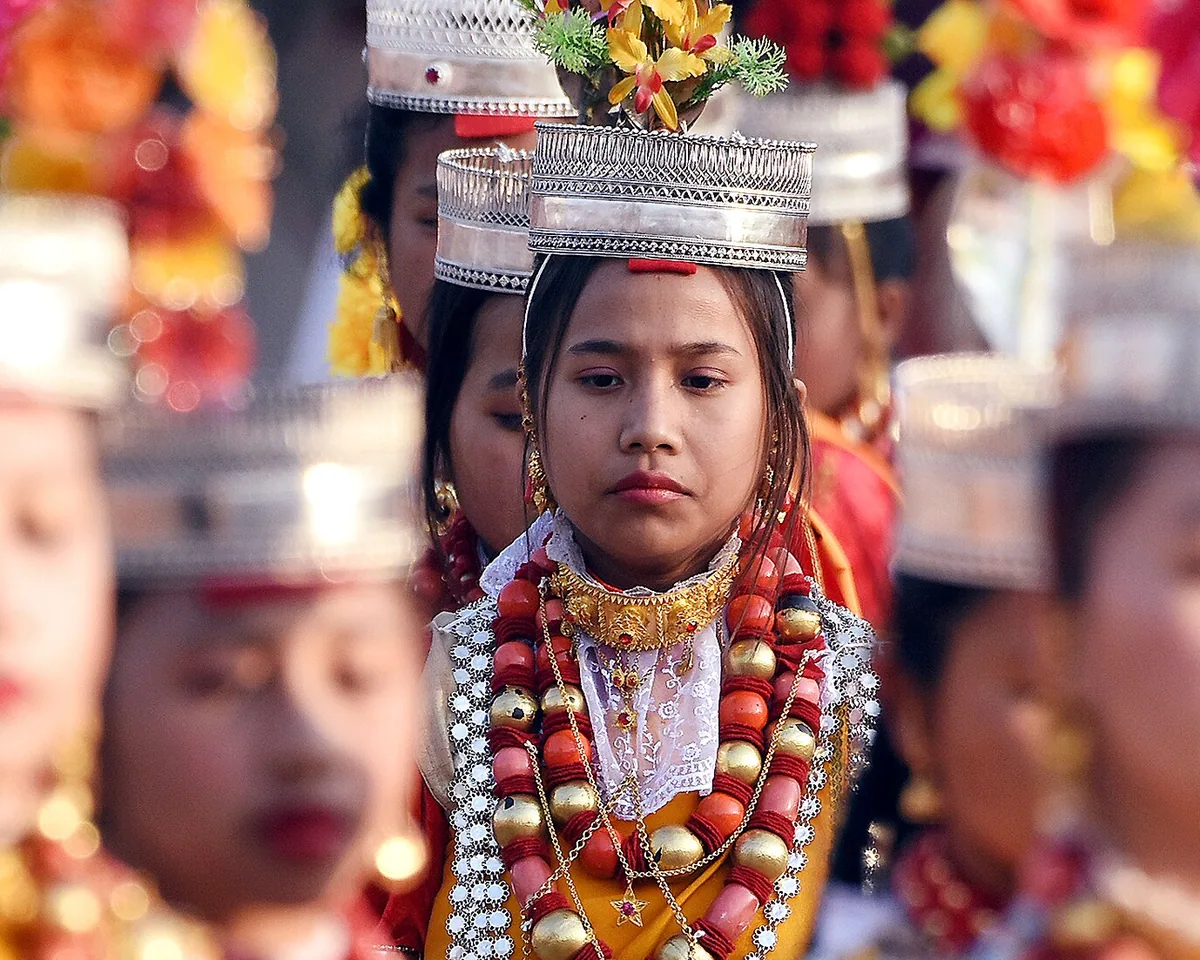
- Community
- Khasi (Hynñiew Trep)
- Season
- April, annually
- Main venue
- Weiking Ground, Shillong
- Form
- Two circles, live drums
The dance itself
What is Shad Suk Mynsiem Dance?
Shad Suk Mynsiem is a community dance of the Khasi people, one of the indigenous communities of Meghalaya in northeast India. It is danced outdoors, in daylight, by large groups of people in traditional dress — not on a proscenium stage, and not to recorded music.
The dance belongs to the agricultural year. It comes after the harvest and before the sowing season, and it is offered as thanks for the year that has passed and as a prayer for the one ahead. That is why it is usually described as a spring thanksgiving dance rather than a festival entertainment.
The name covers two things that are easy to confuse: the dance, and the three-day festival at which it is performed. The best-known gathering takes place at Weiking Ground (Madan Weiking) in the Jaiaw area of Shillong and is organised by the Seng Khasi. The same dance is also performed in villages across the Khasi Hills at raid and hima level, where local custom adds its own variations.
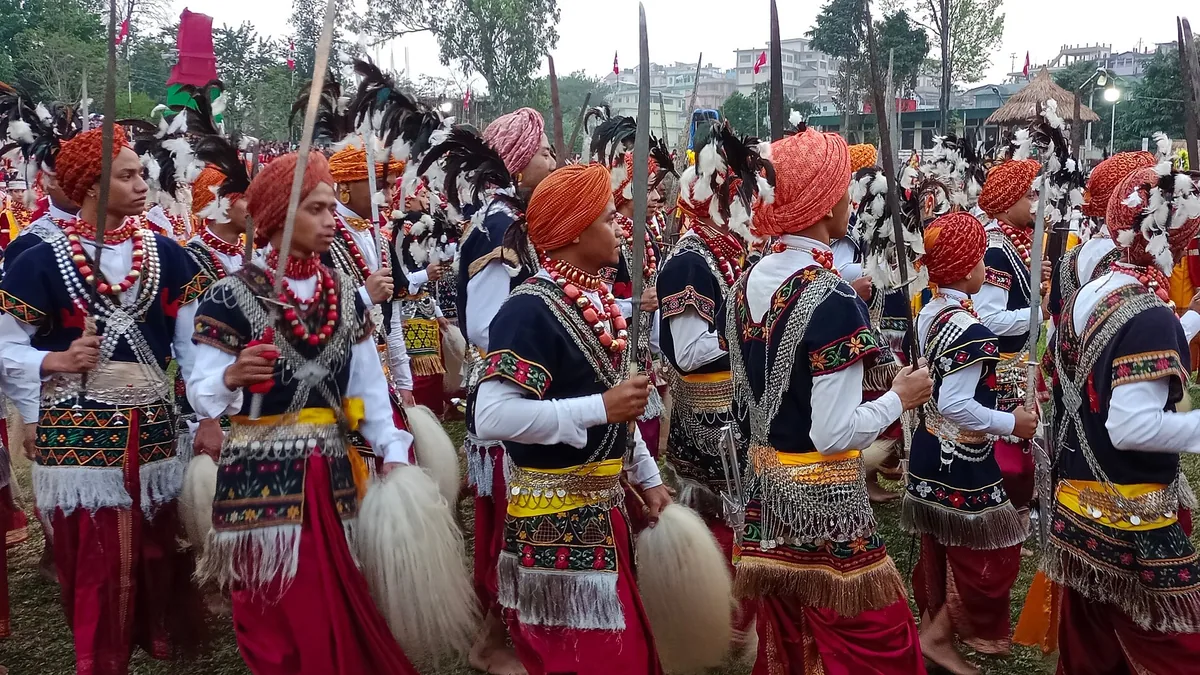
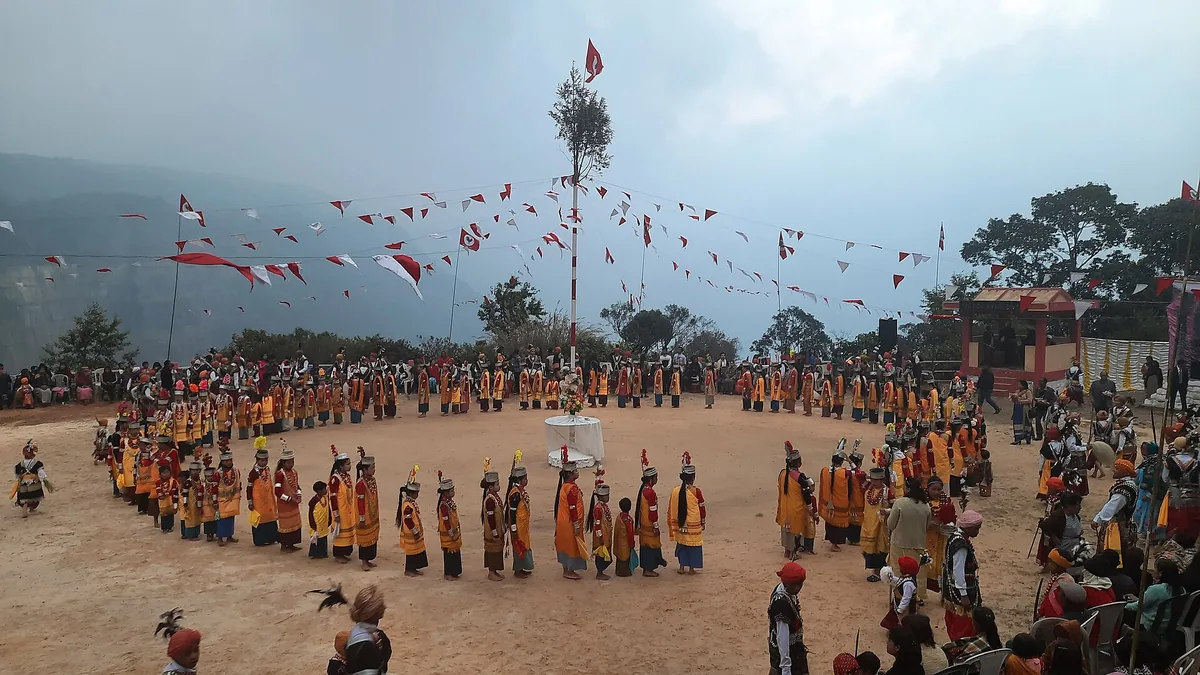
Structurally, the dance is simple to describe and difficult to perform well. Unmarried women form an inner circle. Men form an outer circle around them. The women's movement is restrained: feet shuffling forward, backward and sideways, toes bent as if to grip the ground, eyes lowered, body held straight. The men move in a fast, galloping step, slowing and quickening with the drums, circling clockwise and anticlockwise as though guarding the women inside. Towards the end the tempo lifts, the men break into mock duels with swords, and the women keep dancing.
It is a dance of gratitude rather than a spectacle. The audience is not the point — the community is.
Meaning and significance
Shad Suk Mynsiem Meaning and Cultural Significance
The name is a sentence in Khasi. Shad means dance. Suk carries the sense of peace, contentment or gladness. Mynsiem means heart or soul. Put together, the phrase is translated variously as the dance of the peaceful heart, the dance of the glad heart or the dance of happy hearts — different English renderings of one Khasi idea.
That idea matters more than the wording. The dance is not a display of skill, and there is no prize at the end of it. It is a public act of thanksgiving, performed by people who have come to the same ground for generations, and its dignity comes from restraint rather than from spectacle.
Three layers of meaning are usually identified in the tradition:
- Gratitude. The community thanks God for the harvest, for protection through the year and for the well-being of the village.
- Unity. The festival draws Khasi and Jaintia families together once a year and renews a shared sense of belonging.
- Continuity. Customs, language and dress are passed on in public, in front of children who will one day dance in the same circle.
The Department of Art and Culture, Government of Meghalaya, describes the dance as ritualistic and symbolic of a fertility tradition — the women as bearers of seed and fruit, the men as cultivators who protect and nurse the crop until harvest. That reading sits naturally with the timing of the festival, which closes one agricultural year and opens the next.
It is also worth separating Shad Suk Mynsiem from the Nongkrem dance, with which it is often confused. Nongkrem is held at Smit in October or November, is tied to the Khyrim Syiemship and includes ritual and sacrifice. Shad Suk Mynsiem is an April thanksgiving with no sacrifice attached; its three days begin with prayers and a procession, and then the ground is given over to the dance.
How it began
History of Shad Suk Mynsiem Dance
The dance as it is performed today is a little over a century old, and its history is bound up with the Seng Khasi, the socio-cultural organisation that founded it.
The Seng Khasi was established on 23 November 1899 — a date still observed as Seng Kut Snem — at a time when Khasi religious and cultural life was under pressure from colonial administration and missionary activity. Its purpose was straightforward: to preserve indigenous Khasi faith, customs, language and music.
In 1910 the organisation resolved to hold a dance every year at Weiking Ground so that Khasi dance and music would not fade out of public life. The first such gathering took place on 14 and 15 April 1911. In 1912 the event was formally named Ka Shad Suk Mynsiem, the dance of the glad heart, and given its purpose: to advance Khasi culture while expressing gratitude to God for care, protection and sufficiency.
The festival has been held every April since, apart from interruptions, and is now recognised as a state festival of Meghalaya. Older local accounts also record the name Shad Weiking, after the ground itself, and some refer to an earlier form called Shad Phur. The dance has outgrown its origins: what began as a cultural defence measure is now one of the clearest public statements of Khasi identity in Meghalaya.
The annual gathering
Shad Suk Mynsiem Dance Festival in Meghalaya
The festival runs for three days in April. Each day begins away from the dance ground: elders of the Seng Khasi offer a prayer of thanksgiving at the Seng Khasi Hall in Mawkhar, and then a procession sets out for Weiking Ground, led by flag bearers and accompanied by musicians and dancers in full dress.
Documented accounts describe the ground as having three entrances — north, east and west — with the procession entering from the east. Once the dancers are inside, the drums and the tangmuri take over and the circles form. Dancing continues through the afternoon and stops at sunset.
Participation is the point. The women's circle is made up of unmarried women and girls, and it grows and shrinks through the afternoon as younger dancers join and step back. The men's circle is open to married and unmarried men alike. Around them stand families, elders and visitors — the festival is public, but it is not staged for an audience.
The Shillong gathering is the best known, but it is not the only one. Shad Suk Mynsiem is danced in villages across the Khasi Hills through April, and celebrations at Sohra and other towns follow the same pattern with local differences in dress and repertoire. If you want to see the dance in its own setting, April in Meghalaya is the month to plan for.
Performance
Traditional Movements of Shad Suk Mynsiem Dance
There is no fixed choreography that every troupe performs identically. What stays constant is the structure: two circles, one rhythm, and a tempo that rises as the afternoon goes on.
Two circles, two kinds of movement
The women dance in the inner circle with their eyes lowered and their arms hanging loose from the shoulders. The steps are small: forward, backward and sideways, with the toes bent to grip the ground, so that the circle seems to turn rather than travel. The effect is deliberate — composure, not display.
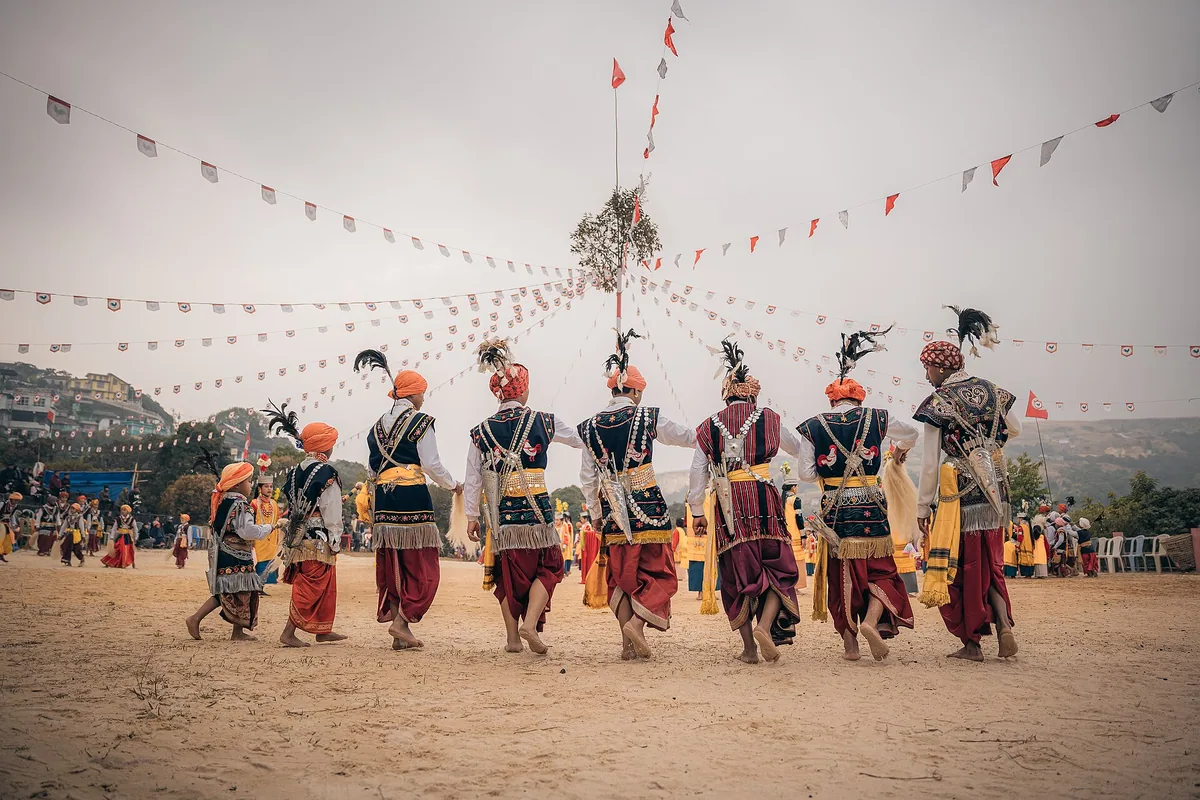
The men's circle moves in contrast. Their step is faster and looser, almost a gallop, and it responds directly to the drums: they speed up when the beat accelerates, ease off when it drops, and change direction on the break. Throughout, they hold the outer ring, facing inward or sideways, in what is usually described as a protective posture around the women.
Music leads, dancers follow
The musicians are not accompaniment in the background; they set the structure. A change in the drum pattern is the signal for a change in movement, and the closing phase is marked by a faster beat rather than by an announcement. Dancers who have grown up with the festival read those signals without counting bars.
The closing sword play
As the dance nears its end, the tempo climbs. Younger girls step out, the women's circle tightens, and the men begin mock duels — feints and parries with the ceremonial sword, never contact. The women continue as though nothing has changed. The dance stops at sunset.
Six modes recorded in the repertoire
A 2022 study of the festival published in the Journal of Research in Humanities and Social Science lists six modes of dancing performed across the three days, each with its own rhythm and drum pattern.
- 01Ka Shad Nalai
The opening mode of the repertoire.
- 02Ka Shad Dumdum
Danced to its own drum pattern within the cycle.
- 03Ka Shad Klang
One of the named modes of the festival dance.
- 04Ka Shad Padiah
Named after the ksing padiah, the small drum that drives it.
- 05Ka Shad Pyllun
The circular formation — the shape most visitors recognise.
- 06Ka Shad Mastieh
The sword dance performed by the men towards the close.
Mode names are given as recorded in academic accounts of the festival. Village traditions may use different names or orderings.
Dress and ornament
Traditional Khasi Dance Costume
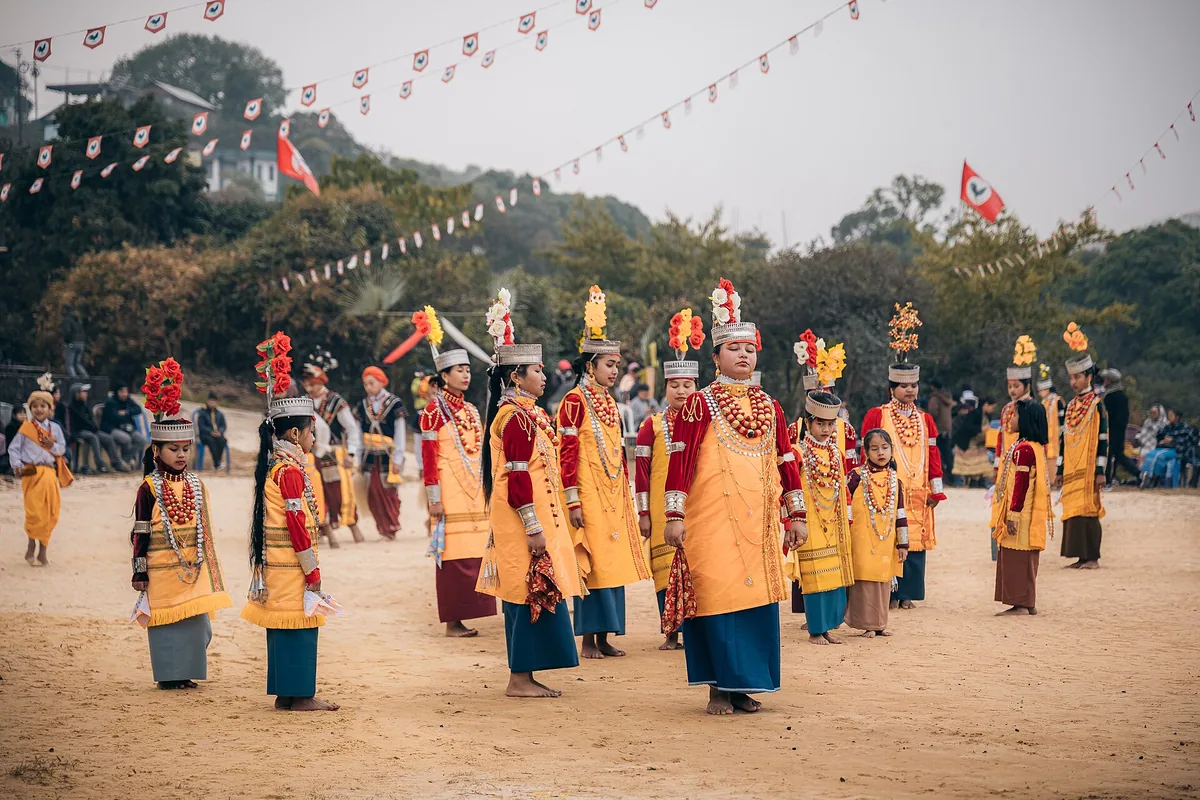
The costume is the most photographed part of Shad Suk Mynsiem, and the most misunderstood. Almost everything worn is named, and much of it is inherited. Gold and coral, not bright synthetics, define the palette — with the red of the women's blouse and the maroon of the men's dhoti providing the only strong colour.
What the dress signals
Every element has a name in Khasi, and most have a function. The crown holds the hair and catches the light; the handkerchief tied to the hand is there to wipe the face; the whisk and the sword belong to the men's role as guardians of the circle.
Because the ornaments are often family pieces, two dancers in the same circle may wear different coral necklaces or slightly different crowns. That variation is not a mistake — it is how the tradition actually looks. Any troupe booked for an event should be asked whether its costumes are complete festival dress or a simplified stage version, because the difference is visible at a distance.
Women
Female dancer's attire
- Ka jingpim shad — cloth draped from waist to ankle
- Ka sopti mukmor — full-sleeve blouse with lacework at the neck
- Ka dhara rong ksiar — two gold-embroidered cloths pinned crosswise at the shoulders
- U kpieng paila — necklace of red coral and foil-covered beads in parallel strings
- Ki sohshkor ksier — gold earrings
- Ka pangsngiet ksiar ne rupa — gold or silver crown with a fine silver braid falling past the waist, often with fresh flowers
- Ki mahu — large silver armlets, worn on both arms
- Ki khadu ne ki syngkha — gold wristlets or bracelets
- U kynjiri tabah — silver chain worn around the neck
- Ki rumal rit — handkerchiefs tied to both hands
Men
Male dancer's attire
- Ka jain spong khor — golden silk turban
- U thuia — plume about eighteen inches long, set in the turban
- Ka jympang — richly embroidered sleeveless jacket
- U shanryndang — semi-circular collar of gold or silver plate tied at the neck
- U taban — silver chain worn across the shoulders
- Ka ryngkap — silver quiver with silver arrows and an animal tail, tied at the waist
- U parnpoh syngkai — silver-mesh belt covering the quiver cord
- Ka jainboh — maroon silk cloth worn like a dhoti
- U symphiah — whisk carried in the hand
- Ka waitlam — ceremonial sword
Rhythm
Music and Instruments Used in Shad Suk Mynsiem Dance
The ensemble is small and acoustic, and it does not perform a fixed composition that the dancers follow bar by bar. Instead it holds a rhythmic frame: drums carry the pulse, a reed pipe carries the melody line, and cymbals mark the beat so that a large circle stays together across an open ground.
This is why the music sounds repetitive to a first-time listener and unmistakable to anyone who has grown up with it. Small changes in the drum pattern are the language of the dance — they tell the circle when to change step, when to reverse direction and when the close is coming.
Why it matters
Why Shad Suk Mynsiem Dance is Important to Khasi Culture
For the Khasi community, Shad Suk Mynsiem does several jobs at once, and none of them is entertainment.
It keeps identity visible
Meghalaya is a state where most people now speak English and Hindi alongside Khasi, and where Christian, indigenous and other faiths coexist. In that setting, a public festival in which thousands of people wear inherited ornaments and dance to Khasi instruments is a statement of identity that no museum exhibit can make.
It passes knowledge between generations
Nobody learns Shad Suk Mynsiem from a manual. Children learn by watching, then by joining the edge of the circle, then by dancing the full day. The same is true of the drumming, which is taught by ear and by hand. The festival is the classroom.
It holds the agricultural calendar together
The dance marks the turn from harvest to sowing. Even for Khasi families who no longer farm, that timing keeps a connection to the seasonal rhythm that shaped the community's earlier life — and it explains why the festival has never been moved to a more convenient date.
It is a living tradition, not a reconstruction
Many Indian folk forms survive today as staged revivals. Shad Suk Mynsiem has been continuously performed since 1911 and is still organised by the same body that founded it. That continuity is unusual, and it is the main reason the dance still looks and sounds the way it does.
Performances for events
Book Shad Suk Mynsiem Dance Performance for Events
A Shad Suk Mynsiem performance brings a piece of Meghalaya's living heritage to an audience that may never have seen Khasi dance before. Done properly — with full festival dress, a live drum ensemble and the two-circle formation — it reads immediately as something real rather than a generic "folk dance" item on a running order.
It suits occasions where the audience is there to watch and learn: cultural festivals, institutional programmes, heritage showcases and events with a stated cultural theme. It is less suited to a short entertainment slot between party performances, because the dance needs time and space to build.
Where the dance works well
Performer availability, group size, travel and staging arrangements all need to be confirmed in advance. April is the festival month in Meghalaya, so troupes are busiest then; events in other months are usually easier to plan.
Before you confirm
What to settle with the troupe
- Group size and composition — the dance needs enough women for a circle and enough men for the outer ring, plus musicians.
- Arena space — a level area wide enough for two concentric circles, with a safe boundary from the audience.
- Live music — confirm whether drums, tangmuri and cymbals travel with the group, and what the sound team needs to support them.
- Duration and number of sets — a festival dance runs long; an event slot rarely does. Ask how the troupe shortens it without breaking the form.
- Costume completeness — whether full festival dress and ornaments are worn, and how they will be handled backstage.
- Travel, stay and green room — especially for out-of-state events, where instruments and ornaments also need secure storage.
- Context for the audience — a two-line introduction before the performance changes how the crowd receives it.
Booking support
Why Book Traditional Khasi Dance Performers Through BookMyDance?
Booking a regional dance form is not the same as booking a party act. The questions are different, the lead times are longer, and the details that decide whether a performance works are cultural as much as technical.
Help finding the right troupe
We help you identify traditional Khasi dance groups whose repertoire and dress suit a cultural programme, rather than a generic folk act.
Briefs built around your event
Slot length, stage size, audience profile and the purpose of the programme are discussed before a performance is agreed.
Coordination, not just a contact
We stay in the loop between organiser and troupe for scheduling, travel planning and on-site requirements.
Realistic planning timelines
Regional troupes and live musicians need notice. We tell you early if a date is tight instead of promising what cannot be delivered.
Pan-India coordination
BookMyDance coordinates dance bookings across India, so a Meghalaya-based troupe can be planned into an event in another state.
One point of contact
You deal with one team for the performance enquiry, the follow-up and the final confirmation.
We do not publish ratings, awards or client counts on this page, because we would rather you judge us on how the booking is handled. Availability is always subject to the troupe's own calendar and is confirmed in writing.
Keep exploring
Explore Other Traditional Dances of Meghalaya
Meghalaya has three major dance traditions — Khasi, Garo and Jaintia — and each has its own festival calendar, instruments and dress. These pages cover the ones we currently offer.
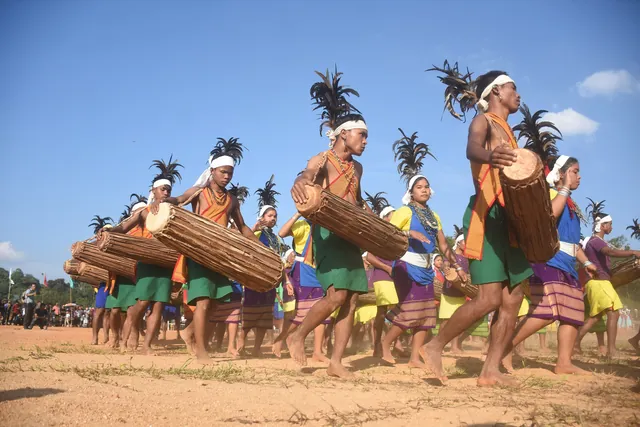
Wangala Dance of Meghalaya
The Garo harvest festival dance, driven by the long dama drum and performed in November at the 100 Drums Festival.
Read the Wangala dance guide →
Traditional Dances of Meghalaya
An overview of Khasi, Garo and Jaintia dance forms, the festivals behind them and the communities that keep them alive.
Browse Meghalaya dances →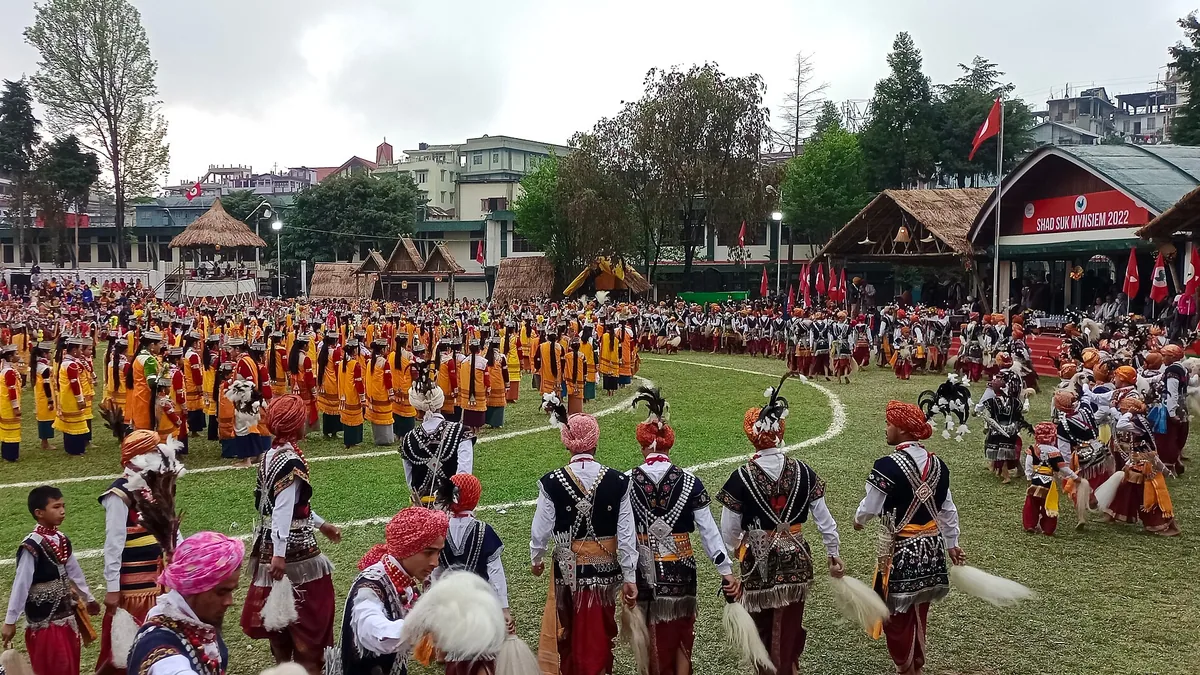
Book Traditional Indian Folk Dancers
Classical, folk and regional performers from across India, listed by dance form, state and occasion.
Explore all dance forms →Questions
Frequently Asked Questions About Shad Suk Mynsiem Dance
Short answers to the questions organisers and visitors ask most often.
What is Shad Suk Mynsiem dance?
Shad Suk Mynsiem is the spring thanksgiving dance of the Khasi community of Meghalaya. Dancers form two concentric circles at Weiking Ground in Shillong each April — unmarried women in the inner circle, men in the outer circle — accompanied by drums, a reed pipe and cymbals.
What does Shad Suk Mynsiem mean?
In Khasi, shad means dance, suk means peace, contentment or gladness, and mynsiem means heart or soul. The name is usually translated as the dance of the peaceful heart or the dance of the glad heart, and it describes a dance of gratitude rather than a performance for an audience.
Which community performs Shad Suk Mynsiem dance?
Shad Suk Mynsiem is performed by the Khasi community, one of the indigenous communities of Meghalaya, also referred to as the Hynñiew Trep. The annual Shillong festival is organised by the Seng Khasi, a socio-cultural organisation founded in 1899 to preserve Khasi religion, language and customs.
What is the history of Shad Suk Mynsiem dance?
The Seng Khasi passed a resolution in 1910 to hold an annual dance at Weiking Ground, and the first such dance took place on 14 and 15 April 1911. In 1912 the event was named Ka Shad Suk Mynsiem. It has continued as an annual April tradition for more than a century.
Why is Shad Suk Mynsiem celebrated in Meghalaya?
It is celebrated as a thanksgiving for the past year's harvest and as a prayer for the sowing season ahead, and it brings the Khasi community together once a year. Unlike the Nongkrem dance, Shad Suk Mynsiem involves no animal sacrifice; the three days open with prayers and a procession from the Seng Khasi Hall.
What costumes are worn during Shad Suk Mynsiem dance?
Women wear a cloth draped from waist to ankle (ka jingpim shad), a lace-trimmed blouse (ka sopti mukmor), gold-thread breast cloths, coral and bead necklaces, silver armlets and a silver crown sometimes decorated with the tiew lasubon flower. Men wear a silk turban (ka jain spong khor), an embroidered sleeveless jacket, a silver quiver, a maroon dhoti, a whisk and a ceremonial sword.
Which musical instruments accompany the dance?
The dance is driven by drums, especially the large nakra and the smaller ksing padiah, with the tangmuri reed pipe carrying the melody and cymbals marking the beat. Other Khasi instruments such as the besli flute, sharati and duitara belong to the wider tradition.
Can I book Shad Suk Mynsiem dance performers for cultural events?
Yes. BookMyDance helps event organisers connect with traditional Khasi dance troupes for cultural festivals, college and school functions, government programmes and corporate events. Group size, travel and staging requirements are confirmed with the troupe in advance.
What types of events can feature a traditional Khasi dance performance?
Shad Suk Mynsiem performances suit cultural festivals, university and college cultural programmes, school annual days, government and institutional events, heritage and tourism showcases, exhibitions and traditional-themed celebrations. The dance works best on a level stage with space for a circle and a live drum ensemble.
Bring Shad Suk Mynsiem to your stage
Tell us the date, city and occasion. We will check which traditional Khasi troupes are available and come back with what a full festival performance needs.