Pnar (Jaintia) Folk Dance · Meghalaya
Laho Dance of Meghalaya – History, Costumes, Steps and Cultural Significance
The Laho Dance of Meghalaya is the cheerful social folk dance of the Pnar (Jaintia) community of the Jaintia Hills — two dancers and a partner linked arm in arm, moving to the beat of recited couplets instead of drums. Discover its history, traditional costumes, formation and cultural meaning.
Introduction
What Is the Laho Dance of Meghalaya?
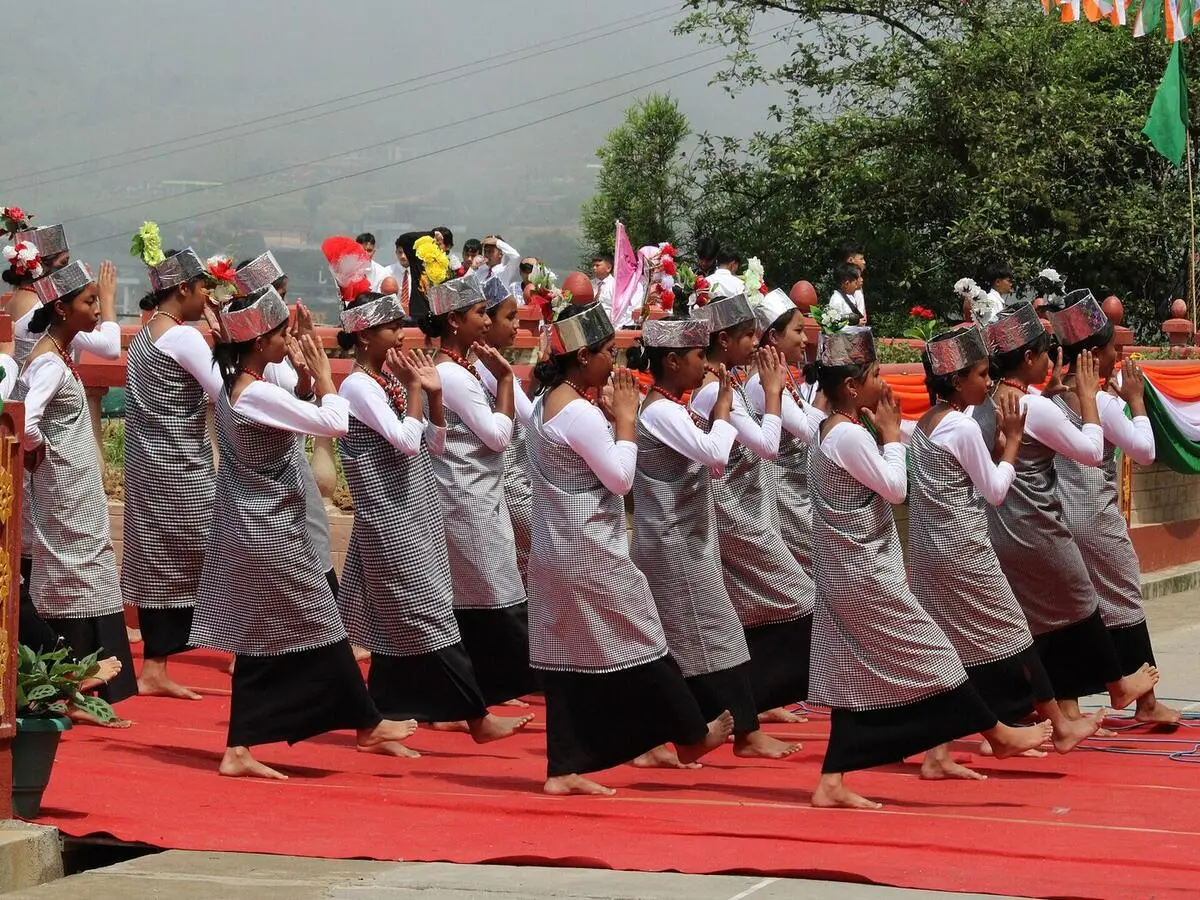
The Laho Dance of Meghalaya is a social folk dance of the Pnar community, who are also known as the Jaintias, living in the Jaintia Hills of Meghalaya. It is danced by young men and women together, usually in the well-known formation of one woman between two men, with all three linked by their arms as they step and sway in unison. Unlike most Indian folk dances, traditional accounts describe the Laho dance as needing no drum or pipe — the rhythm comes from a lead performer with the gift of rhythmic recitation, who calls out lively couplets that keep the dancers moving and the spectators laughing.
Cultural records describe Laho as a festival devoted to entertainment rather than ritual. It appears among the festivals of the Jaintia people documented by the Department of Arts and Culture of Meghalaya, and Meghalaya Tourism also lists it as the Chipiah Dance, a name by which it is widely known. The dance reflects the cheerful, community-centred side of Pnar life: celebration, wit and togetherness, performed in colourful traditional dress at festivals, gatherings and cultural programmes.
In Meghalaya, dance is a living tradition, and each community has its own signature form — the Garo have the Wangala harvest dance, the Khasi have Shad Suk Mynsiem, and the Pnar have Laho (explore traditional folk dances of Meghalaya). This page brings together everything documented about the Laho folk dance of Meghalaya: where it comes from, how it is performed, what the dancers wear and why it matters to the community that keeps it alive.
Origins
History of Laho Dance
The Laho dance belongs to the highlanders of the Jaintia Hills, and the Indira Gandhi National Centre for the Arts (IGNCA) records it as one of the principal dances of the region. Its cultural roots lie with the Pnar people — historically referred to as the Jaintias or Syntengs — whose kingdom once spread across the Jaintia Hills, with its capital at Jaintiapur in the plains at the foot of the hills.
Government cultural documentation places Laho among the festivals and ceremonies of the Jaintias, where it is described as a festival devoted to entertainment — a deliberate counterpoint to the community's solemn ritual ceremonies. While ritual festivals such as Behdienkhlam carry prayers for good health and harvest, Laho exists for joy: for laughter, courtship-friendly social play and the shared pleasure of dancing together.
Because it is a community tradition rather than a codified court art, Laho has no single documented date of origin, and no reliable historical record fixes when it first appeared. What the record does show is continuity: the dance has been passed down through generations of Pnar families and village communities, and it is still performed at Jaintia festivals and community gatherings today. As with many living folk traditions, the way it is presented has adapted over time — a point explored in the sections on formation and music below.
The People Behind the Dance
Laho Dance of the Jaintia and Pnar Community
The Pnar are one of the main tribes of Meghalaya's hill country, concentrated in the Jaintia Hills. The East Jaintia Hills district administration notes that the Jaintias are also known as Syntengs and Pnars, that Pnar is the common language of the district, and that the community is rich in cultural heritage — including music, dance, artistic weaving, wood-carving and cane and bamboo craft.
Jaintia society is matrilineal: children take their family identity from the mother, and the youngest daughter inherits the family property. This social character — strong women, close-knit clans and community-first celebrations — is visible in the Laho dance itself, where men and women dance side by side as equals in a playful, linked formation.
Community participation is central to the dance. Laho is not a performance by specialists for an audience; it is traditionally a group activity in which young people of the village take part together, and in some documented community occasions, participants of all ages — children to elders — join in. The dance's signature three-person units and shared rhythm make it a physical expression of social bonding.
Why It Matters
Cultural Significance of Laho Dance
Every documented description of Laho returns to the same theme: it is a dance of enjoyment, performed for the pleasure of dancing together. In a cultural calendar that also carries solemn rituals, Laho holds a special place as the community's expression of happiness — and that gives it real cultural weight.
- Community bonding. The arm-linked trio formation means no one dances alone. The dance physically ties participants to one another, and its shared rhythm demands cooperation.
- Celebration and enjoyment. Cultural records describe Laho as devoted to entertainment, with recited couplets that make spectators "roll with laughter". Joy itself is the purpose.
- Cultural identity. For the Pnar community, performing Laho — at Behdienkhlam, at spring festivals or at gatherings — is a public statement of Jaintia heritage.
- Intergenerational continuity. In community occasions such as the Chad Sukra festival, participants of all ages join the Lahoo dance together, passing the tradition from elders to children in practice, not just in memory.
- Preservation of indigenous heritage. Documentation by Meghalaya's cultural institutions and IGNCA helps record the dance for the future; every live performance keeps that record alive.
Attire
Laho Dance Traditional Costumes
Cultural records agree on one thing: dancers appear "always dressed in their colourful best". Beyond that, documented descriptions of Jaintia dress give us the following picture of traditional Laho dance costumes.
What women wear
Jaintia women traditionally wrap several pieces of cloth around the body so that the dress takes a cylindrical shape, and on ceremonial occasions they wear crowns of silver and gold with a peak attached at the back, along with ornaments. In contemporary stage presentations of Laho, women dancers are often seen in the dhara — a fine silk garment — with traditional ornaments completing the look.
What men wear
Jaintia men traditionally wear the jymphong, a longcoat-style garment without sleeves or collar in its classic form, paired with a dhoti. In modern Laho performances, male dancers are frequently presented in a traditional male robe (referred to as sla taroh in cultural write-ups of the dance) with headgear and simple ornaments for stage presentations.
Ornaments and cultural meaning
Silver and gold crowns with a peak at the back are documented as ceremonial headwear for Jaintia men and women during functions, and decorative ornaments are part of the festive presentation of the dance. The attire matters because Laho is a celebration: dressing in one's finest is part of the honour the community pays to the occasion and to one another.
Movement
Laho Dance Steps and Movements
Laho is not built on difficult virtuoso footwork — its charm lies in coordination, rhythm and wit. Based on documented descriptions, the movement pattern of the Laho folk dance of Meghalaya works like this:
- Group arrangement. Dancers form three-person units: two young men on either side of a girl, their arms linked together (see the formation diagram below).
- Stepping in unison. Each trio dances in step — matched, rhythmic steps and swaying movements — so that the linked arms swing naturally with the beat.
- Playful interaction. The linked formation encourages lively exchanges of movement between the men and the woman of each trio, reflecting the dance's social, celebratory character.
- The narrator sets the pace. A lead performer — described in cultural records as a "cheer leader" — recites rhythmic couplets. The dancers respond to the tempo of the recitation, making the verse the de facto music of the dance.
No detailed classical-style choreography of Laho has been published in the sources consulted, and this page deliberately does not invent step names or counts. What can be stated with confidence is the essence: linked arms, synchronised stepping, swaying bodies and a reciting voice leading the rhythm.
How It Is Performed
How Is Laho Dance Performed? The Traditional Formation
The Laho dance formation is the feature that makes the dance instantly recognisable. In the description recorded by Meghalaya's Department of Arts and Culture, "usually two young men on either side of a girl, linking arms together, dance in step". Meghalaya Tourism describes the same arrangement: a woman dancing arm-in-arm with two men, swaying rhythmically. The trios then perform together, filling the space with linked, swaying groups rather than solo stars.
Both formations create the same effect: the performance is about the group, not the individual. Linked arms mean that every step must be negotiated with your neighbours, and the swaying rhythm turns a row of trios into one moving, laughing whole — which is exactly why the dance is remembered as much for its atmosphere as for its steps.
One Dance, Two Names
Why Is Laho Dance Also Known as Chipiah Dance?
The Chipiah dance of Meghalaya is not a separate dance form — it is the same Pnar folk dance documented under an alternative name. Meghalaya Tourism introduces it directly as "The Laho Dance, also known as the Chipiah Dance", and the official East Jaintia Hills district portal likewise states that "Laho dance, also known as the Chipiah dance, is performed for sheer entertainment."
Both names appear in official and cultural writing, so searchers may encounter either term for the same tradition: the arm-linked trio, the recited couplets and the festive, mixed-gender celebration of Pnar culture. Whether you search for the Laho dance or the Chipiah dance, you are looking at one living folk tradition of the Jaintia Hills.
When You Will See It
Laho Dance Festival of Meghalaya
Laho is woven into the festive life of the Jaintia Hills in two ways: as a performance within the community's great festivals, and — in cultural records — as a festive occasion in its own right, a "festival devoted to entertainment".
Laho and the Behdienkhlam festival
Behdienkhlam is the most important festival in the socio-cultural life of the Jaintias, observed by followers of the traditional Niamtre faith and celebrated most grandly at Jowai during the monsoon months (June–July in most records; some accounts place it in the rainy season around July–August). Its focus is prayer for prosperity, good health and a bountiful harvest. Meghalaya Tourism describes the Laho dance as traditionally performed during Behdienkhlam, and the festival days are filled with dancing, drumming and community processions in which the spirit of Laho — people celebrating together — is very much alive.
Laho at Chad Sukra, the pre-sowing spring festival
The Pnar spring festival of Chad Sukra, organised by community bodies such as Sein Raij, honours Mother Nature (Ka Bei Rymaw) before the agricultural year begins. Meghalaya Tourism records that participants of all ages join in the traditional dance of Lahoo at this festival — children to elders moving together to chants and recited verses, symbolically signalling the start of the planting season.
Weddings, gatherings and cultural programmes
Beyond the festival calendar, Laho's festive, social character makes it a natural fit for weddings, community gatherings and cultural showcases. It is important to note that Laho is not restricted to a single occasion: as an entertainment dance of the community, it appears wherever Pnar people gather to celebrate — which is precisely why it travels so well to modern cultural events.
Sound of the Dance
Traditional Music and Accompaniment in Laho Dance
The most striking documented feature of Laho's music is its absence of instruments in the traditional form. Descriptions from Meghalaya's Department of Arts and Culture and Meghalaya Tourism agree that in place of the usual drum and pipe, a lead dancer recites couplets that carry the rhythm. Cultural records describe these verses as lively and humorous — "ribald couplets" that make spectators roll with laughter — and the lead performer is described as a man with the gift of rhythmic recitation, often nicknamed the dance's "cheer leader".
🎙️ Traditional community performance
Recited couplets and chants are the rhythm. No drum or pipe accompanies the dance; the narrator's voice keeps every linked trio in step.
🎶 Modern stage presentation
Contemporary cultural presentations of Laho sometimes add accompaniment — the site's own Meghalaya dance page describes the duitara (a plucked string instrument) and drums setting an upbeat festive rhythm for stage performances.
Rather than treating these as contradictory, it is more accurate to see them as two documented settings of one tradition: the village and festival form, driven by the human voice, and the stage form, which may add instrumental support for larger audiences. Both keep the same heart of the dance — the recited word and the linked, swaying group.
A Living Tradition on Stage
Laho Dance Performance in Cultural Events
Folk dances survive by being performed, and Laho today appears well beyond the Jaintia Hills. Documented and contemporary settings include state and regional cultural celebrations, heritage programmes, tourism showcases and cultural festivals across Meghalaya and India, as well as educational events where students encounter the traditions of India's northeastern communities.
A Laho dance performance gives audiences something few other forms can: a dance they can understand instantly. The linked trio formation, the playful call-and-response energy of the recited couplets and the colourful Jaintia attire communicate community joy without needing translation — which is why the dance is often chosen to represent Meghalaya's Pnar heritage on stage. For a wider view of the region's traditions, you can discover other northeastern folk dance traditions or see how a neighbouring state celebrates, for example the Bihu dance of Assam.
Bring the Traditional Laho Dance of Meghalaya to Your Event
An authentic Pnar folk dance performance turns an event into a cultural experience — linked-arm trios in colourful Jaintia attire, recited couplets and a festive energy your audience will remember.
BookMyDance arranges traditional folk dance performances for events across India. Share your event details on our contact page and our team will help you plan a Meghalaya folk dance presentation that suits your venue, audience and occasion.
- Cultural festivals
- College & university events
- Heritage programmes
- Corporate cultural events
- Government & institutional programmes
- Regional & international showcases
Answers
Frequently Asked Questions About Laho Dance
What is the Laho Dance of Meghalaya?
It is a social folk dance of the Pnar (Jaintia) community of the Jaintia Hills, performed mainly for entertainment. Men and women dance arm in arm — typically one woman between two men — while a lead performer recites rhythmic couplets that set the pace for the whole group.
Which tribe performs the Laho Dance?
The Pnar community of Meghalaya's Jaintia Hills. The Pnar are also known as the Jaintias or Syntengs, and Pnar is the common language of the region. Laho is documented as one of the principal dances of these highlanders.
Is Laho Dance also known as Chipiah Dance?
Yes. Meghalaya Tourism and the East Jaintia Hills district administration both record Laho as also being called the Chipiah dance. The two names refer to the same Pnar folk dance.
What is the traditional formation of Laho Dance?
The best-documented formation has two young men on either side of a woman, all three with arms linked, dancing in step and swaying rhythmically. A documented variation from the eastern Jaintia region shows men performing in two rows with their hands clasped over each other's shoulders.
What costumes are worn during Laho Dance?
Dancers dress in their colourful best. Documented Jaintia dress includes the jymphong and dhoti for men and wrapped cloth garments for women, with silver and gold crowns worn on ceremonial occasions. Modern stage presentations commonly show women in the dhara and men in a traditional robe.
What is the cultural significance of Laho Dance?
Laho is the community's dance of joy: it builds social bonds through its linked formations, celebrates youth and togetherness, and publicly expresses Pnar cultural identity. Because participants of all ages join in on festive occasions, it also passes the tradition from one generation to the next.
During which festivals or occasions is Laho Dance performed?
It is associated with Jaintia celebrations such as Behdienkhlam — the community's most important festival, celebrated grandly at Jowai in the monsoon months — and Chad Sukra, the pre-sowing spring festival where dancers of all ages join the Lahoo. It is also performed at weddings, community gatherings and cultural programmes, so it is not tied to one festival alone.
Can Laho Dance be presented at cultural events?
Yes. Its lively group formation and festive attire make Laho well suited to cultural festivals, heritage programmes, school and college events and institutional celebrations. Enquire with BookMyDance about arranging a traditional Laho dance performance for your event.
Keep Exploring
Related Meghalaya and Northeast Folk Dance Pages
If you enjoyed learning about the Laho dance, these pages from our library cover the neighbouring traditions of Meghalaya and the Northeast:
In Summary
Preserving the Joy of the Laho Dance of Meghalaya
The Laho Dance of Meghalaya is everything a folk tradition should be — communal, joyful and unmistakably itself. Born in the Jaintia Hills among the Pnar people, it turns entertainment into heritage: linked arms, shared rhythm and recited couplets that have carried laughter through generations. As both Laho and Chipiah, it stands today as one of the signature folk dances of the Jaintia community, documented by cultural institutions and kept alive by every performance.
Traditions like this survive when they are seen. Whether you are exploring India's folk heritage or planning a cultural programme, contact BookMyDance to enquire about a traditional Laho dance performance for your event.