
Meghalaya · Khasi Heritage
Ka Shad Mastieh Dance
The Khasi warrior dance of Meghalaya — a ring of men, a sword in the right hand, a white yak-hair whisk in the left, and drums that decide when the mock duel begins.
- Warrior dance
- Sword & whisk
- Shad Nongkrem
- Smit, East Khasi Hills
What is Ka Shad Mastieh Dance?
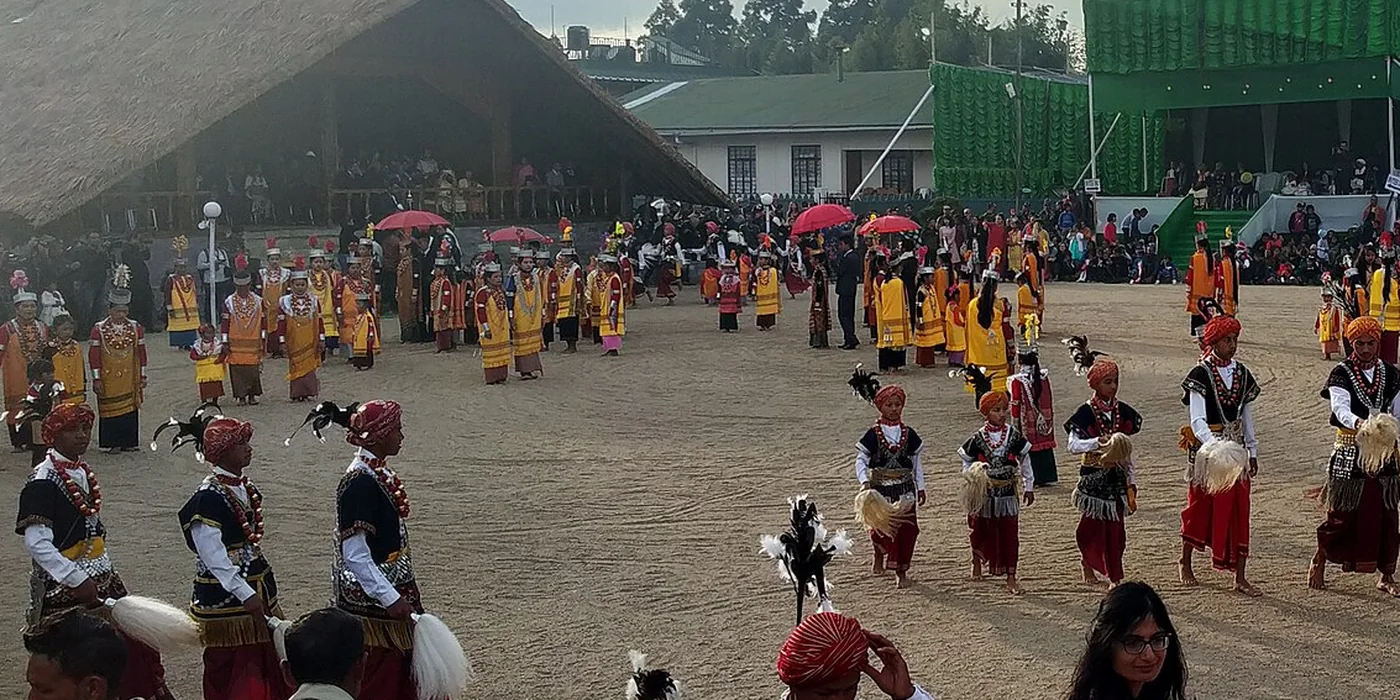
Ka Shad Mastieh Dance is the men’s warrior dance of the Khasi community of Meghalaya. It is performed in the open dancing ground of a Khasi ceremonial festival, most famously in the courtyard in front of the Iing Sad at Smit during the five-day Shad Nongkrem observance.
The clearest short definition is also the oldest written one. A Khasi–English dictionary published in 1906 records “Shad-mastieh, ka. n. a sword-dance” — that is, the word shad for dance joined to the sword. Almost everything a first-time viewer notices follows from that: the blade in the right hand, the white yak-hair whisk in the left, the plumed turban, and the moment when two dancers turn towards each other and clash swords in mock combat.
The dance belongs to the Khasi, one of Meghalaya’s major indigenous communities, and its home ground is the East Khasi Hills around Smit and Shillong. It is not a generic “tribal” item on a tourism list. It is a ceremonial dance with rules about who dances, when, in what dress and in which direction — and those rules are still followed.
Why this dance stands apart
Most Khasi festival dances are led visually by women: the slow, restrained inner circle of unmarried dancers is usually the image people carry home. Ka Shad Mastieh reverses that emphasis. Here the men carry the spectacle — the sword, the plume, the burst of speed, the duel — while the women’s circle stays calm at the centre. That contrast, rather than any single step, is what makes the dance recognisable.
Name check
You will see it written as Ka Shad Mastieh, Shad Mastieh or Ka Shad-Mastieh. The Khasi article ka is often dropped in English. All three refer to the same men’s dance — not to the festival itself.
History of Ka Shad Mastieh Dance
No founder, date or single origin story for Ka Shad Mastieh is recorded, and any page that offers you one is inventing it. What exists is a documented trail: a name fixed in the Khasi language, an early colonial-era description, and an unbroken ceremonial practice that continues at Smit today. The honest history is the story of that continuity.
The dance inside the pom-blang cycle
The men’s dance is embedded in the older Khasi thanksgiving cycle around the pom-blang, the goat-offering ceremony. In 1907 the British administrator and ethnographer P. R. T. Gurdon described the Nongkrem dance as part of that ceremony, performed by the Syiem of Khyrim with his high priest and priests for Ka Blei Synshar, the ruling goddess, so that the crops might prosper. The dance was not an entertainment attached to a religious event; it was one of the event’s own acts.
The earliest written description
Gurdon’s account is still the most precise early record of the dance itself. He separates the women’s dance, ka shad kynthei, from ka shad mastieh, “the dance of the men, who are gaily dressed, wearing plumes of black and white cock’s feathers (u thuiyah) and hold swords and shields.” He then describes what happens next: two men at a time approach quickly, clash their swords in mock combat, retire, and are replaced by another pair — a cycle that continues until the dancers tire or are told to stop.
“After gyrating for some time, two men at a time rapidly approach one another and clash their swords together in mock combat.” P. R. T. Gurdon, The Khasis (1907)
A name older than the record
The 1906 Khasi–English dictionary entry shows that shad mastieh was already a settled word with a settled meaning — a sword-dance — before Gurdon wrote his description. That matters for how the dance is described today: the sword is not a modern addition bolted on for tourists, and the “warrior” label is not a marketing line.
What changed, and what did not
Two things have visibly shifted. The calendar moved: Gurdon places Nongkrem in late spring, generally May, while Meghalaya’s Department of Arts and Culture notes that the festival was once held in mid-summer and is now observed in October or November. And the scale grew: the 2026 edition at Smit recorded 224 men in Ka Shad Mastieh and 237 young women in the women’s dance. What has not changed is the structure — outer ring of men, inner circle of women, drums and tangmuri pipe setting the pace.
Significance of Ka Shad Mastieh Dance
The dance carries several kinds of meaning at once, and they are easier to understand separately than bundled into a single sentence about “Khasi culture”.
An act of remembrance
Meghalaya Tourism describes Ka Shad Mastieh as a dance performed by men “to honour their forefathers who defended the land and protected the dignity of Khasi women”. That is the clearest statement of the dance’s purpose in official material, and it explains the tone: this is not a celebration of fighting for its own sake, but a public acknowledgement of people who are gone.
A protective formation, read two ways
At Nongkrem the men form an outer ring around the women’s inner circle. The Government of Meghalaya notes that the men’s dancing is “naturally more vigorous and energetic”, and the national Utsav portal reads the arrangement as women representing purity and prosperity at the centre while men guard tradition, clan and land from outside. That reading is a published interpretation, not a rule inscribed anywhere — but the formation itself is plain to see, and it is the dance’s most quoted image.
A religious obligation before a performance
Shad Nongkrem is a religious festival first. The rites led by the Syiem of Khyrim and the high priest come before the dancing, and the dancing happens in the courtyard of the Iing Sad, the ruling house. To treat Ka Shad Mastieh purely as a spectacle is to arrive late to the event and leave early from its meaning.
Identity carried in public
Khasi society is matrilineal — clan membership and inheritance pass through the mother — yet the men’s dance holds a central public role. The dance gives the community an annual occasion to display, together, its language, its dress, its music, its clan and state structure and its relationship with the land. Very few cultural institutions do that much work at once.
For the family
A dancer’s regalia is family property, assembled and maintained over years. Taking part is a household statement as much as a personal one.
For the clan
Clan membership can determine who dances, in what order, and with whom — a social map made visible in the ring.
For the state
The Hima Khyrim’s ceremonial order is enacted in the courtyard, with the Syiem and priests at the centre of the ritual.
Ka Shad Mastieh: The Khasi Warrior Dance
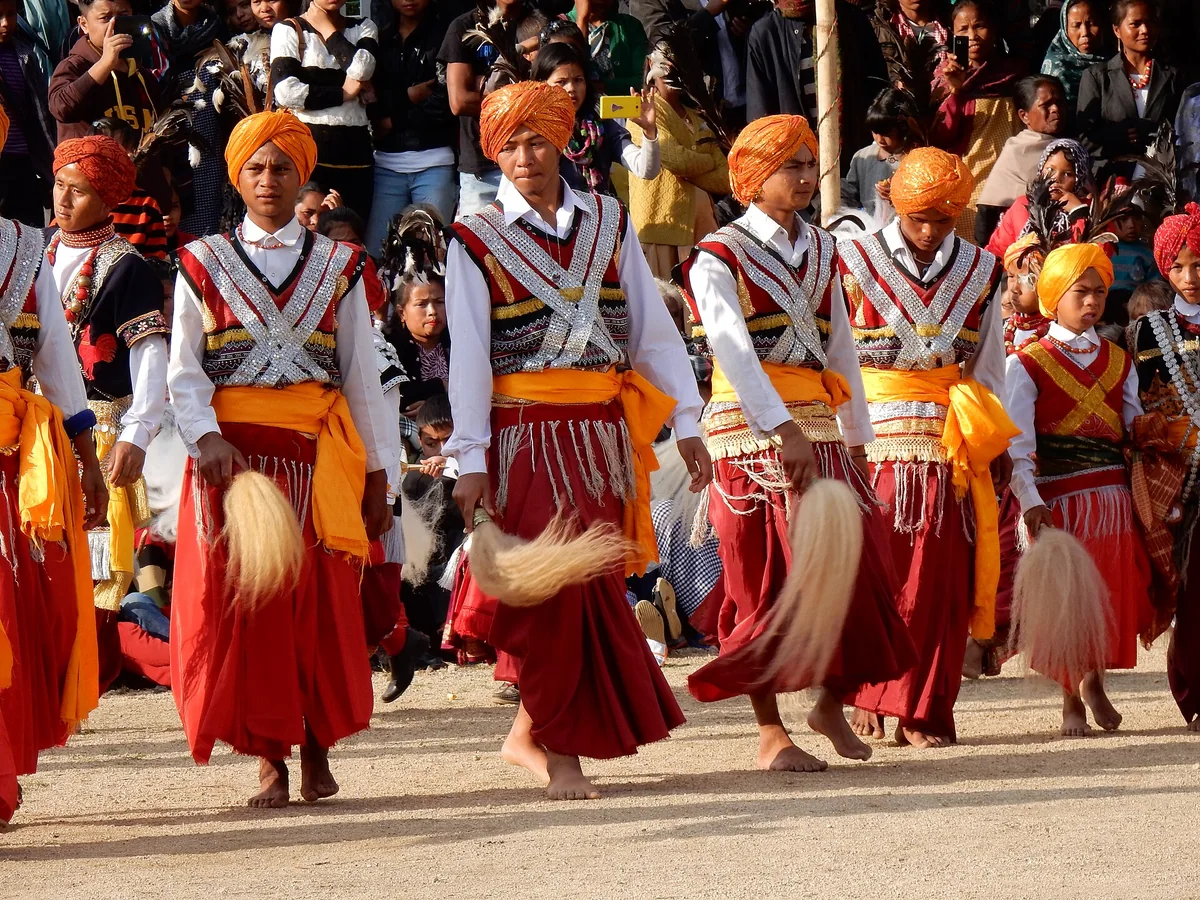
The “warrior” label is used by Meghalaya Tourism, by state government material and in most reporting on the festival. It is not a loose metaphor. Three documented features justify it.
First, the weapon. The dance is built around a sword held in the right hand, with a mock combat at its centre. Second, the role. The men dance on the outside of the women’s circle, in a formation that official material describes as protective. Third, the dedication. The dance is offered to forefathers who defended the community — a memorial function, performed in public, once a year.
What the warrior dance is not
It is not a battle re-enactment, and no source describes it as one. There is no opposing army, no narrative of a particular war, no victory tableau. It is a ceremonial honouring of warriors, expressed through the vocabulary of combat: the advance, the parry, the feint, the clash of blades.
It is also not a martial arts demonstration. The swordplay is symbolic and stylised. The purpose is the ritual and the memory, not the technique.
Who dances
The dance belongs to men. In photographs of Nongkrem you will often see boys dancing beside older men — the tradition is learned by joining the ring, not by enrolling in a class. Outside Nongkrem, documentation of Khasi village ceremonies records that the men’s mastieh can be restricted to particular clans and performed on a fixed day, which is a reminder that access to the dance has always been governed by custom rather than by ticket.
“The men’s dancing is naturally more vigorous and energetic. They hold a sword in their right hand and usually a white yak hair whisk in their left hand, keeping time to the changing beats of drums and playing of the tangmuri.” Government of Meghalaya, Nongkrem Dance
Ka Shad Mastieh Sword Dance
Yes — on the evidence available, Ka Shad Mastieh is properly described as a sword dance. The Khasi–English dictionary defines shad-mastieh as exactly that, and the sword is named in every serious description of the dance from 1907 to the present. The ceremonial sword is ka waitlam.
What the sources actually record
Gurdon, writing in 1907, has the men holding “swords and shields” and clashing them two at a time. Contemporary official descriptions simplify this to a sword in the right hand and a white yak-hair whisk in the left, with pairs of men staging a dramatic mock combat. Meghalaya Tourism describes the dance building to precisely that moment — “pairs of men clash swords in symbolic battle”. The blade is not decoration; it is the reason the dance exists as a form.
Not every hand holds a sword
This is where many online descriptions overreach. In photographs of actual performances, whole rows of dancers can be seen carrying the whisk as the main prop, with swords carried by others or held at rest. A single image is not proof that every dancer is armed at every moment. If you are describing a specific photograph, describe what is in it; if you are describing the tradition, say that the sword is central to the form without claiming that every dancer carries one throughout.
What the sword means
Published sources agree on what is carried, and disagree on what each object symbolises. Meghalaya Tourism links the dance to honouring forefathers; the Utsav portal links the outer ring to protection of tradition, clan and land. Beyond that, specific readings of the sword or the whisk are usually the writer’s interpretation. Treat them as interpretation, not as documented doctrine.
Note on terminology: some sources call Ka Shad Mastieh a “victory dance”. Others call it a war dance or warrior dance. The Khasi dictionary sense is “sword-dance”, which is the safest description to use in print because it describes the form rather than an assumed occasion.
Traditional Costume of Ka Shad Mastieh
The Ka Shad Mastieh traditional costume is the most misunderstood part of the dance online, largely because writers mix Khasi festival costumes from different occasions. What follows is the male regalia set out by Meghalaya’s Department of Arts and Culture for Khasi festive dancing — the same vocabulary of dress you see in the ring at Smit.
| Item | What it is |
|---|---|
| Turbanka jain spong khor | A golden silk turban wrapped in the Khasi style. Colours vary between troupes; red, orange and gold are all seen. |
| Plumeu thuia / u thuiyah | A tall plume fixed in the turban. Gurdon records black and white cock’s feathers; later descriptions give an 18-inch plume. |
| Sleeveless jacketka jympang | A richly embroidered waistcoat, usually dark, with silver or gold detailing across the chest. |
| Dhotika jainboh | Maroon silk cloth worn like a dhoti, sometimes patterned, tied at the waist. |
| Silver collaru shanryndang | A broad semi-circular plate of silver or gold plate, tied around the neck. |
| Shoulder chainu taban | A silver chain worn across the shoulders, often with coral or foil beads. |
| Silver-mesh beltu parnpoh syngkai | A mesh belt at the waist, which also covers the cord of the quiver. |
| Quiverka ryngkap | A silver quiver with silver arrows, tied at the waist, with an animal tail hanging from the end. |
| Ceremonial swordka waitlam | Carried in the right hand; the centre of the mock combat. |
| Whisku symphiah | A white yak-hair whisk held in the left hand, moving with the drumbeat. |
| Handkerchiefka rumar | A small cloth carried by dancers, traditionally used to wipe the face. |
Details differ by clan, village and troupe. A dancer’s regalia is often family property, and the quantity of silver and gold on display is a visible statement about the household as well as about the occasion.
What to look for in a photograph
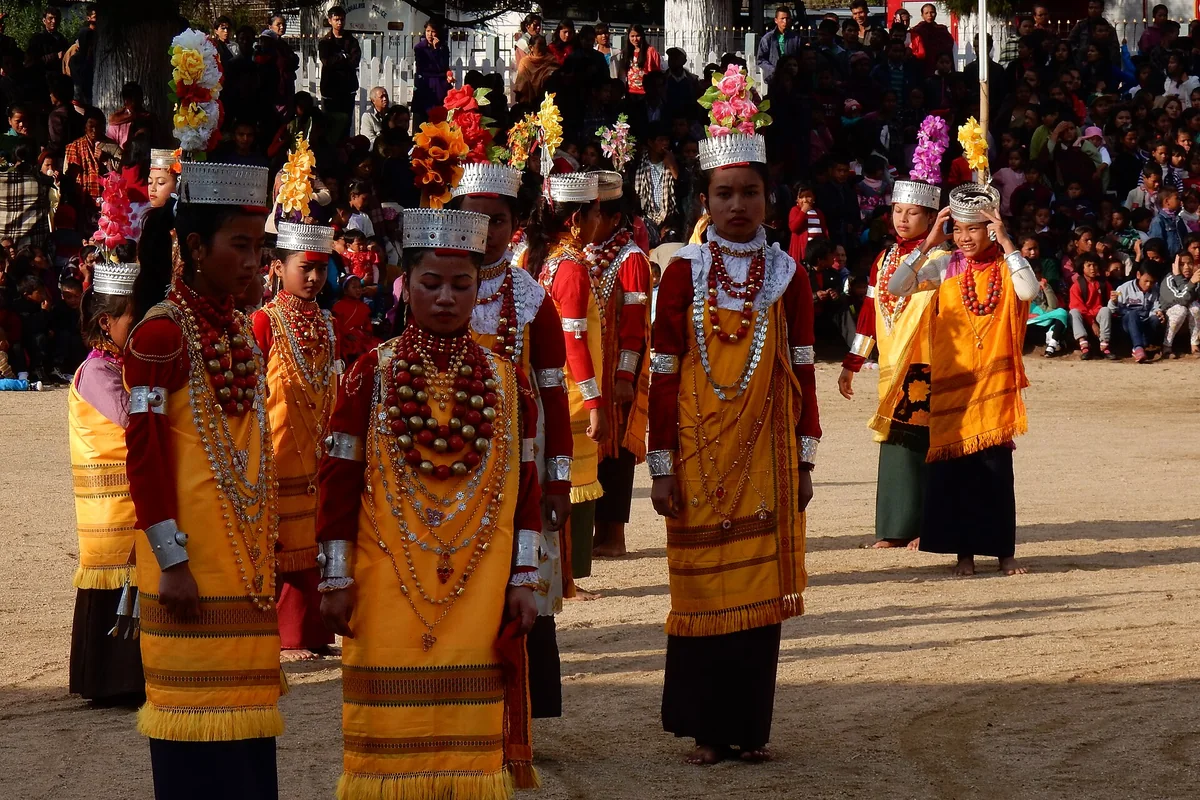
If you are checking whether an image really shows Ka Shad Mastieh, look for the combination rather than a single item: a plumed turban, a dark embroidered sleeveless jacket, a red or maroon lower cloth, a silver chest ornament, and a whisk — with or without a sword. Images that show only women in crowns and silk belong to the women’s dance, Ka Shad Kynthei, and should not be captioned as Ka Shad Mastieh.
Music and Instruments Used
The dance has no song leading it. Rhythm does the leading. A small group of musicians sets the tempo, the dancers answer it, and the whole ring changes pace together when the drums change.
The lead melodic instrument, made from japung reed with seven finger holes and a circular horn at the end. Its piercing, carrying tone cuts through the drums outdoors; Khasi tradition calls it the queen of instruments.
The drum that drives the dance. Documentation of Khasi ceremonies notes that for the shad mastieh the bom is beaten with sticks — unlike some other ritual drums played by hand.
Brass cymbals that mark the pulse and add a bright edge to the ensemble, especially as the men’s steps accelerate.
The large nakra and the small ksing padiah appear in Khasi ensembles. Sources do not agree that both are present at every Nongkrem performance.
How the music shapes the dance
Official descriptions describe the men keeping time to “the changing beats of drums” and the tangmuri. In practice that means the dance is built out of accelerations and stops: the ring moves, the beat shifts, the men halt and resume, and the mock duels are triggered by the rhythm rather than by a caller. Documentation of Khasi ceremony also records musicians seated at the centre of the dancing ground on a raised platform — the ring forms around the sound.
Drums do a second job in Khasi life: the Department of Arts and Culture notes that they are used not only to accompany a festival but to invite people to it. In a dispersed hill community, that is how a dance ground fills.
Ka Shad Mastieh Dance Steps and Performance Style
No published source sets out Ka Shad Mastieh dance steps as a fixed sequence, and there is no notation or step count. Any page that lists “step 1, step 2, step 3” is inventing choreography. What the sources describe is a movement vocabulary and a structure, and that is enough to understand what you are watching.
The opening: ground first
Meghalaya Tourism describes the dancers moving in coordinated steps similar to the Ka Nohkjat style, striking the ground before breaking into brisk motion. That ground contact is the signature opening — weight down, foot planted, then release into speed.
The ring: advance and withdraw
Meghalaya’s Department of Arts and Culture describes the men in a wide circle who “advance and parry and feint and retreat” to the drums and cymbals. The ring is not a static circle with steps in place; it is a moving formation with a defensive logic, the men turning around the women’s circle.
The duel: two at a time
The most distinctive passage is the mock combat. Gurdon’s 1907 description remains the clearest: two men approach rapidly, clash swords, retire, and after further circling another pair takes their place. The duel is therefore not a climax performed once — it is a repeating rotation that continues until the dancers stop.
The tempo: stop and go
Speed is controlled by the drum. The men move fast, then hold, then move again, and the alternation is part of the aesthetic. A description of the dance that mentions only “energetic movements” misses the restraint that makes the bursts legible.
How it is learned
By joining the ring. Khasi ceremonial knowledge — music included — is passed on by watching elders and taking part, not through written instruction. That is why the dance has survived without a manual.
Ka Shad Mastieh Dance in the Nongkrem Festival
Ka Shad Mastieh is one half of the public dancing at Shad Nongkrem, the annual five-day religious festival of the Hima Khyrim, held at Smit in the East Khasi Hills — roughly 11 to 15 kilometres from Shillong, depending on which official figure you follow. The other half is Ka Shad Kynthei, danced by unmarried women.
Where the dance sits in the festival
The religious rites come first. The Syiem of Khyrim and the high priest perform the Pomblang ceremony, with offerings to Lei Shyllong, the deity of Shillong Peak, and to the ancestors of the ruling clan. Only after that do the dancers enter the courtyard in front of the Iing Sad, the ruling house. Meghalaya Tourism places the public dance by young men and unmarried women on the fourth day; the exact programme is set locally and is not published as a visitor schedule.
The men take the outer ring, the women the inner circle. The men’s steps are faster and more energetic, with the sword in the right hand and the whisk in the left, and the mock combat unfolds in the same courtyard. Recent reporting from the 2026 edition recorded 224 men in Ka Shad Mastieh and 237 young women in the women’s dance — a useful reminder of the scale of a living ceremony, not a staged show for visitors.
Dance and festival are not the same thing
This distinction matters for anyone researching the subject. Shad Nongkrem is the festival: five days of ritual, offering, dance, fair and community gathering. Ka Shad Mastieh is one dance within it. The festival has its own history, its own ritual sequence and its own meaning, and it is covered separately in our guide to the Nongkrem Dance of Meghalaya.
For the same reason, this page does not attempt to be a Nongkrem festival guide. If your question is “when is Nongkrem and how do I get there”, the festival page is the right destination. If your question is “what is the men’s sword dance and what does it mean”, you are on the right page.
Cultural Importance in Modern Times
Ka Shad Mastieh is not a reconstruction. It has not been revived from photographs for the tourism market; it is performed because the ceremonial calendar requires it. That is unusual, and it is the single most important fact about the dance’s place in modern Meghalaya.
Between ritual and stage
Two kinds of performance now exist side by side. At Smit, the dance remains part of a religious occasion, with clan rules, ritual sequence and a courtyard setting. Elsewhere — at cultural festivals, school and college events, museum demonstrations and community gatherings of Khasi families outside the state — troupes present an excerpt of the dance as a cultural programme, usually with a spoken introduction explaining the festival context.
Both are legitimate, but a Ka Shad Mastieh dance performance on a stage and the ceremony at Smit are not interchangeable. What travels is the dance’s visual and musical language. What stays at Smit is the ritual. Good cultural programming says so plainly instead of presenting a stage excerpt as the ceremony itself.
What keeps it alive
Three things, mainly: families who maintain regalia across generations, dancers who learn by joining the ring, and musicians who pass the repertoire on by ear. Add a festival calendar that still requires the dance to be performed, and you have a tradition with an inbuilt reason to continue.
Interest from outside Meghalaya helps — documentation, cultural exchanges and audiences who arrive already knowing what they are watching all raise the value of the tradition. It helps most when visitors treat the rites as rites: some parts of the festival are not open to photography, and the dancers are worshippers before they are performers.
Living, not curated
The dance is still governed by clan and ceremonial rules rather than by an event producer. That is the difference between heritage and heritage-themed entertainment.
Documented, but thin
Written sources are few: one colonial monograph, one dictionary, official state pages and current reporting. Anyone claiming detailed choreographic documentation is overstating what exists.
Visible beyond the hills
Troupes from Meghalaya now present Khasi dance at national cultural festivals, which has made Ka Shad Mastieh familiar to audiences far outside the Khasi Hills.
Why Ka Shad Mastieh Dance Is Special?
Strip away the adjectives and four things remain that make this dance genuinely distinctive, not just photogenic.
A sword dance that is actually a sword dance
The name, the dictionary definition, the props and the mock combat all agree. Very few Indian folk forms carry their central object so consistently from language to practice.
The men carry the image
In a repertoire where women’s circles usually dominate the photograph, Ka Shad Mastieh gives the men the movement, the metal and the drama — while the women remain the still centre.
Dress as a record
Turban, plume, collar, chain, belt and quiver together preserve a vocabulary of Khasi ceremonial dress that has changed remarkably little since Gurdon described it in 1907.
A ritual with an audience
It is performed for the community and its ancestors, not for a ticket-holding crowd. Watching it well means understanding that the audience is a guest at someone else’s ceremony.
Frequently Asked Questions
What is Ka Shad Mastieh Dance?
Ka Shad Mastieh is the men’s warrior dance of the Khasi community of Meghalaya. Dancers move in a ring with a ceremonial sword in the right hand and a white yak-hair whisk in the left, keeping time to drums and the tangmuri pipe. Khasi–English dictionaries record the name simply as “a sword-dance”.
Which community is associated with Ka Shad Mastieh Dance?
The dance belongs to the Khasi people of Meghalaya, particularly the East Khasi Hills around Smit and Shillong. Its best-known setting is the annual Shad Nongkrem ceremony of the Hima Khyrim, one of the traditional Khasi states.
What is the history of Ka Shad Mastieh Dance?
No founder or exact date is recorded. The name was already established when a Khasi–English dictionary defined it in 1906, and P. R. T. Gurdon described the men’s sword combat at Nongkrem in 1907. The dance belongs to the older pom-blang thanksgiving cycle, and the festival’s timing has shifted over time from spring to October or November.
Why is Ka Shad Mastieh known as a warrior dance?
It is danced to honour forefathers who defended Khasi land and protected the dignity of Khasi women, and its central action is a mock sword combat. The men form the outer ring around the women, a formation widely described as a protective one. It is a ceremonial honouring of warriors rather than a battle re-enactment.
What traditional costume is worn during Ka Shad Mastieh Dance?
Men wear a silk turban with a tall plume, a sleeveless embroidered jacket, a maroon silk dhoti, a silver collar, a silver chain across the shoulders and a silver-mesh belt, sometimes with a silver quiver. They carry a sword, a white yak-hair whisk and a handkerchief. Turban colours and details vary between clans and troupes.
Are swords used in Ka Shad Mastieh Dance?
Yes. Gurdon recorded dancers holding swords and shields in 1907, and official descriptions today place a sword in the right hand and a whisk in the left, with pairs of men clashing swords in mock combat. Individual dancers or rows may carry the whisk as the main prop, so a sword is not guaranteed in every photograph of the dance.
What is the connection between Ka Shad Mastieh Dance and the Nongkrem Festival?
Shad Nongkrem is a five-day Khasi religious festival held at Smit. Its public dancing has two parts: Ka Shad Kynthei, danced by unmarried women in the inner circle, and Ka Shad Mastieh, danced by men in the outer ring in the courtyard of the Iing Sad. The dance is one element of the festival, not the whole of it.
What makes Ka Shad Mastieh Dance culturally significant?
It is a living ritual rather than a staged revival. Performed as part of ancestral and harvest observances, it carries Khasi language, clan roles, dress and music together, and it keeps a public place for the community’s memory of its defenders.
Planning a Khasi cultural performance?
Explore Meghalaya’s dance traditions and find performers for cultural festivals, heritage events and community programmes.