Musindo
A cylindrical drum played on both sides, one of the core drums of the ensemble.
Gujarat · African-Indian folk tradition
Siddi Dhamal is the drum-led dance tradition of the Siddi community — Indians of African descent whose ancestors arrived on the subcontinent over several centuries. In Gujarat, where Siddi families live mainly around the Gir forest and the Junagadh region, Dhamal is performed as a circle dance of call-and-response singing, layered percussion and increasingly fast footwork. This guide sets out what is documented about the form, how a performance is structured, and how event organisers can arrange a Siddi Dhamal dance group for a cultural programme.
Cultural guide and booking assistance · availability, group size and fees are confirmed per event.
Population figure: Census of India 2011, as cited in public reference sources on the Siddi. Format and terminology details follow published cultural documentation cited at the foot of this page.
The tradition
Siddi Dhamal is a community dance of the Siddi — an ethnic group of African ancestry living mainly in western India and Pakistan. In Gujarat the form is also called Dhamaal or Goma, and it sits at the meeting point of two worlds: Bantu African drumming and dance traditions carried across the Indian Ocean, and the Sufi devotional culture of western India.
The word dhamal in Gujarati and Urdu carries a sense of joyful abandon — celebration, movement, even ecstatic wildness. That meaning fits the dance: a group forms a circle, drummers take the centre, and call-and-response singing gradually gives way to faster, harder-driven stepping. Many performances are tied to the veneration of Siddi ancestor-saints, and some participants enter trance states during the most intense passages.
For a festival audience, what stands out is the layered rhythm, the visible coordination between dancers and drummers, and the way the energy climbs rather than staying flat. It is not a choreographed folk item with a fixed running time; it is a communal practice that has also been adapted, in recent decades, into a stage presentation for cultural events.
One tradition, many names. Sources describe the practice as "Siddi dhamaal, or goma", and note that Gujarati Siddi sometimes call it Dhamaal while the music is referred to as Goma. Treat the names as connected rather than as two unrelated dances — the section on Dhamal and Goma below explains this in detail.
Origins
The history of Dhamal cannot be separated from the history of the Siddi themselves — a story of forced migration, settlement, and the slow building of a distinct Afro-Indian identity on India's western coast.
The Siddi are descended primarily from Bantu-speaking peoples of East and Southeast Africa. They reached the subcontinent through Indian Ocean trade and the slave trade, and also as sailors, merchants, indentured labourers and soldiers. The port of Bharuch in Gujarat is traditionally associated with the earliest arrivals, and historians record a much larger movement of Africans into the region between the thirteenth and nineteenth centuries, when captives were brought from present-day Ethiopia, Eritrea, Mozambique, Tanzania, Sudan and Zanzibar by Arab, Gujarati, Portuguese and later British traders.
In Gujarat, Siddi communities are concentrated around the Gir forest and the Junagadh region; the village of Sirvan, on the road to Deva-dungar, is described in reference sources as entirely Siddi. Local tradition holds that Siddi families were brought to serve the Nawab of Junagadh. Others trace descent from escaped slaves who formed forest communities. Both accounts circulate within the community and in written histories, and neither can be reduced to a single date.
Published documentation traces the Dhamal known today to nineteenth-century Gujarat, from where it spread to Sindh (where the community is called Sheedi) and to other parts of India. It grew out of the music, movement and ritual practices that diverse African-origin groups had developed as a shared language across differences of origin, language and status — a way of recognising one another and of holding a community together.
The devotional frame came from local Sufism. Bantu spirits and mythical ancestors were refigured as Siddi patron saints, above all Bava Gor (Gori Pir), his brother Bava Habash and their sister Mai Mishra. Shrines to these saints, including dargahs at Bharuch and in the Gir forest, became the spaces where Dhamal was performed and passed on. In the 1980s the Siddi were designated a Scheduled Tribe in Gujarat; since then community performers have increasingly been invited to present Dhamal at public functions, festivals and tourism events, and professional groups have toured in India and abroad.
Performance style
A Dhamal session is built from rhythm, repetition and escalation. The sequence below describes the common shape of a performance; exact practice differs between shrines, families and troupes, so no single version should be treated as the standard.
A performance is often inaugurated by the blowing of a conch shell — a signal that the gathering is beginning and that the saints are being invited to be present.
Many sessions start in the baithaki format: performers sit and sing zikr verses in call-and-response, often led by older women of the community, with percussion kept steady underneath.
The circle is the choreography. Drummers play from the middle while dancers move around them. In ritual settings men and women dance together, which distinguishes Siddi practice from several other shrine-based traditions in South Asia.
Dancers stomp, swing their arms and turn in time with the drums. Movements are sometimes stylised imitations of animals, trees or water — a repertoire compared to East African ngoma dance. Tempo and intensity build through the session rather than arriving fully formed.
At the height of a long session some participants enter a trance or possession state, understood as the presence of a saint. In ritual contexts this can include striking a coconut thrown into the air with the head — a feat attributed to a saint's blessing. Stage performances usually end at the musical climax instead.
What an audience sees varies by context. A shrine observance and a festival stage slot are different events. Ritual Dhamal may run for hours into the night; a cultural programme usually needs a condensed set. Ask which format you are booking before you plan your running order.
Sound
In Dhamal the music is not accompaniment — it is the engine. Documentation of the form describes an ensemble that pairs East African drums and plucked instruments with South Asian ones, and a song repertoire of zikr verses sung in call-and-response.
Performers sing zikr — devotional songs that invoke the Siddi ancestor-saints and sometimes narrate events from Islamic history or from community memory. Recorded corpora run to more than a hundred such songs. Many are in Urdu or in a Swahili creole that blends Kiswahili with Gujarati, Balochi, Hindi and Urdu; a few older pieces survive in a Bantu language but are now rarely performed.
The singing sets the architecture of a performance. A leader opens a line, the group answers, and the drums lock into the response. As the tempo lifts, singing recedes and drumming moves to the front — which is why the same song can carry a seated baithaki passage and a full dance sequence in one session.
Instrumentation varies by group and by setting. The instruments below are the ones named in published documentation of Siddi Dhamal; a touring ensemble may carry only a handful of them, and some groups work with recorded tracks for stage shows.
A cylindrical drum played on both sides, one of the core drums of the ensemble.
A single-sided goblet drum played by hand, adding high, cutting tones over the bass drums.
A one-sided cylindrical drum; in stage ensembles it often carries the main pulse.
A single-sided Bantu drum — the instrument that gives the tradition one of its names.
A wooden board with metal tines plucked by the thumbs, adding a shimmering melodic layer.
A single-stringed bow with a gourd resonator. Its use declined sharply by 2000 and is being revived through training programmes.
A funnel-shaped rattle filled with small stones, named for the Siddi saint Mai Mishra and played with zikr singing.
The harmonium carries melody and the dholak reinforces the beat — both are standard in Siddi ensembles.
A large kettledrum sometimes added for proscenium performances, where volume has to reach a hall.
Appearance
Costume is the point where ritual practice and stage presentation diverge most sharply — and it is worth understanding the difference before you brief a group.
In shrine-based observance, documentation records that participants wear everyday clothes with no special adornment. Dhamal there is an act of devotion rather than a show: the dress code is ordinary, and the "costume" is the gathering itself — bodies, voices and drums in a circle.
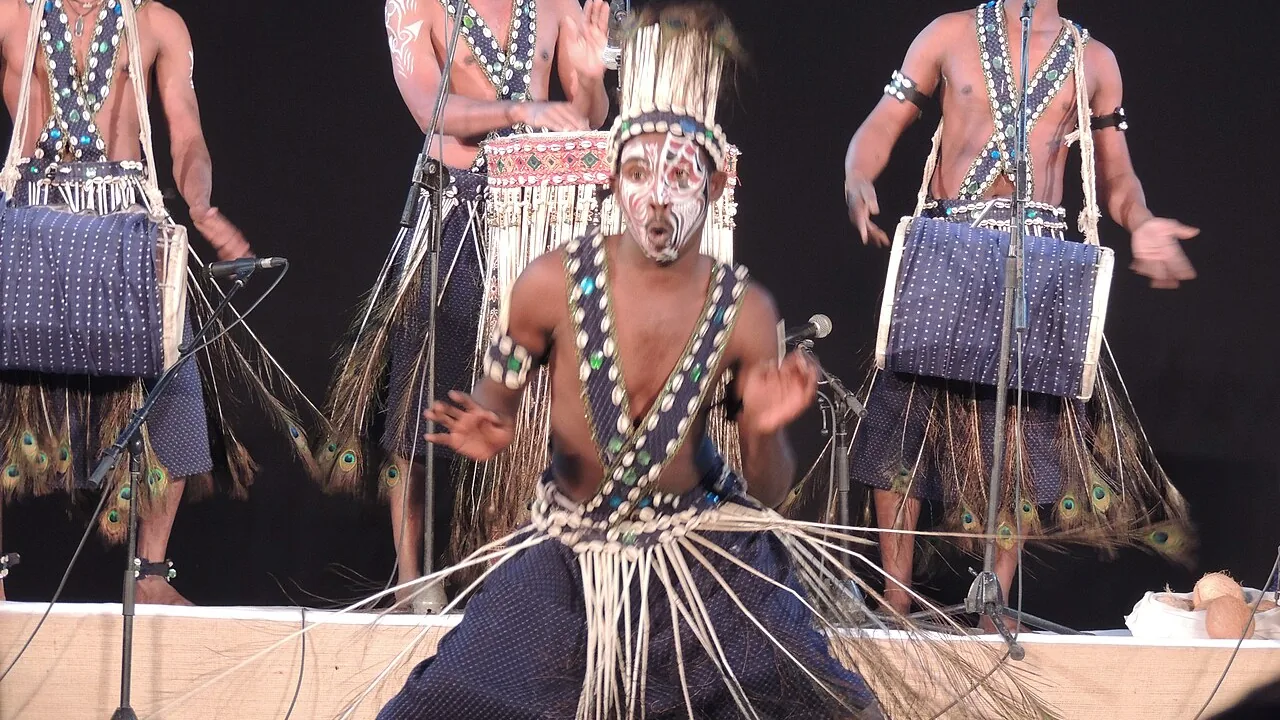
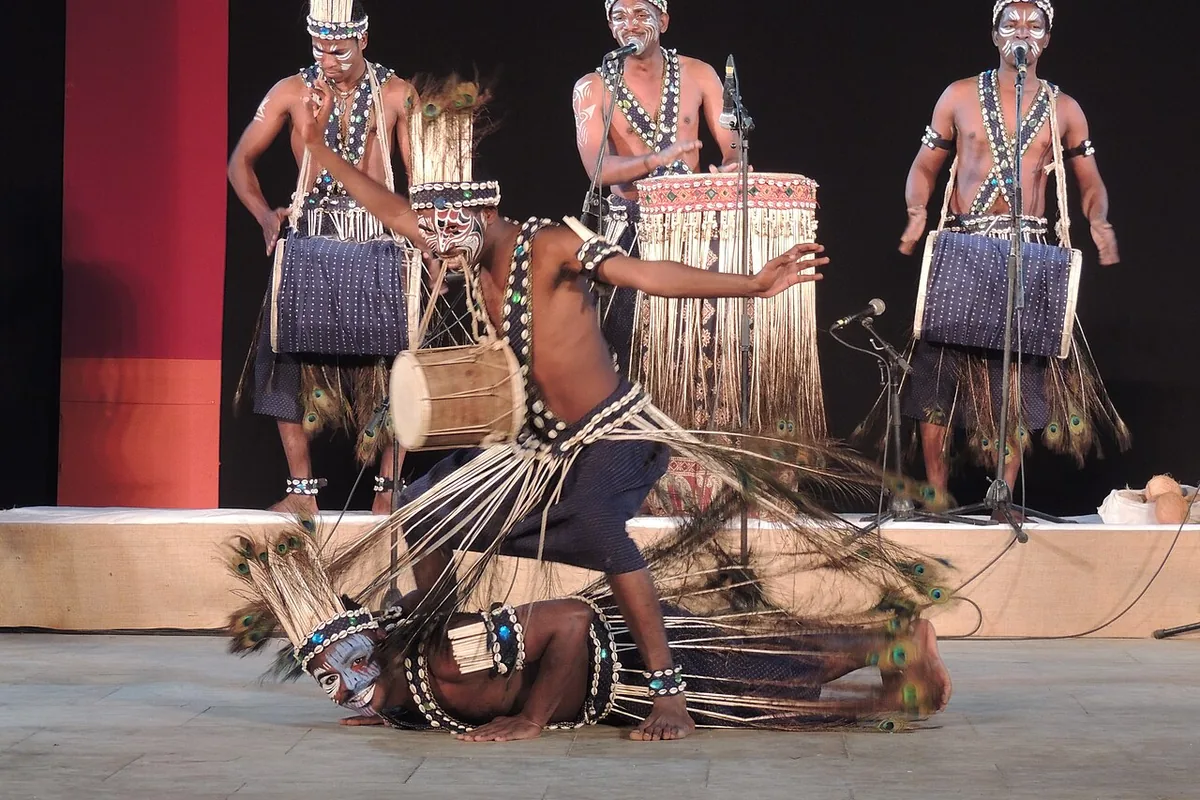
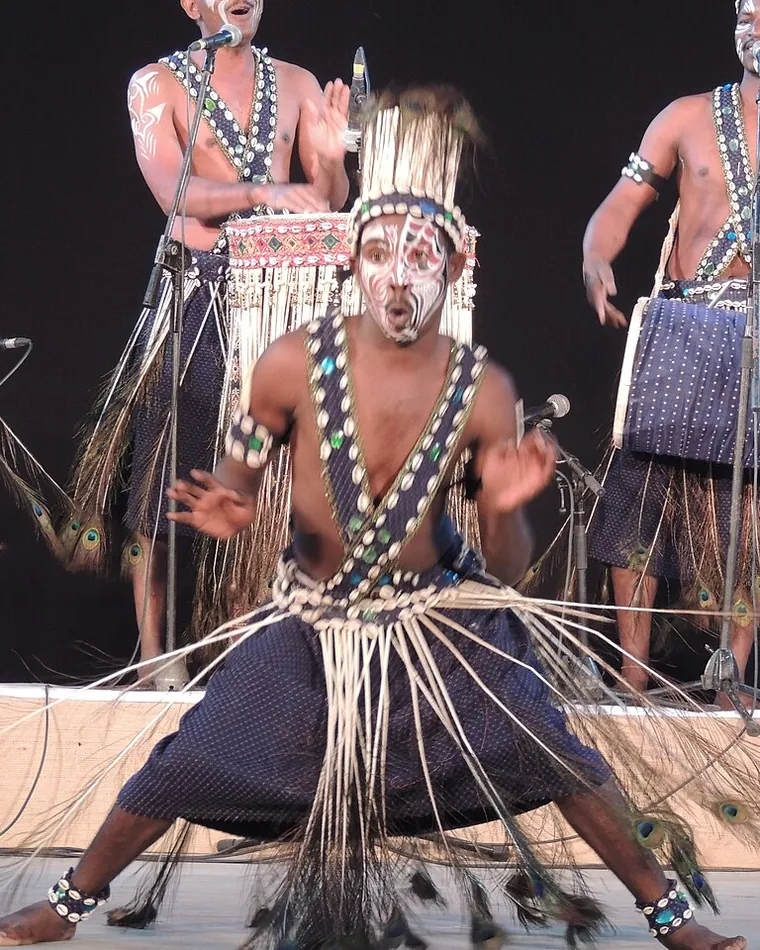
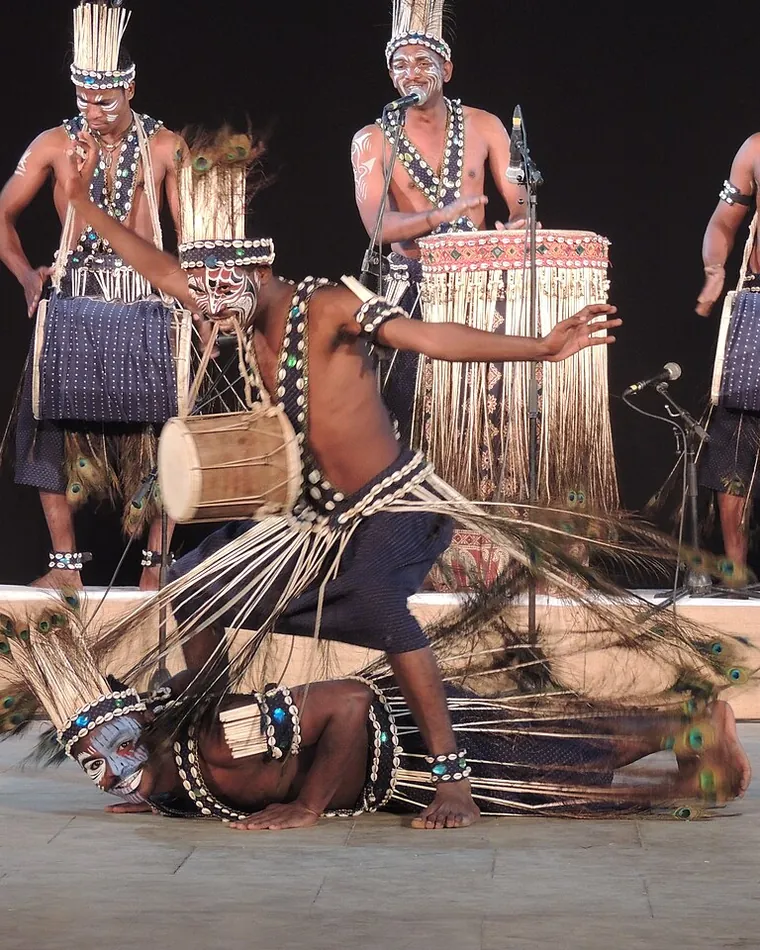
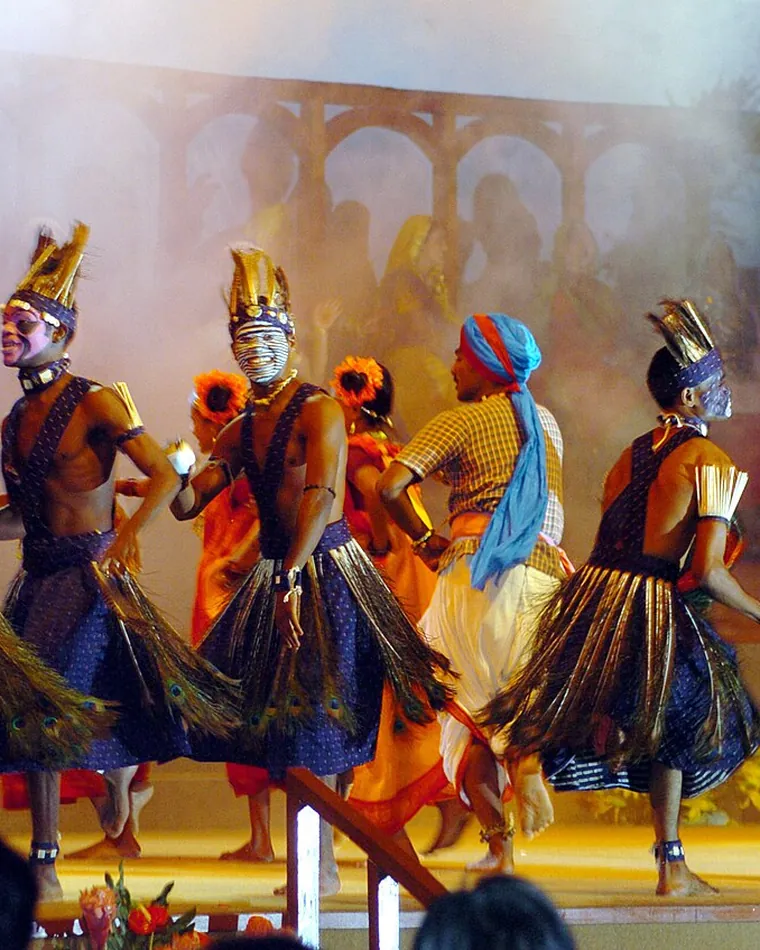
Professional troupes performing for festivals, tourism events and cultural programmes have adopted a very different visual language: face and body paint, feathered headdresses, cowrie-shell straps and fringed skirts. Accounts of where this costume came from differ. Many performers say it was introduced by outside promoters seeking a recognisable image of "Africa", and the costume is strictly excluded from sacred Siddi spaces, where many community members regard it as degrading.
There is no single fixed Siddi Dhamal costume to specify in a booking brief. If you want authenticity for a cultural festival, the more respectful request is a performance in the community's own presentation — and a conversation with the group about what they wear and why.
Meaning
For the Siddi, Dhamal is less a performance genre than a piece of social infrastructure: it carries memory, marks religious time, and holds a scattered community in contact with itself.
Song texts, drum patterns and movement vocabularies preserve fragments of East African practice inside an Indian devotional frame. Much of this survives only in performance — which is why documentation and transmission matter to the community.
Dhamal structures Siddi religious observance: offerings, healing and initiation ceremonies, processions and the multi-day urs commemorations at Siddi dargahs, including those at Bharuch and in the Gir forest.
Siddi recognition as a Scheduled Tribe in Gujarat in the 1980s brought visibility and new performance invitations. Community organisations in Bhavnagar, Jamnagar and Ahmedabad have used cultural programming to press for education and representation.
The practice is not reserved for specialists: any member of the community may take part. That openness is how it is taught — children learn by joining the circle rather than by formal training.
For festival audiences, Siddi Dhamal makes an often-overlooked strand of Indian history visible — an Afro-Indian presence centuries old, with its own saints, songs and shrines.
Professional performance has created income and audiences, and also pressure to exaggerate: fixed, faster, more acrobatic choreography and costumes built for outsiders' expectations. Presenting the form well means naming that tension rather than hiding it.
Why this matters for event organisers. A cultural programme that treats Siddi Dhamal as spectacle alone repeats an old mistake. Introducing the group, the community and the devotional roots of the form costs two minutes of stage time and turns a dance item into genuine cultural exchange.
Terminology
Search results, event listings and even scholarly writing use "Dhamal", "Dhamaal" and "Goma" loosely. They are related terms for overlapping practice, not three separate dances — but they are not perfect synonyms either.
From a South Asian word for ecstatic celebration
From Kiswahili ngoma — drum, drumming, dance occasion
The most useful way to hold the two terms is this: Dhamal describes the devotional practice and its ritual occasion, while Goma points to its drum-centred, Bantu-derived musical identity. Published documentation states the relationship plainly — "Siddi dhamaal, or goma" — and reference sources note that the Gujarati Siddi "Goma music and dance form ... is sometimes called Dhamaal".
What follows is that a Siddi Goma dance performance and a Siddi Dhamal performance may be the same event described by two names. When you see either term in a programme, ask the organiser or group which format is being presented: ritual-style Dhamal, a staged cultural set, or a shorter festival item.
Treating the names as interchangeable without checking is where errors creep in — event listings sometimes advertise "Goma" for a purely acrobatic stage act, or "Dhamal" for a devotional session that was never meant for a proscenium. Accuracy here is a mark of respect for the community, and it also helps you brief a group correctly.
Programming
A Dhamal set gives a programme something most folk items cannot: an unfamiliar tradition with a strong rhythmic hook. It works wherever an audience is ready to be pulled into a circle of sound.
The strongest fit is an event with a cultural theme and a seated audience that can hear live percussion properly. Dhamal is loud, layered and communal; it does not need a large stage, but it does need a sound system that can handle drums without distortion and a floor that can take stamping.
For corporate and institutional programmes, a short set with a spoken introduction usually lands better than a long one. For festivals and heritage events, a longer performance with a participation segment — where the audience is invited to clap or join the circle — turns the item into a highlight rather than a slot on the running order.
Booking
Siddi Dhamal dance booking works best as a conversation about the event, not a menu of fixed packages. Group size, repertoire, travel distance and format all change the arrangement.
Date, venue and format go to the booking desk, which checks which Siddi Dhamal artists are available for that window.
You agree the set length, group size and presentation style, and whether musicians travel with the dancers.
Travel, stay, green room, sound check and stage requirements are confirmed before the event.
The group arrives for sound check; the anchor introduces the tradition before the performance begins.
On availability and pricing. No booking is confirmed until the group and the date are matched. Fees depend on group size, travel, duration and production needs, and are quoted per event — this page does not publish rates, and no artist credentials are claimed here on the group's behalf.
Send your event brief and we will come back with the options that fit your date, city and format.
Book Siddi Dhamal Dance ArtistsAvailability is confirmed per event. No enquiry form on this page — the booking desk handles your brief directly.
Why us
Booking a community performance is mostly a coordination problem: the right group, the right format, the right logistics. That is the part we handle.
One point of contact for enquiries, availability checks and confirmation, instead of chasing individual performers across cities.
Format, set length, music and presentation discussed in context — including whether a group performs ritual-style or stage-style Dhamal.
Group size and duration scaled to your slot — a campus festival, a corporate annual day and a heritage evening need different things.
Written confirmation of what has been agreed — performers, duration, logistics — so nothing is left to assumption on the day.
Questions
Siddi Dhamal is the drum-led dance tradition of the Siddi community, Indians of African descent living mainly in western India. In Gujarat it is tied to the veneration of Siddi ancestor-saints and is performed as a circle dance with call-and-response singing, layered percussion and fast, stamping footwork.
The Siddi reached India through Indian Ocean trade and the slave trade over several centuries, and settled in Gujarat around the Gir forest and Junagadh. The Dhamal known today is documented as taking shape in Gujarat in the nineteenth century, blending Bantu drumming and dance with local Sufi devotional practice, before spreading to Sindh and other regions.
The Siddi, also called Sheedi or Sidi, an ethnic group of East and Southeast African descent. In Gujarat they are recognised as a Scheduled Tribe and number around 8,600 according to the 2011 Census. The practice is not reserved for specialists — any member of the community may take part.
It is one of the few Indian performance traditions where African and South Asian elements are inseparable: East African drums such as the musindo, djembe and goma sit alongside the harmonium and dholak, and zikr verses are sung in Urdu or a Swahili creole. The energy builds through the session, and some performances include trance states understood as the presence of a saint.
Rhythm leads. Drummers play cylindrical and goblet drums — musindo, djembe, mugarman and the goma drum — supported by the malunga bow, mbira and rattles, with harmonium and dholak from the South Asian side. Singers perform zikr in call-and-response, and a conch shell often opens the session.
Yes, closely. Published documentation describes the practice as "Siddi dhamaal, or goma". Goma comes from the Kiswahili word ngoma, meaning drum or drumming occasion, and points to the tradition's Bantu musical identity, while Dhamal names the devotional practice and its ritual setting. They are related terms for overlapping practice, not two separate dances.
Groups do perform at cultural programmes, festivals and institutional events. Share your date, city, venue and preferred duration through the BookMyDance booking desk, and availability will be checked for that window. Fees and group size are quoted per event; nothing is confirmed until the group and date are matched.
Corporate cultural events, state and city festivals, college and school programmes, government cultural events, heritage and tourism showcases, wedding cultural evenings, community celebrations and international cultural festivals. It suits events with a seated audience, a drum-friendly sound system and a stage that can take stamping.
Siddi Dhamal Dance
A Dhamal performance gives your audience something rare: a centuries-old Afro-Indian tradition, performed live, with drums that fill the room and a circle that pulls people in. Tell us your date and venue, and we will help you plan the right format.
Book Siddi Dhamal Dance Performance Browse Gujarat Dances