Everyone is a participant
There is no front row and no backstage. Elders, young men and women, and children all join the same line, and the dance is judged by how well the group holds together.
Dang District · Tribal Folk Dance
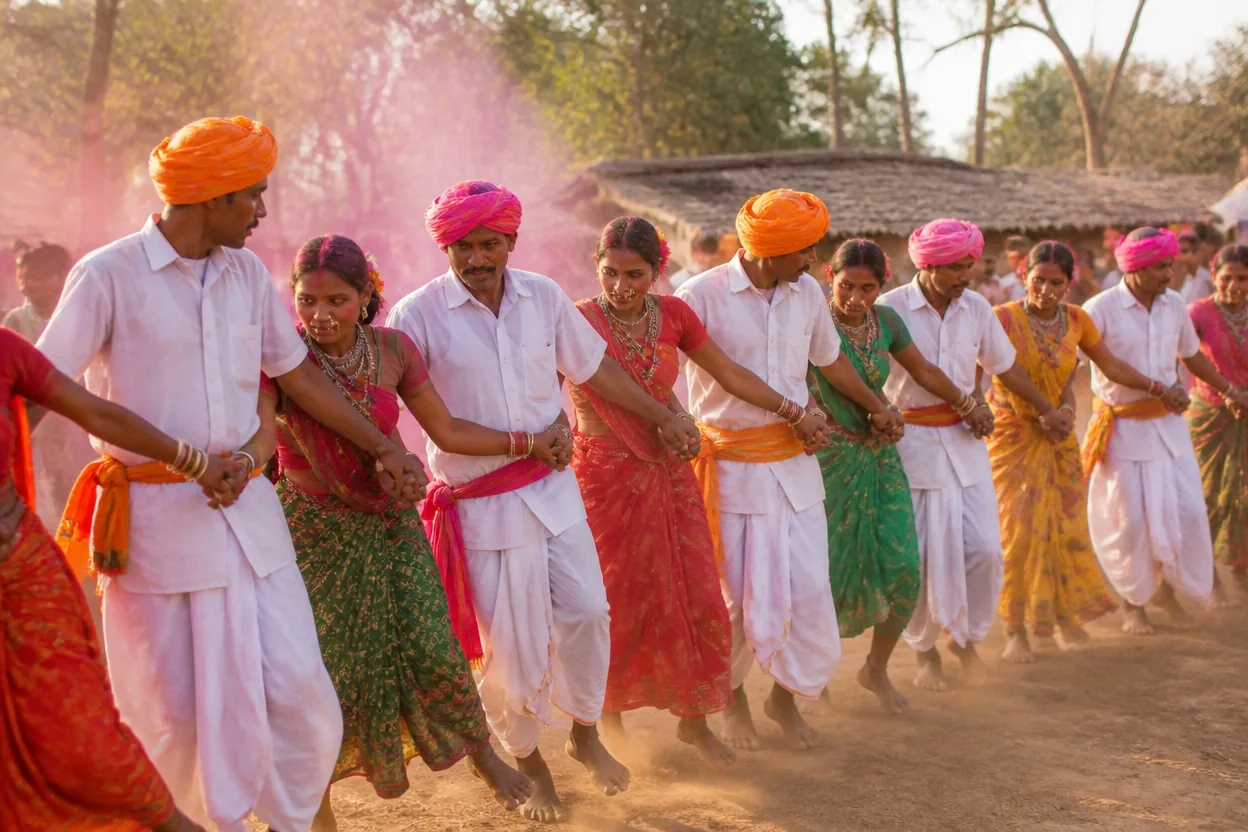
In the forested hills of the Dang district, Dangi Dance is how a village celebrates together: men and women link hands in a long chain, a lead dancer sets the pace, and the line moves in quick, winding steps to the beat of the dhol. It is one of Gujarat's most distinctive tribal folk dances — less a performance for an audience than a shared expression of community, season and identity.
A cultural guide from BookMyDance · Performance availability is confirmed for each event.
The basics
Dangi Dance is the traditional tribal folk dance of the Dang district in south-eastern Gujarat, close to the border with Maharashtra. Dancers — usually men and women together — join hands to form a chain, and the whole line moves in swift, curving patterns across the ground. It is often called Dangi Nritya in Gujarati, and it belongs to the wider family of folk dances of Gujarat that are tied to season, harvest and community worship.
The form is easy to recognise once you have seen it. There is no stage line-up and no single star dancer. Instead, one performer leads the chain and the rest follow, holding hands, matching the step and adjusting to the leader's changes of direction. Because the chain bends and doubles back, the dance looks like a moving stream rather than a fixed circle — a shape that suits the uneven ground of a village square or a forest clearing.
Dangi tribal dance is also physically demanding. The tempo is brisk, the line changes direction quickly, and dancers often lean into the movement with their arms linked. Some troupes add vigorous footwork, turns and acrobatic formations when they perform on a cultural stage, while village versions stay closer to the simple, repetitive chain that everyone present can join.
For the Dangi communities, the dance carries memory. Songs sung with it refer to the forest, farming, the rains and village life; the occasion decides who dances, when and for how long. In a district where the great majority of the population belongs to Scheduled Tribes, Dangi Nritya is one of the clearest public expressions of adivasi identity in Gujarat — and one of the reasons cultural organisations, schools and tourism bodies now invite troupes to perform outside the district.
If you are planning an event, the practical point is simple: this is a group tradition, so it works best when a troupe performs as an ensemble — several dancers moving as one line, with live percussion — rather than as a solo item.
Roots
Dangi dance history is a history of oral tradition rather than of documents. There is no recorded founder, no single founding year and no reliable date of origin — and any page that offers one should be read with caution. What can be described with confidence is the world the dance grew out of.
The Dang is a small, hilly, heavily forested district in the south-east corner of Gujarat. Its villages sit among teak and bamboo, and for generations the communities there lived close to the forest and to the farming calendar. Dangi dance origin is usually traced to that setting: dances performed at seasonal festivals, at weddings and before village deities, where the whole community took part and no ticket separated performer from spectator.
The communities most often associated with the form include Kokan (also written Kokni), Kunbi, Warli and Bhil families, along with other adivasi groups of the district. Because the dance was passed down by participation rather than by notation, its details differ from village to village: a song known in one hamlet may have a different verse in the next, and the step that one group calls the standard may be unknown a few kilometres away. That variation is not a flaw in the tradition — it is how folk forms survive.
Three things have carried Dangi Nritya across generations. The first is the festival calendar: Holi in particular brings villages together and gives the dance a fixed place in the year. The second is the family and neighbourhood group — children learn by standing in the line long before they lead it. The third is public celebration, from village fairs to the Dang Darbar, where troupes perform for a wider audience and the dance becomes visible as heritage rather than only as routine.
In recent decades, school and college cultural programmes, district-level festivals and tourism events have added a new layer. Troupes now rehearse for stages, shorten items to a few minutes and sometimes combine the chain with formations borrowed from other performance styles. Most people involved see this as continuity rather than loss — the dance reaches new audiences — but it does mean that a stage performance and a village Holi dance can look quite different.
Meaning
Dangi Nritya of Gujarat is often described as entertainment, but that undersells it. In its own setting the dance is a social institution: it marks time, strengthens relationships and teaches belonging.
There is no front row and no backstage. Elders, young men and women, and children all join the same line, and the dance is judged by how well the group holds together.
The dance belongs to occasions — Holi above all, but also weddings, harvest gatherings and village celebrations — and the calendar decides when the drum comes out.
For adivasi communities of the Dang, the form is a visible statement of who they are, sung in local languages and shaped by local custom rather than by outside taste.
Children absorb the songs, steps and etiquette by taking part. Nothing is written down, so participation itself is the teaching method.
The dance does not need an audience to be complete — the circle of dancers is the celebration.
That collective character is why the dance travels well to cultural programmes. When a troupe performs, the line still reads as a group activity, and organisers often use the final section of a show to invite guests to join the chain — a simple, low-risk way to give an audience a felt experience of the tradition rather than only a spectacle.
There is also a quieter significance. Folk forms like this one document everyday life: agricultural work, forest knowledge, courtship, humour and grief all appear in the songs that accompany the steps. Preserving the dance is therefore also a way of preserving language and local memory, which is why documentation efforts by cultural institutions matter as much as stage performances.
What dancers wear
Dangi dance costume is village dress at its most festive — the everyday clothing of the Dang, worn in its brightest colours and finished with jewellery and a turban.
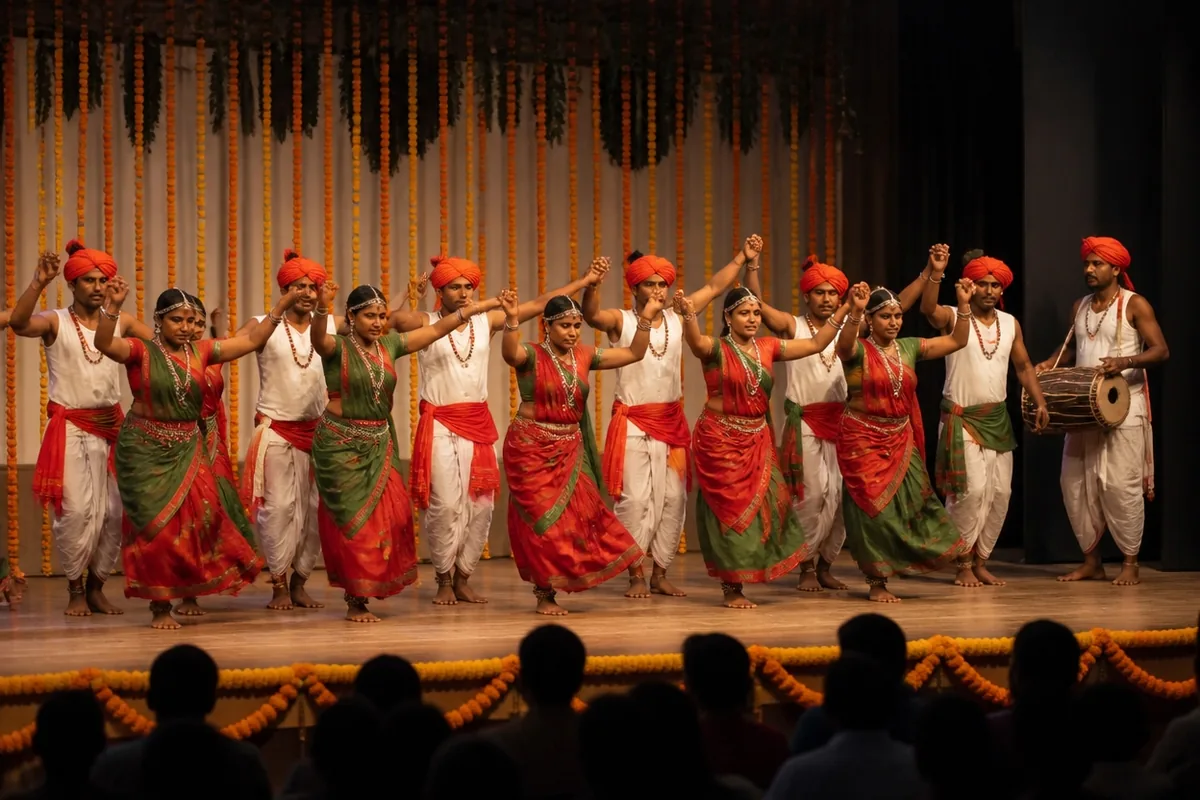
Women generally wear a saree in the local draping style, often in strong reds, greens, yellows and pinks, with a contrasting border. On festival days the saree is paired with silver or oxidised jewellery — necklaces, bangles worn in stacks, anklets, earrings and a nose ring — along with flowers in the hair. The overall effect is bright and deliberately festive, and the jewellery often adds a soft sound to the movement.
Men typically dance in a white dhoti with a kurta or short jacket, a coloured waist sash and a turban — often orange, pink or saffron — with a scarf or shoulder cloth. Turbans are tied in local styles and are the most visible sign of festival dress. Anklets with small bells are sometimes worn, and many dancers keep their feet bare or use simple footwear suited to uneven ground.
There is no single official uniform for Dangi dance. Dress changes with the community, the village, the occasion and the weather, and troupes that perform on stage often standardise colours so that the line reads clearly from a distance. If you are briefing a troupe for an event, ask what they will wear and share photographs of the stage and backdrop in advance; that is more useful than specifying a costume from a photograph taken in a different district.
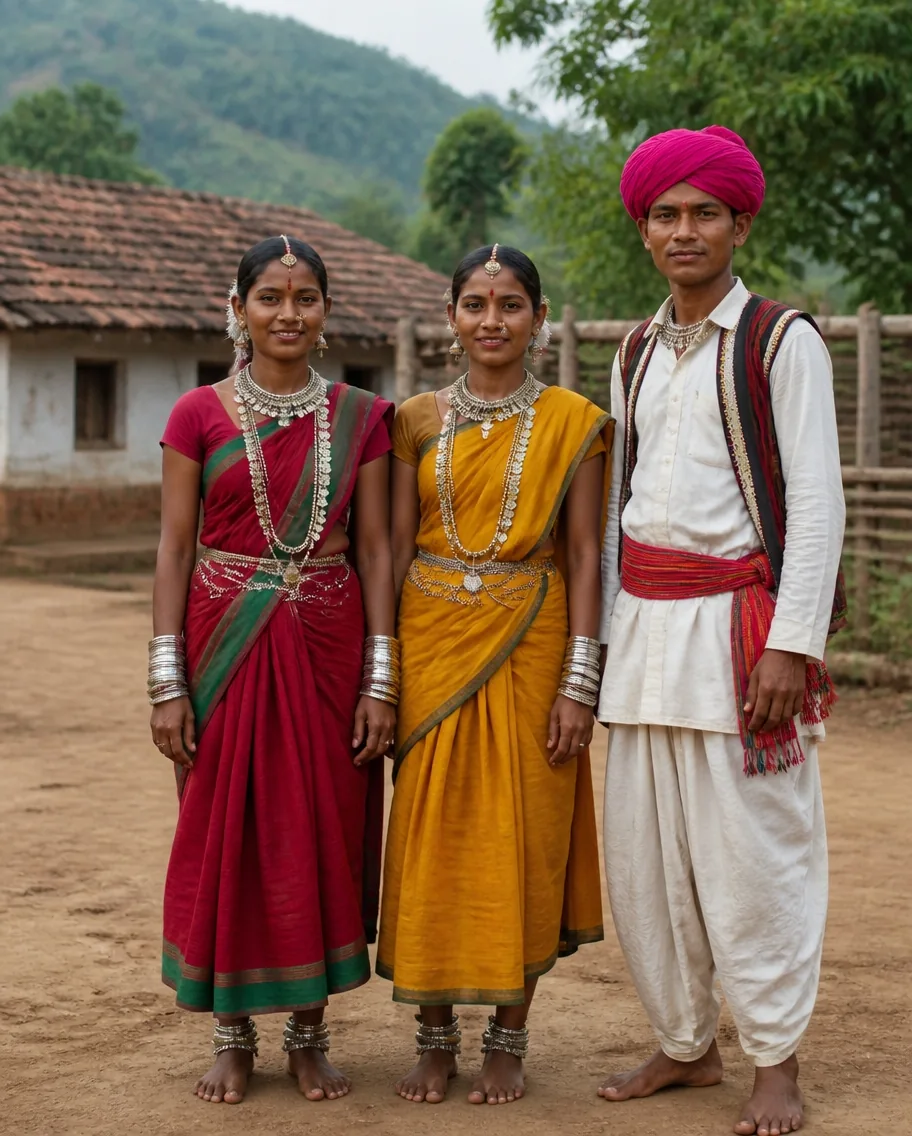
Costume also links the Dang to other Gujarat traditions without being identical to them. The embroidered, mirror-work outfits seen in Tippani Dance performances belong to a different region and a different working tradition, and the chaniya choli associated with Navratri is a separate festival style. Dangi dress is simpler and closer to everyday village clothing.
Sound
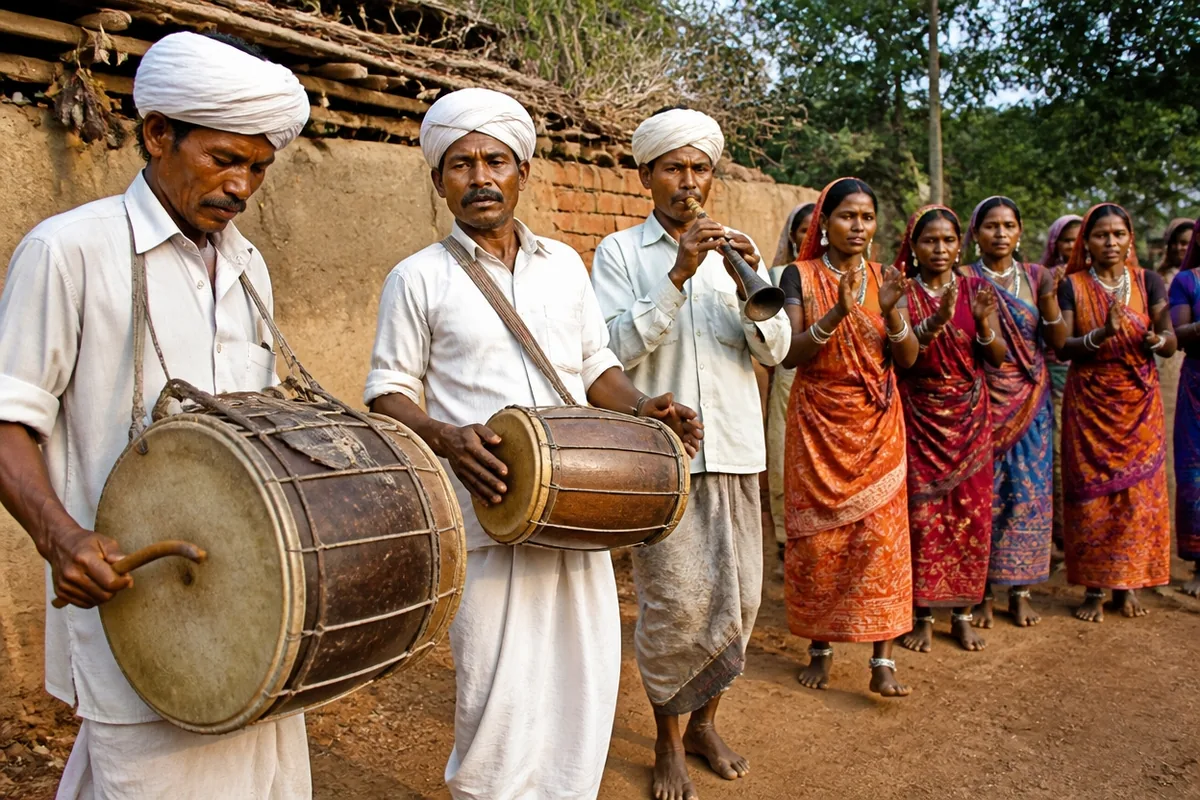
The music is what makes the chain move. Dangi dance music is percussion-led and repetitive by design: a short rhythmic cycle repeats, the singers build on it, and the line of dancers responds.
The dhol is the anchor — a double-headed drum that carries the pulse and signals changes of speed. A smaller dholki often fills in the off-beats, while the kahaiya, a paired percussion instrument associated with the region, adds a crisp, ticking texture. The pawri, a straight folk trumpet played by Dangi musicians, gives the music its distinctive outdoor call, and the shehnai or a simple bansuri flute carries melody where a troupe includes one. Hand cymbals, bells and the dancers' own anklets complete the sound.
Unlike a concert piece, the music here has no fixed length. The drummers set a tempo, the singers deliver couplets, and the lead dancer decides when to lift the pace or change direction. A village dance can run for hours in short cycles; a stage item compresses the same structure into a few minutes with a clear beginning, acceleration and finish.
Most professional troupes now perform with live percussion and recorded vocal tracks, or with a fully live ensemble when the venue allows it. Live drumming is worth asking for if your event has the space — the interaction between drummer and dancers is a large part of what makes the form feel authentic.
Instrument line-ups differ between villages and troupes. No single instrument should be described as exclusive to Dangi dance; the dhol, dholki, kahaiya and pawri are simply the ones most often heard in the district.
Festival
Holi is the occasion most closely associated with Dangi dance. Across the Dang, the festival is not a single morning of colour but a stretch of days filled with music, visits between villages and long spells of dancing.
Dangi dance during Holi follows the rhythm of the community rather than a stage schedule. Groups move from one locality to another, drummers start a cycle, and dancers join the chain as it forms. Colour powder, abir and water are part of the celebration, and the dancing often continues into the night around a fire or in an open courtyard.
The festive atmosphere changes the dance in small ways. More people join, the line becomes longer, and the songs shift towards seasonal and comic themes. Women and men dance together, children follow at the end of the chain, and the boundary between performer and onlooker disappears almost completely — which is exactly the point of a community festival dance.
Holi is the best-known setting, but it is not the only one. Dangi troupes also dance at weddings, at village deity festivals, during harvest celebrations and on cultural occasions such as school annual days and district fairs. Some communities also include the dance in Diwali celebrations. The common thread is a gathering worth marking — the dance is a way of making an occasion public.
For event organisers, Holi-season programming is the most authentic context in which to present Dangi dance. A Holi-themed cultural evening, with colour, live drums and a chain that guests can join, echoes the original setting far more closely than a generic stage slot.
Public celebration
The Dang Darbar is the district's best-known annual gathering, held at Ahwa around Holi. It brings together the five hereditary Dang chiefs, government officials, villagers, craftspeople and performers — and Dangi dance is part of how the occasion is marked.
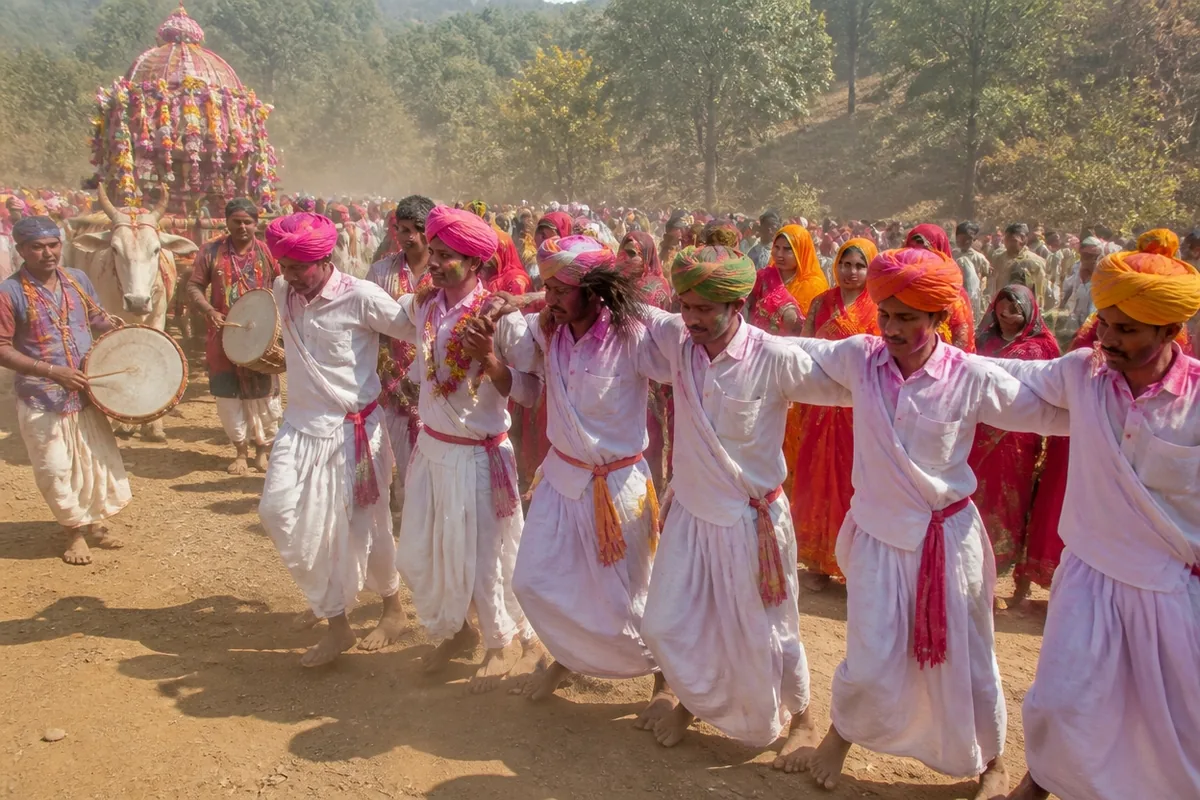
The fair is usually described as a coming together of the five Dang states — Daher-Amala, Linga, Gadhvi, Vasurna and Pimpri — whose rulers hold hereditary titles recognised under an agreement with the East India Company dating to 1842. At the end of the financial year, around Holi, the chiefs gather at Ahwa in ceremonial procession to receive the annual payment due under that arrangement. Over time the event has grown into a public festival with crafts, food, music and dance.
For Dangi dance, the Darbar matters because it places the tradition on a public stage without removing it from its season. Troupes from across the district perform, drum groups play, and the procession itself becomes a moving performance. Visitors see the dance as part of a living civic occasion rather than as a folk item inserted into an unrelated programme.
An annual Darbar is held at Ahwa, the district headquarters, around Holi. Five Dang chiefs hold hereditary titles recognised by government, and the gathering includes ceremonial processions, tribal music and dance.
Descriptions of the Darbar as a "royal court" where dance is performed for the chiefs are a modern reading. Historically it has been a community and administrative gathering as much as a court, and the dance belongs to the assembled public.
If you are travelling to see it, treat the Darbar as a living community event rather than a ticketed show: dates follow the festival calendar, crowds are large, and the programme is informal. For event organisers unable to visit, the practical alternative is to invite a Dangi troupe to perform at your own cultural programme and to present the dance in its festival context.
On the ground
A Dangi dance performance is built around the line. Where it goes, how fast it moves and how the group holds together matter more than any individual step.
The basic formation is a single chain of dancers holding hands, moving in a winding path. As numbers grow, the chain may split into two lines that weave around each other, open into a wide circle, or close into tighter turns. Some troupes performing on stage add paired sections and acrobatic formations — shoulder stands and human pyramids — to create a visual climax, a practice that belongs to the modern performance circuit rather than the village original.
Steps are quick and grounded, with a spring in the knee and a strong swing of the linked arms. Coordination comes from watching the lead dancer and listening to the drum: when the drummer changes the pattern, the line changes direction. Good troupes make this look effortless, with the whole chain turning at almost the same instant.
In its own setting the dance has no boundary between performers and guests. On stage, troupes preserve that spirit by ending with an invitation to the audience — a short segment where guests join the chain while the drummers keep a simple, steady beat.
Why it matters
Gujarat's folk dance map is usually drawn with Garba and Dandiya at the centre. Dangi dance belongs to a different, equally old layer: the tribal traditions of the state's forested south-east.
That layer matters because it is less visible. Garba has global recognition, including a place on the UNESCO Representative List of the Intangible Cultural Heritage of Humanity since 2023, and it fills stadiums during Navratri. Dangi dance has no comparable platform; it survives through village participation, school programmes, district festivals and the efforts of troupes who travel to perform. Giving it space on cultural stages — and describing it accurately — is part of keeping that balance.
There is a practical caution here too. When a folk form becomes a stage product, it can be flattened into a five-minute item that loses the songs, the length and the participation that gave it meaning. The healthier model is the one many troupes already follow: perform a tightened version on stage, explain the context, and keep the participatory ending. That way the audience leaves knowing what the dance is, not only what it looks like.
Performers
A Dangi dance troupe brings the sound and movement of the Dang to audiences that may never visit the district. Because the form is communal, it works especially well where you want guests to feel part of the occasion rather than watch from a distance.
Troupe size, duration, travel and pricing depend on your city, date and stage, and are confirmed directly with the performers. No availability or price is guaranteed on this page.
Share these details and the right troupe can be suggested for your programme.
Choosing well
A folk performance earns its place on a programme when it does something a playlist cannot: it shows a living tradition, with real musicians and a form that invites response.
The steps, songs and instruments come from the Dang, not from a film choreography. That grounding is what makes the performance credible to an audience that knows the culture.
Dress, percussion and movement are designed as one experience, so the item reads clearly even on a large stage or from the back of a hall.
Because the dance is a chain, guests can be brought in for the closing cycle — a participation moment that is simple, safe and memorable.
A short introduction to the region, the festival and the instruments turns entertainment into cultural learning for schools and corporate audiences.
The same logic applies across Gujarat. A Dandiya Dance segment suits a Navratri evening, a Garba Dance set fills a festive floor, and a Padhar Dance item brings a devotional tone. Dangi dance is the right choice when you want the tribal, forest-side identity of Gujarat — a different sound, a different formation and a different story from the Navratri repertoire.
Questions
Dangi Dance, also called Dangi Nritya, is a traditional tribal folk dance from the Dang district of south-eastern Gujarat. Dancers — usually men and women together — hold hands to form a chain and move in fast, winding patterns, led by one dancer and driven by dhol-based folk music. It is performed mainly at Holi, village festivals, weddings and public cultural events such as the Dang Darbar.
The dance grew out of the community life of the Dang's adivasi villages, where celebrations were marked by group singing and dancing rather than by staged performance. There is no documented founder or founding date — the tradition has been passed down orally, and its songs and steps vary from village to village. Its history is best understood through the festival calendar, especially Holi, which has kept the form alive across generations.
The Dang district, in the south-eastern corner of Gujarat near the Maharashtra border, with its headquarters at Ahwa. The district is hilly and forested, and the majority of its population belongs to Scheduled Tribe communities, including Kokan, Kunbi, Warli and Bhil families.
Dangi Nritya is a collective tradition rather than a performance for spectators. It marks festivals and seasons, strengthens community bonds, and gives adivasi identity a public expression. Because children learn the songs and steps simply by joining the line, the dance also carries language, local history and social values from one generation to the next.
Women generally wear a saree in the local draping style, in bright colours, with silver or oxidised jewellery, stacked bangles, anklets, earrings and a nose ring, plus flowers in the hair. Men usually wear a white dhoti with a kurta or short jacket, a coloured waist sash and a turban. Dress varies by community, village and occasion, and stage troupes often standardise colours for visibility.
The dhol is the main drum, supported by the dholki and the kahaiya, with the pawri — a straight folk trumpet played by Dangi musicians — and the shehnai or bansuri carrying melody in many ensembles. Hand cymbals and the dancers' anklets add texture. Instrument line-ups differ between villages and troupes, so no single instrument should be treated as exclusive to the form.
Yes. Holi is the best-known occasion for Dangi dance, with villagers moving between localities, drumming, playing with colour and dancing in long chains. The Dang Darbar, held at Ahwa around Holi, is the district's major public gathering, where processions, tribal music and dance are part of the celebration. The dance is also performed at weddings, harvest festivals and cultural programmes through the year.
Yes. Dangi troupes perform at corporate cultural events, government programmes, school and college functions, folk dance festivals, weddings and stage shows. Availability, troupe size, duration and pricing depend on your date, city and venue, so these are confirmed directly with the performers. Sharing your event details in advance helps the right troupe be suggested.