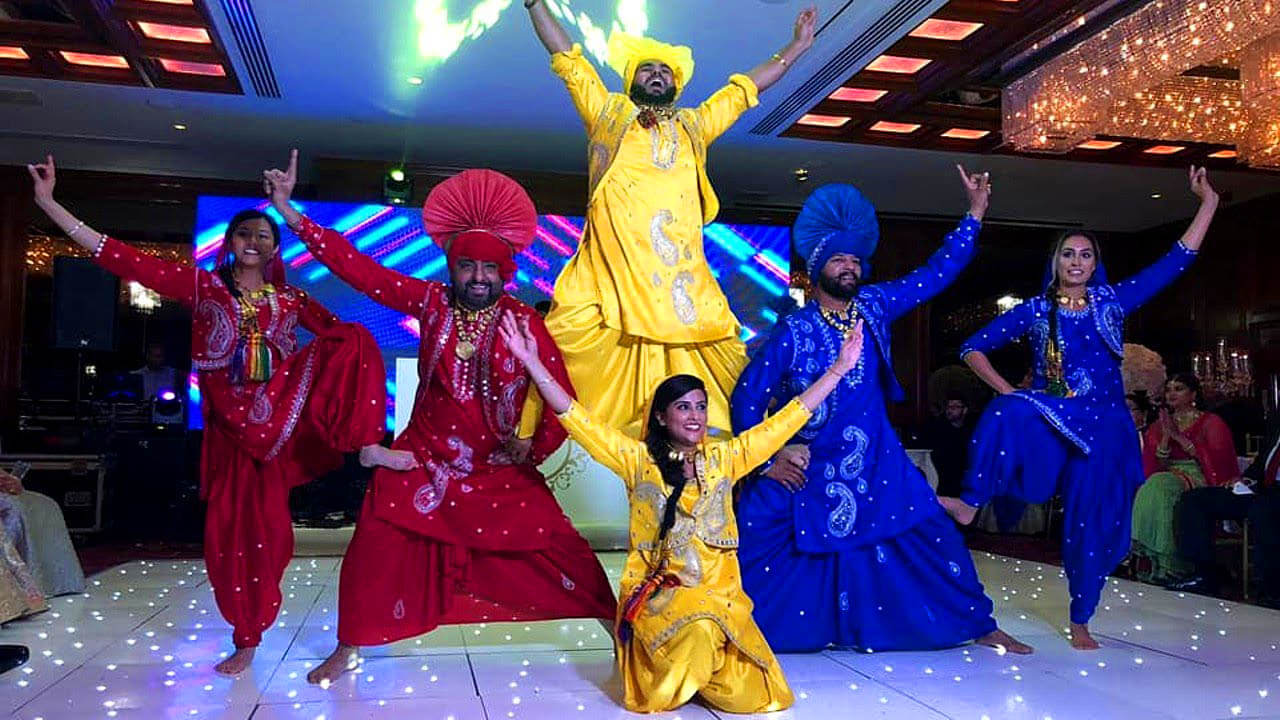
Punjabi folk · the flagship set
Bhangra & Giddha
The drum-driven harvest dance and the women's circle of boliyan — the two Punjabi forms most often booked together, and the family Dankara belongs to.
Learn about Bhangra & GiddhaPunjabi folk tradition · stick dance
Dankara dance — written Dhankara in most published descriptions — is a celebratory folk dance of Punjab in which dancers hold colourful sticks and tap them together in rhythm with the dhol. Performed in a circle with structured, repeating patterns, it is documented primarily as a Punjabi wedding dance. This guide covers what the dance is, its history, its steps and attire, and how to enquire about a performance.
A Punjabi traditional stick dance of the wider Bhangra family — the rhythm is not only heard on the dhol, but seen in every crossing of the sticks.
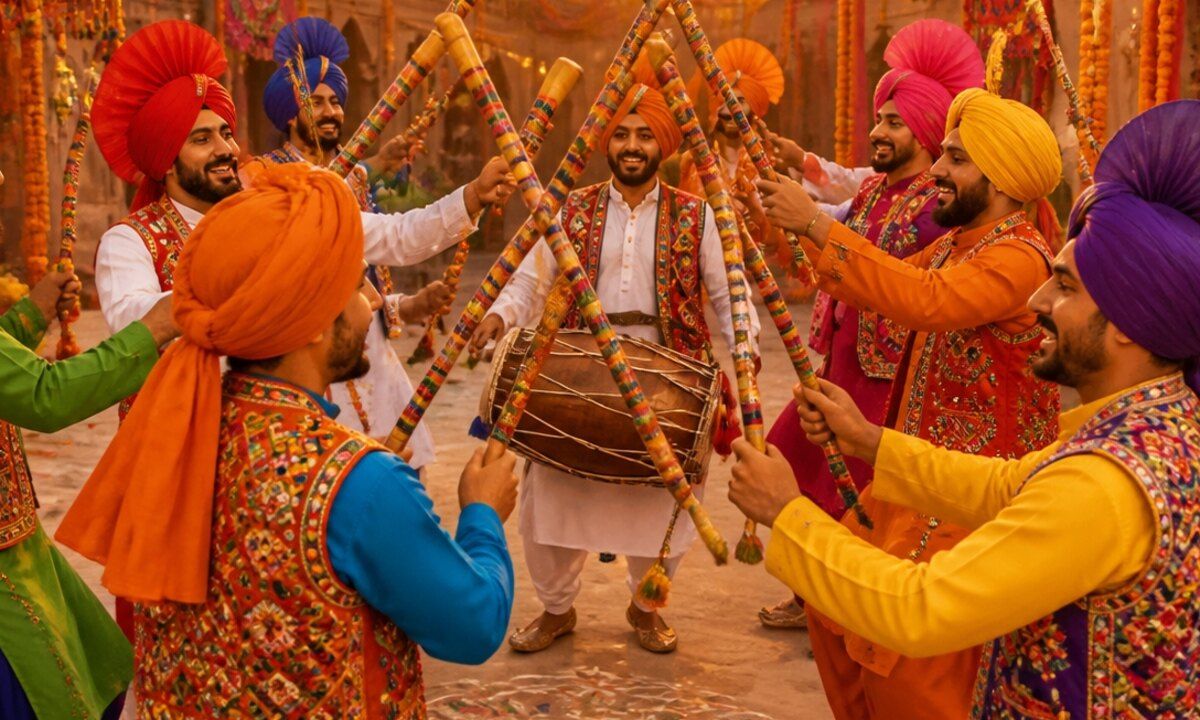
Dankara dance is a Punjabi traditional stick dance: each dancer holds a pair of decorated sticks of different colours and strikes them against a partner's sticks in time with the dhol. Published descriptions place the dance in a circle, moving in structured patterns so that dancers meet, tap and rotate — a format that is regularly compared to Gujarat's Dandiya Raas, but danced in Punjabi style, to Punjabi rhythms.
The name points to the prop. It is usually derived from daang, the Punjabi word for a stick, and the dance is recorded under both the spellings Dankara and Dhankara — sometimes even as a Gaatka dance, because of the shared stick idiom. What the descriptions consistently agree on is simpler than the spellings: a wedding-rooted, joyful group dance in which the sticks themselves become a musical instrument.
People look up Dankara dance for different reasons: to understand a lesser-documented Punjabi folk form, to prepare a school or college cultural item, to check whether it is the same as Dandiya or Gatka, or to plan a folk performance for a wedding or celebration. This page answers each of those needs and clearly separates what published sources record from what is simply not established.
Dankara appears in published compilations of the folk dances of Punjab, where it is described as a ceremonious wedding dance of the wider Bhangra family. The accounts agree on the essentials recorded above: the name from daang (stick), at least two performers, colourful sticks of various hues, the dhol as the rhythmic anchor, and a circle format with striking patterns.
The stick is also why the dance is sometimes labelled a Gaatka dance in popular listings. The overlap is real but limited: Gatka proper is the Sikh martial art — a system of stick-fighting with wooden sticks simulating swords, performed today as a display at Sikh festivals. Dankara shares only the prop, not the martial purpose: published descriptions frame it as a social, celebratory dance, not combat. Punjab has other stick traditions as well — for instance Tipri, a stick-and-rope dance recorded in Patiala — so "stick dance" does not mean the same thing across the state.
Because the dance belongs to the shared Punjabi heritage documented on both sides of the India–Pakistan border, its village-level practice has been carried through community performance rather than through written records. That is true of most Punjabi folk forms, and it shapes what can honestly be said about the dance's age and origin.
We have not found reliable evidence for an exact origin date, a founder, a particular district of origin, or a documented "first performance" of Dankara — so this page does not state one. Precise step-by-step choreography is likewise not documented in sources we could verify. Where a claim about the dance's history cannot be traced, we say so rather than filling the gap with a confident story.
Within Punjabi folk tradition, Dankara sits in the family of community dances — forms in which the group, the circle and the shared beat matter more than any solo performer. Published descriptions classify it as a sub-form of the Bhangra family: joyful, social and visually striking, which is exactly why it has been recorded as a wedding item. The crossed sticks give a gathering a focal point that everyone can take part in or watch and follow.
The dance also shows a familiar Punjabi pattern: rhythm made visible. In Sammi, the beat is carried by claps and finger clicks; in Dankara, it is carried by wood on wood. The sticks turn the music into movement, which makes the form easy to stage, easy to teach to a group, and easy for an audience to enjoy even without knowing the tradition.
As with other Punjabi folk forms, it helps to keep two things apart. The traditional context recorded in the sources is a wedding celebration danced by community members themselves. The Dankara seen at cultural programmes, festivals and competitions today is usually a staged adaptation: choreographed for a set duration, performed by trained groups in coordinated dress, often arranged alongside a Bhangra and Giddha set. Both are genuine ways of keeping the form alive — a group booking a performance should simply be clear about which one it wants.
No authoritative, step-by-step choreography of Dankara is published. What published descriptions do agree on is a small set of movements — and every stage version builds on them.
Group size, duration and formations are decided by the performers and the occasion — there is no single official routine. On stage, groups typically add what a traditional circle does not need: an entry, a few formations, coordinated costumes and a set running time that fits the programme. For an event booking, the practical points to agree in advance are the number of dancers, the length of the item, whether the dhol is live or recorded, and the costume style the group will wear.
The details below come from published descriptions of the dance. They record what the tradition is described as, not a uniform that every troupe must wear.
Sticks of various hues are the heart of the dance — held one in each hand and tapped against a partner's in rhythm. Stage groups typically decorate them so the crossings read clearly from a distance.
Published descriptions record men in bright kurtas with vibrant turbans of different colours, and decorative bands tied at the waist. The multicoloured turbans are the detail most closely associated with the dance.
The dhol is the documented accompaniment, with the stick-taps layered on top of it as live percussion. Whether a booked troupe brings a live dhol player or uses recorded music is a practical question — confirm it while planning.
Published descriptions record Dankara as a ceremonious folk dance performed primarily at wedding celebrations — men in vibrant turbans, sticks in hand, the dhol carrying the celebration. That is a genuine, documented association, and it is the context in which the dance is most often remembered.
What the sources do not support is a claim that every Punjabi wedding includes Dankara, or that it is tied to one specific ritual of the wedding. Think of it as a wedding-rooted celebration dance rather than a fixed ceremony item.
Beyond weddings, a stick dance of this kind is a practical choice wherever a short, lively folk item is needed:
BookMyDance works on an enquiry basis: you share the event details, and the team comes back with the performers, group size and pricing that fit your programme. Availability is confirmed on enquiry — we do not publish fixed packages, standard fees or guaranteed troupe sizes for a Dankara performance.
Helpful details to include in your enquiry: event date, city and venue, audience size, stage or floor dimensions, whether the event is indoors or outdoors, the duration you want, and whether you would like a live dhol. BookMyDance states that its team responds to enquiries within 24 hours and that consultation is free, with pricing discussed upfront. For larger programmes, see dance troupe bookings, wedding and sangeet performances or private party dancers.
Three quick distinctions that answer the questions readers most often bring to this page.
The stick-tapping circle is genuinely similar to Gujarat's Dandiya Raas — published descriptions say so themselves. The difference is everything around it: the dhol, the Punjabi attire, the wedding context and the Bhangra-family styling.
Some listings call it a "Gaatka dance" because both use sticks. But Gatka is the Sikh martial art — stick-fighting displayed at festivals — while Dankara is a social celebration dance. Same prop, entirely different purpose.
Bhangra leaps, Giddha claps, Sammi sways — Dankara's signature is that the percussion is made of wood: every beat lands visibly as sticks meet. It is also documented specifically as a wedding item, which few other forms are.
Dankara is one thread in a much larger Punjabi dance tradition. These pages cover the forms most often programmed alongside it.
Punjabi folk · the flagship set
The drum-driven harvest dance and the women's circle of boliyan — the two Punjabi forms most often booked together, and the family Dankara belongs to.
Learn about Bhangra & Giddha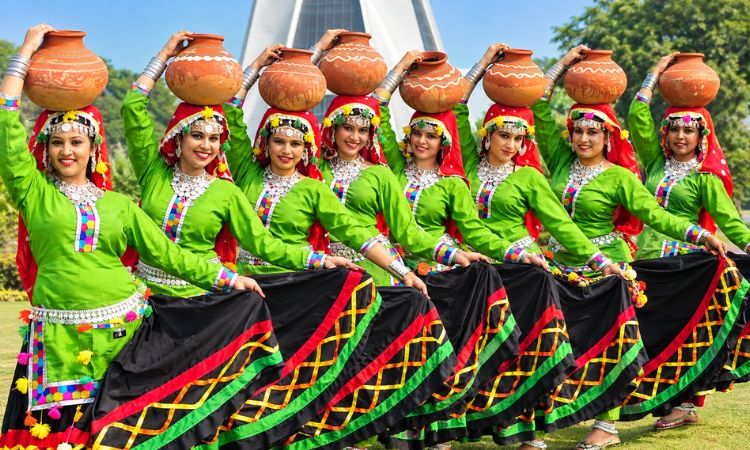
Punjabi folk · women's circle
The gentle women's circle dance of the Sandal Bar belt — claps and footwork instead of drums, and a lovely contrast item next to a stick dance.
Discover the Sammi dance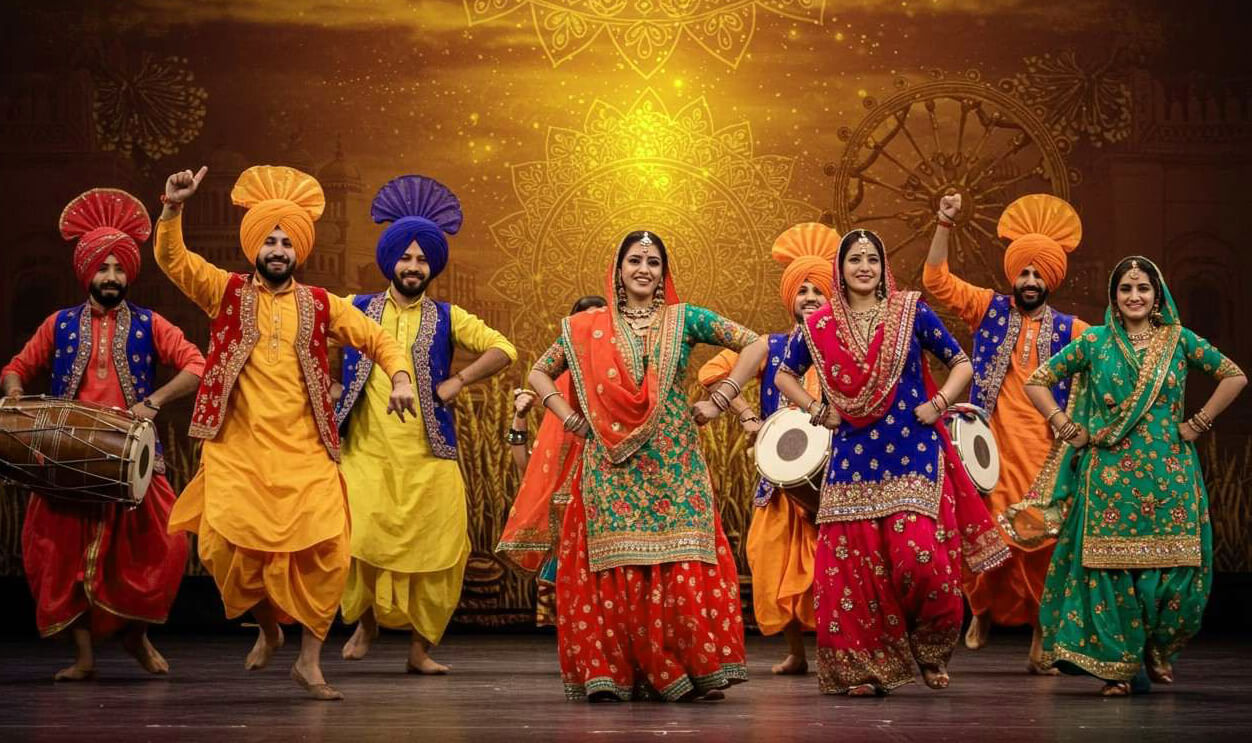
Directory · 20+ forms
Bhangra, Giddha, Luddi, Kikli, Jhumar, Sammi and more — with the communities and regions behind each one, including Dankara itself.
Explore more Punjabi folk dancesDankara dance — more often written Dhankara in published descriptions — is a Punjabi folk dance in which dancers hold colourful sticks and tap them together in rhythm with the dhol. It is described as a celebratory stick dance of the wider Bhangra family, performed in a circle with structured patterns, and is closely associated with Punjabi wedding celebrations.
Dankara is recorded in published lists of the folk dances of Punjab, where the name is derived from daang, meaning stick, and the dance is described as a wedding celebration item performed with coloured sticks. No exact origin date, founder or place of origin is established in reliable sources, so its early history is best described in broad terms as part of the shared folk heritage of the Punjab region.
Yes. Dankara and Dhankara are used interchangeably for the same Punjabi stick dance — this page uses Dankara, the spelling in its web address, while published descriptions more often carry the Dhankara spelling. Some readers also search the phonetic spelling Daankara. The name relates to the stick (daang) the dancers hold, which is also why some descriptions call it a Gaatka dance — though it is a celebration dance, not the Sikh martial art Gatka.
No standard written syllabus of Dankara dance steps is documented. Published descriptions agree on the pattern: dancers form a circle, hold colourful sticks, tap them together in rhythm with the dhol, and move in structured patterns that bring partners together to strike sticks with each rotation — a movement often compared to Gujarat's Dandiya Raas. Stage groups arrange their own choreography around this core.
Yes. Published descriptions describe it as a ceremonious folk dance performed primarily at wedding celebrations, with men in bright turbans dancing with sticks to the dhol. That documents a strong wedding association — though not a claim that every Punjabi wedding includes it. Today the dance is also presented at cultural programmes, festivals and community events.
The defining prop is the pair of colourful sticks each dancer holds. For attire, published descriptions mention bright kurtas and vibrant turbans of different colours, with decorative bands tied at the waist. Women participate separately in some traditions. Modern stage groups often adapt the look, so costume details should be confirmed with the performers.
Use the enquiry options on the BookMyDance contact page, message the team on WhatsApp or call +91-9355056666 with your event date, city, venue, programme type, preferred duration and the number of performers you have space for. BookMyDance works on an enquiry basis: availability, group size and pricing are confirmed on enquiry, and the team states that it responds within 24 hours with consultation free of charge.
If you came here to understand the Dankara dance of Punjab, the Punjab dance directory shows how it fits beside Bhangra, Giddha, Sammi and the rest of the state's folk forms. If you came to plan a performance, send us your event details and we will tell you what is possible.