Traditional Group Dance · Kerala
Kaikottikali Dance of Kerala
Kaikottikali — Kerala's much-loved hand-clapping circle dance — is performed by women in ivory-and-gold kasavu attire, singing and clapping in unison around a glowing nilavilakku. Below you'll find how it is danced, what it means, and how to bring a live Kaikottikali troupe to your own event.
BookMyDance arranges verified Kaikottikali dance groups for cultural programmes, Onam events, weddings and stage shows across India.
- Dance style
- Traditional group folk dance, graceful (lasya-leaning) in character
- Cultural home
- Kerala, India — performed across communities and regions
- Signature occasions
- Thiruvathira (Dec–Jan) and Onam; temple & community festivals
- Visual identity
- Circle formation around a nilavilakku, rhythmic clapping, kasavu attire
What Is Kaikottikali Dance of Kerala?
Kaikottikali is a traditional group dance in which women dance in a circle, sing together and keep the beat with their own hands. The name says exactly that: kai means hand, kotti means clapped, and kali means dance — the hand-clapping dance.
The form is closely tied to Kerala's festival calendar. When it is danced on Thiruvathira day, it is usually called Thiruvathirakali; in some parts of Kerala the same tradition is known as Kummikkali, with small regional differences in style and song. Because the names overlap, you will see all three used for what is essentially one family of circle dances.
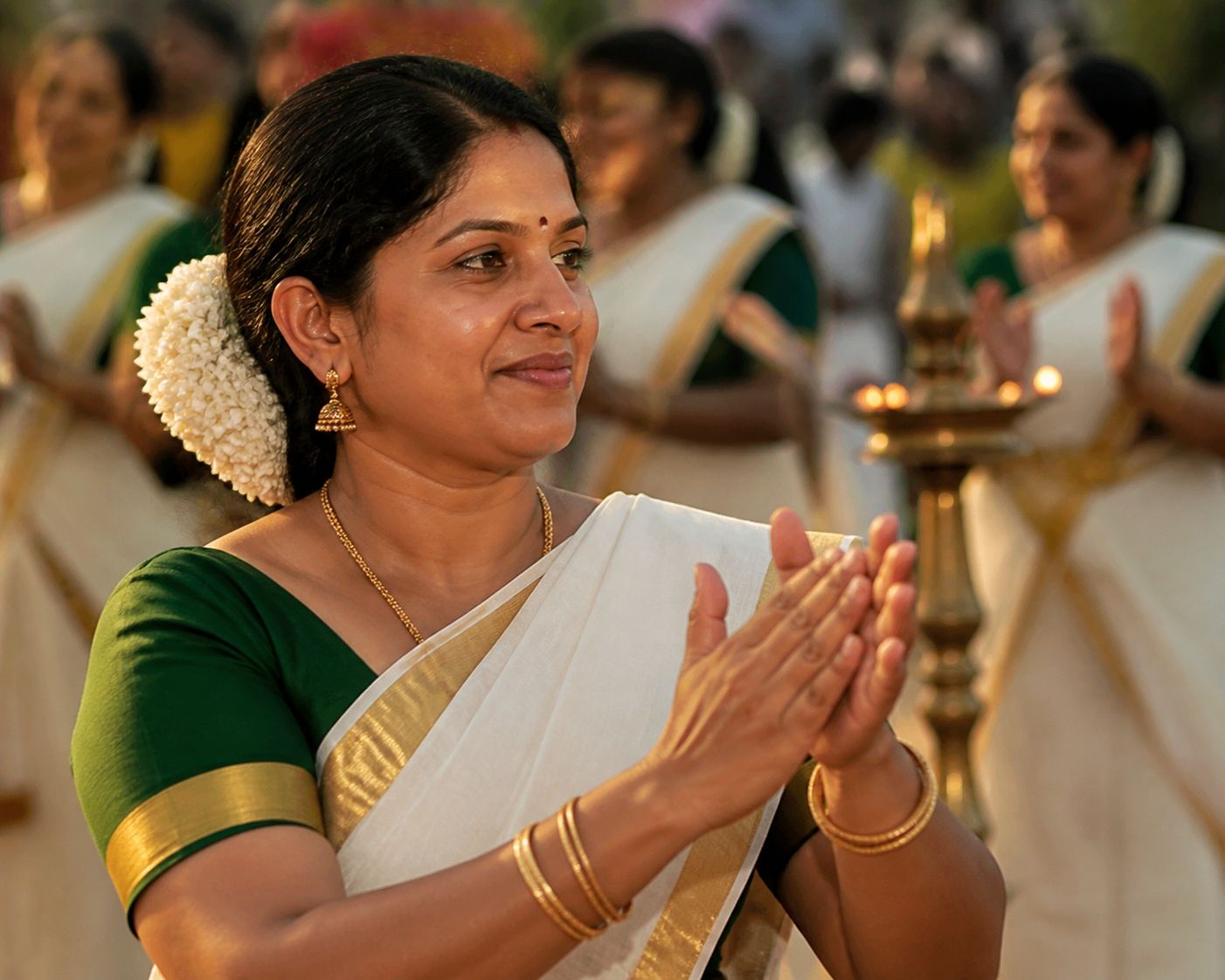
Its visual identity is unmistakable: a ring of dancers in Kerala's off-white kasavu attire with golden borders, jasmine flowers in their hair, palms clapping up and down in unison around a lit nilavilakku (traditional standing lamp). Alongside classical stage arts such as Kathakali, Kaikottikali belongs to the people's tradition — learned in courtyards and community gatherings rather than in a codified classical syllabus.
That everyday, communal origin is also why it has stayed alive: it is a dance that welcomes participants rather than only spectators.

History and Cultural Background of Kaikottikali
Kaikottikali has no single documented starting date — and honest writing about it should not invent one. What cultural historians and practitioners broadly agree on is that it grew out of the agrarian, devotional and community life of Kerala, passed from one generation of women to the next in homes, temples and neighbourhoods.
The Thiruvathira connection
The dance is deeply woven into the Thiruvathira festival, observed on the Thiruvathira star in the Malayalam month of Dhanu (around December–January). Women who observe the Thiruvathira vrata traditionally gather after sunset, sing the praises of Shiva and Parvati, and dance through the night. The belief that the dance brings auspiciousness and a happy married life remains part of the tradition — the first Thiruvathira after a woman's marriage is still celebrated as Poothiruvathira in many families.
The Onam connection
Kaikottikali is equally at home in Onam, Kerala's harvest festival. During Onam the same circle, the same clapping style and the same loving attention to song carry a different song set — Onam songs that recall the legendary rule of King Mahabali. Kerala Tourism describes it as among the most popular of the state's festival dances.
A living tradition
In earlier times, some accounts describe the dance continuing across many days of the Dhanu month; practices vary today. What has not changed is its reach — from temple courtyards and school competitions to mass public performances (one gathering of 6,582 dancers earned a Guinness World Record for the largest Kaikottikali dance). Few folk forms stay this present in everyday life.
Its graceful, feminine quality — the lasya element that also shapes Kerala's classical Mohiniyattam — is often noticed by first-time viewers, but Kaikottikali's true character is collective: many voices, many palms, one circle.
How Is Kaikottikali Performed?
Part of Kaikottikali's charm is how simply it begins — and how much coordination it hides in that simplicity. A typical performance unfolds like this:
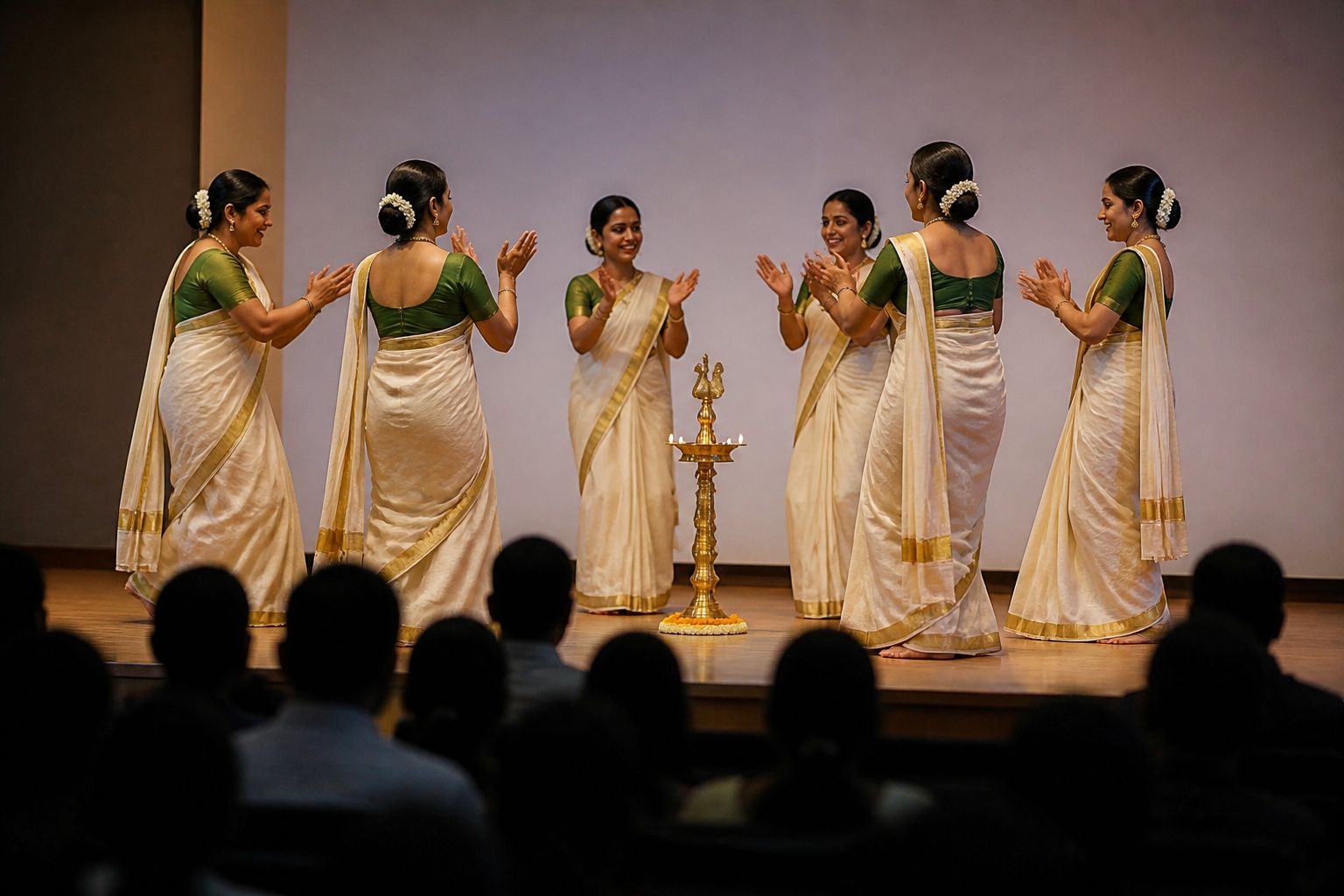
- The formation. Dancers — traditionally women, often around eight to twelve in informal settings — stand in a circle around a lit nilavilakku, facing inward. On stages without space for a circle, troupes adapt to semicircles and curved rows.
- The song begins. A lead singer, usually the most experienced dancer, starts the song line by line. The rest of the group repeats each line as a chorus, so the whole circle sings in one voice.
- The clapping. Palms are clapped in rhythm — upwards, downwards, and against the palms of the dancers on either side — matching the song. Kerala Tourism describes dancers coordinating these hand movements "clapping upwards and downwards in a rhythm, in tune with the songs that they are singing."
- The steps. The group moves through simple, elegant step patterns, circling clockwise and then anticlockwise. The steps stay light and grounded, letting the song and the claps carry the energy.
- The build and close. As the song progresses the tempo rises, the claps sharpen, and the circle turns faster — before the performance settles into its closing salutation, usually offered to the lamp at the centre.
Because the dancers create the rhythm themselves, the form needs no instrument and no amplified music to be complete — one reason it spreads so easily to schools, offices and community celebrations.
Kaikottikali Dance Costume
The traditional Kaikottikali costume is Kerala's own festive dress, worn with deliberate simplicity so that nothing competes with the song and the movement.
- Kasavu set-mundu or saree. Off-white handloom cotton with a golden kasavu border — a mundu and neriyathu, or a kasavu saree, draped for free movement.
- Blouse and draping. A well-fitted blouse (often in a matching or deep contrasting shade) with the neriyathu pleated at the waist or over the shoulder, so the gold border travels with every turn of the circle.
- Hair and flowers. Hair tied in a traditional knot and worn with fresh jasmine flowers (mullappoo) — as much a part of the look as the garment itself.
- Jewellery — kept light. Simple traditional pieces such as small earrings and bangles; heavy ornament is not part of the form's character.
Stage presentations sometimes introduce colour variations for visibility under lights or to match an event's theme — and that is a legitimate modern adaptation. But ask any troupe: the ivory-and-gold classic remains what audiences picture when they picture Kaikottikali.
Music, Songs and Rhythm in Kaikottikali
In Kaikottikali, the song is the engine. The dancers are the orchestra.
The songs
Thiruvathira songs praising Shiva and Parvati anchor the dance during the Thiruvathira festival; Onam songs take over during Onam. Popular themes in the wider repertoire include episodes from Krishna's life, Kuchelavritham, Dhruvacharithram and Shakuntalam — the set changes with the occasion.
The rhythm
Clapping is the percussion. The lead singer keeps the tempo, the chorus follows, and the dancers' palms — up, down, together — lock the circle into one beat. No instrument is required, which is why the form travels so well.
Stage adaptations
For event performances, troupes may use recorded song tracks or a live singer with light percussion support. The traditional format — unaccompanied singing with clapping — is still considered the most authentic presentation.
Cultural Significance of Kaikottikali in Kerala
Kaikottikali was never designed for a proscenium. It belongs to the courtyard — a dance that women taught each other, sang together and passed down, generation after generation. That makes it one of Kerala's most genuinely communal art forms: knowledge of the songs, the steps and the clapping patterns lives in groups, not in individuals.
The form carries the state's festival rhythm. On Thiruvathira, it is the devotional heart of the night's observance; on Onam, it is part of the celebration the whole neighbourhood shares. In between, it surfaces wherever Keralites gather — school and college youth festivals, temple anniversaries, club Onam celebrations, and public cultural programmes.
Its continued vitality is easy to evidence. Mass Kaikottikali events draw thousands of participants; a gathering of 6,582 dancers holds the Guinness World Record for the largest such performance. For a folk tradition, that scale of living participation is remarkable — Kaikottikali is not preserved, it is practised.
Why it endures
- Low barrier to entry — basic steps are learnable in a single session
- No instruments or stage required to be performed properly
- Passed on informally within families, schools and communities
- Carries Malayalam folk songs that might otherwise fade
- Scales from four dancers in a home to thousands in a public ground
When Is Kaikottikali Performed?
Two very different calendars keep this dance busy — the traditional festival calendar, and the modern events calendar. It helps to keep the two distinct.
Traditional occasions
- Thiruvathira — the festival night in Dhanu (December–January), danced by women observing the vrata
- Onam — the harvest festival, with the Onam song set
- Temple and community festivals across Kerala
- Household celebrations — notably Poothiruvathira, a woman's first Thiruvathira after marriage
Modern event contexts
- Corporate Onam celebrations and office cultural days
- School and college cultural programmes and competitions
- Kerala-themed festivals, tourism events and mall activations
- Wedding and private celebrations, often as a family-friendly group item
- Stage shows and televised cultural programmes
The distinction matters for authenticity: on Thiruvathira night the dance is an observance, not a show. Modern bookings borrow its beauty — and responsible troupes present it with the context intact.
Kaikottikali Dance Performance for Events
What does a Kaikottikali slot actually look like at an event? Usually a troupe of women in full kasavu attire, a prepared song set, and a presentation that works on a stage, a lawn or a cleared hall floor.
A well-run set keeps the traditional grammar — circle, clapping, live or recorded song — while adapting to the venue. The circle needs floor space; where a stage is narrow, the troupe shifts to a semicircle or curved rows without losing the visual rhythm. Song count and pacing are matched to your programme slot, and many troupes happily close with a short, simple segment where guests can step into the circle and join the clapping — reliably the most photographed minute of an Onam party.
Kaikottikali pairs naturally with other Kerala and Indian folk items on the same bill. If you are planning a mixed cultural evening, BookMyDance can suggest complementary acts — from dance troupes for group performances to wedding and sangeet dance performers — so the programme flows as one event rather than a series of disconnected items.
Book Kaikottikali Dance Artists
BookMyDance connects you with Kaikottikali dancers and dance groups for cultural programmes, corporate Onam events, festivals, weddings and private functions across India. To get an accurate availability check and quotation quickly, keep these details ready:
- Event date and city (venue readiness helps)
- Type of event and audience profile
- Stage or open-floor dimensions
- Programme slot duration
- Preferred number of dancers
- Live singing or recorded tracks
- Costume format — classic kasavu or themed variation
- Travel and accommodation for outstation troupes, if applicable
Pricing depends on group size, city, duration and travel — there is no fixed rate card, and we do not publish indicative prices. Share your event details and the team will respond with availability and a quotation. You'll also find direct call and WhatsApp buttons in the site footer.
Planning a house party or a small family function instead? BookMyDance also arranges dancers for private parties, including compact Kaikottikali groups that fit living-room and terrace gatherings.
Why Choose a Kaikottikali Performance?
Practical reasons, not marketing ones — why organisers keep picking this form:
An authentic Kerala theme
Nothing signals a genuinely Malayali Onam or Kerala-themed evening faster than the kasavu circle and the nilavilakku.
Group choreography that reads from any seat
Symmetry is built into the form — the circle, the unison claps and the mirrored steps stay legible even from the back of a hall.
Audience participation, built in
The closing "join the circle" segment turns spectators into participants — ideal for community and family events.
Daytime-friendly and family-friendly
No pyrotechnics, no volume war — a Kaikottikali set works at 11 a.m. as gracefully as at 8 p.m.
Modest technical needs
A clean floor or stage, a sound system if you want amplified singing, and basic lighting. That is the entire rider.
Culture, not costume
Presented by practising dancers with the songs and context intact — tradition honoured, not merely worn.
Kaikottikali Dance FAQs
Short, factual answers to the questions people actually ask about the Kaikottikali dance of Kerala.
What is Kaikottikali dance of Kerala?
Kaikottikali is a traditional group dance of Kerala in which women dance in a circle, usually around a lit nilavilakku (standing lamp), singing and clapping in rhythm. The name comes from kai (hand), kotti (clapped) and kali (dance) — literally the hand-clapping dance.
Is Kaikottikali a folk dance of Kerala?
Yes. Kaikottikali is regarded as one of Kerala's best-known traditional folk dances. It grew out of community and festival life rather than the codified classical tradition, although its movements are graceful and lasya-oriented.
What is the difference between Kaikottikali and Thiruvathirakali?
The two names are closely linked and often used interchangeably. Thiruvathirakali refers specifically to the dance as performed during the Thiruvathira festival, while Kaikottikali describes the hand-clapping style itself. In some regions it is also called Kummikkali, with slight variations.
How is Kaikottikali performed?
Dancers stand in a circle around a nilavilakku. A lead singer begins the song line by line and the others repeat it as a chorus. The dancers clap in rhythm — palms up, palms down and against each other's palms — while moving through simple steps, circling clockwise and anticlockwise as the tempo builds.
What do Kaikottikali dancers wear?
Traditionally, women wear Kerala's kasavu set-mundu or kasavu saree — off-white cotton with a golden border — with a blouse, fresh jasmine flowers in the hair and simple jewellery. Stage troupes sometimes adapt the colours, but the ivory-and-gold look remains the classic choice.
When is Kaikottikali traditionally performed?
It is traditionally performed on Thiruvathira day (the Thiruvathira star in the Malayalam month of Dhanu, around December–January) and during Onam, as well as at temple and community festivals and household celebrations.
Is Kaikottikali performed during Onam?
Yes. Kaikottikali is one of the most recognisable Onam traditions, performed alongside flower carpets (pookalam) and boat races. During Onam the dancers usually sing Onam songs instead of the Thiruvathira song set.
How many dancers are needed for a Kaikottikali performance?
There is no strict rule. Informal neighbourhood gatherings often number around eight to twelve dancers, while stage troupes scale the group up or down to suit the venue, the programme slot and the budget.
Can Kaikottikali be performed at corporate events or weddings?
Yes. Kaikottikali is a popular choice for office Onam celebrations, Kerala-themed cultural programmes, festivals, and wedding-related functions. It needs only a clean stage or open floor and a basic sound system.
How can I book Kaikottikali artists through BookMyDance?
Share your event date, city, venue, slot duration and preferred group size through the enquiry options on this page. The BookMyDance team will confirm the availability of Kaikottikali dance groups and send you a quotation — prices vary with group size, location, duration and travel, so there is no fixed rate card.
Explore More Dance Performances
Building a full programme around your Kaikottikali slot? These BookMyDance pages are a good next step:
Kerala Dance Performances
The complete guide to Kerala's classical, ritual and folk performers.
Explore Kerala →Kathakali Dancers
Kerala's classical story-dance — a striking centrepiece for cultural evenings.
View Kathakali →Mohiniyattam Performers
The graceful lasya classical dance of Kerala, ideal for refined stage slots.
View Mohiniyattam →Dance Troupes
Group dance acts across folk, classical and contemporary styles for events.
View troupes →